
The ChillX Zone | November 5, 2026
What if the greatest secret of America’s elite college societies isn’t what happens behind closed doors, but how those doors separate insiders from everyone else?
The Number on the Tomb
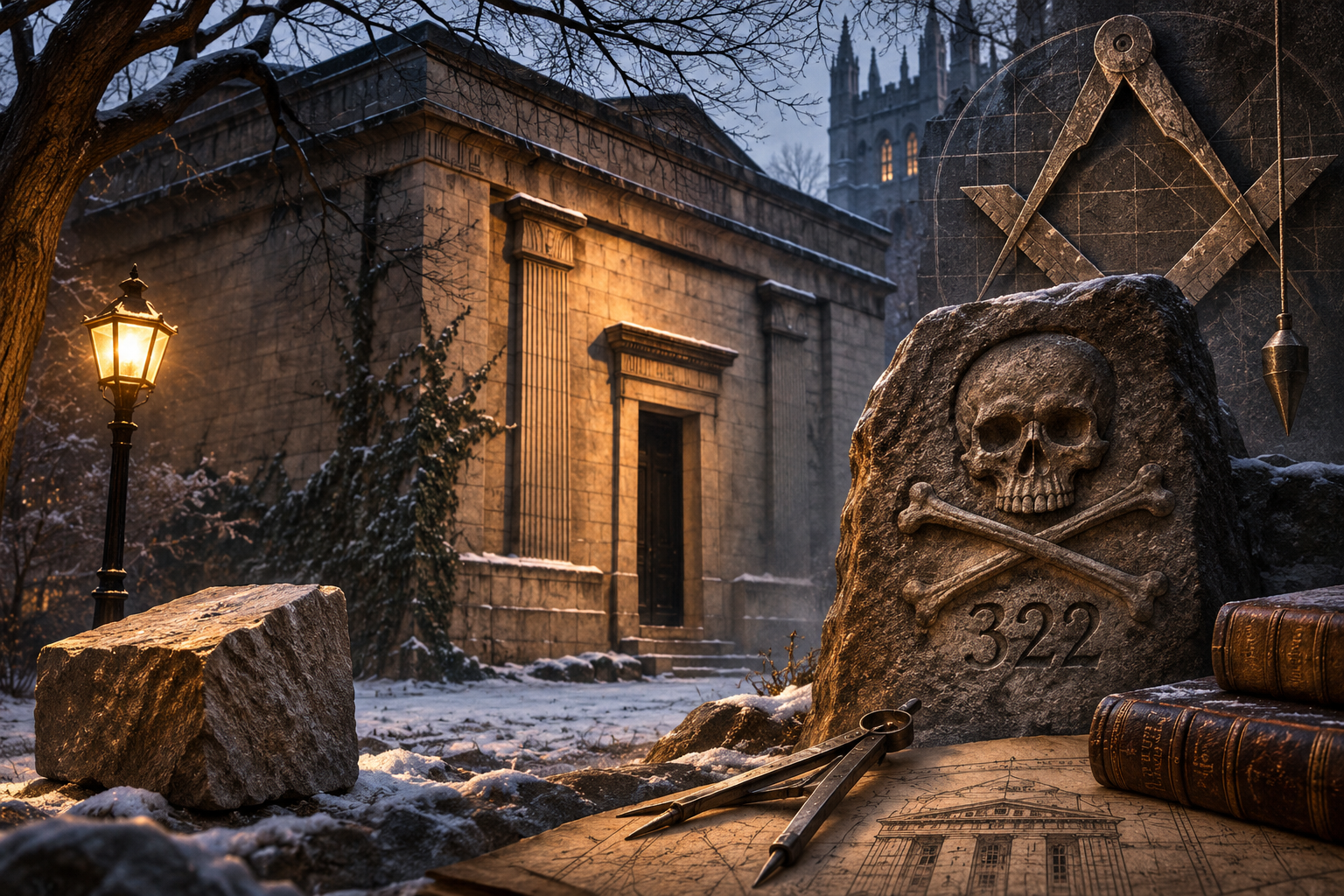
On a freezing November evening in New Haven, Yale’s imposing stone buildings can seem to guard another age. Among them stands the headquarters of Skull and Bones, a private senior society founded in 1832. Its emblem bears a skull and crossbones and the number 322. Explanations for that number vary, including an association with 322 BCE and the death of the Athenian orator Demosthenes. The competing interpretations have helped sustain the society’s mystique.
When Brotherhood Becomes Dangerous
The desire to belong is powerful. Across American campuses, documented hazing has included forced drinking, humiliation, sleep deprivation and physical punishment. In freezing climates, coerced exposure to cold can add the risks of hypothermia and frostbite. In warmer climates, heat, dehydration and alcohol can be just as dangerous. The 2024 federal Stop Campus Hazing Act reflects the seriousness of this nationwide problem. These documented hazards should not be misrepresented as proof of comparable conduct by Skull and Bones: the broader issue is what happens when loyalty and secrecy override personal safety.
The Architecture of Secrecy
The Skull and Bones headquarters, often called the Tomb, dates to 1856 and has an austere, largely windowless appearance. Such architecture can create an atmosphere of permanence, secrecy, and separation, inviting speculation about private traditions without providing evidence of wrongdoing.
Published accounts and images offer glimpses of the society’s history, but they do not provide a complete record of its private activities. The Tomb’s restricted access and unusual exterior have helped turn a meeting place into a cultural symbol.
Who was Russell, and why was the trust named for him?
William Huntington Russell (1809–1885), a Yale graduate and educator, was a founder of Skull and Bones alongside Alphonso Taft in 1832 in New Haven, Connecticut. In 1856, the same year the society’s windowless headquarters was built on High Street, the Connecticut legislature incorporated the Russell Trust Association, named for Russell. Its incorporators included Russell, John S. Beach, Henry B. Harrison, Daniel Coit Gilman, Henry T. Blake, and Henry D. White.
The association provided a legal entity to hold property and manage the society’s financial affairs, including maintenance of the Tomb. Yale University Library identifies the association as the organization managing Skull and Bones finances.
Thus Russell’s connection to the Tomb is foundational and organizational, not evidence that he personally designed it. Architectural histories have attributed the original Tomb to Alexander Jackson Davis, although Henry Austin has also been proposed. Yale Alumni Magazine and Yale University Library’s Russell Trust Association records document this history.
The Uncanny Atmosphere: Why Secret Buildings Feel Haunted
There is a reason the Tomb invites ghost stories. Its guarded entrance, dark stone and restricted interior leave room for imagination. In folklore, thresholds, sealed chambers and silent buildings are often portrayed as places where the past refuses to disappear. Some observers read the skull emblem as a memento mori—a reminder of mortality—while others imagine occult rites behind the walls. Those interpretations belong to symbolism and speculation: no credible evidence establishes that the building is haunted or that supernatural events occur inside.
The paranormal question is therefore psychological as much as supernatural. Why do secrecy, architecture and ritual make us sense an invisible presence? When the public cannot see a ceremony, rumor supplies the missing scene. A place can become eerie without a ghost; an emblem can be unsettling without being an occult confession. That tension between documented history and the unknown is precisely what makes 322 such a lasting mystery.
Masonic Stones and the Limits of Symbolism
Freemasonry uses builders’ tools as moral metaphors: the square, compasses and level are associated with principles such as upright conduct, restraint and equality. The rough and perfect ashlars—unfinished and worked stones—symbolize personal refinement. Difficult stonework and abstract geometry can invite symbolic readings, but the hardness of a material does not indicate a higher secret rank or hidden message. Skull and Bones has not been established as a Masonic lodge. Similar visual languages are an invitation to compare traditions, not proof of organizational ties.
Eggers & Higgins: An Architectural Connection
New York architects Otto Reinhold Eggers and Daniel Paul Higgins formed Eggers & Higgins in 1937 after working in John Russell Pope’s practice. John Russell Pope (1874–1937) was a leading American architect associated with the Beaux-Arts and classical revival traditions. He designed major civic and cultural landmarks, including the Jefferson Memorial and the National Gallery of Art’s West Building in Washington, D.C., and was known for using monumental architecture to express dignity, permanence, and institutional authority.
After his death, Eggers and Higgins continued his practice and helped complete prominent Washington buildings associated with his designs. Their firm also designed Yale’s Silliman College quadrangle, constructed around 1938–1940. That gives the firm a documented place in Yale’s architectural history. It does not establish that either architect belonged to Skull and Bones or that their firm designed or renovated its Tomb. The connection matters because architecture helps prestigious institutions project continuity and authority—not because every designer belonged to a secret network.
How Pope came to Yale.
The connection was more substantial than a passing association. In 1919, Pope produced an ambitious master plan for Yale’s future buildings at the university’s request, with the Garvan family connected to the commission. Yale Alumni Magazine identifies alumnus Francis Patrick Garvan (Class of 1897) as the commissioner; a Yale archival finding aid credits Mrs. Frances P. Garvan with securing and offering Pope’s services. These accounts differ in attribution but agree on the Garvan connection.
Yale’s leadership commissioned the planning effort, and Pope proposed monumental axes, Gothic buildings, new gateways, and a reorganized campus. Otto Reinhold Eggers supplied the illustrations for Pope’s 1919 publication, making his participation in the Yale project direct and documented.
Yale did not adopt the sweeping plan wholesale: James Gamble Rogers developed a more feasible alternative in the 1920s, although parts of Pope’s vision influenced later campus design.
These plans illustrate how wealthy patrons, institutional priorities, and architects shaped the physical identity of an elite university. Because Skull and Bones also operated within Yale’s social landscape, it is reasonable to ask whether overlapping alumni networks affected commissions or planning decisions; the sources cited here, however, do not show that Skull and Bones or the Russell Trust directed Pope’s work. See Yale Alumni Magazine’s history of the unbuilt plan, Yale’s archival account of Pope and Eggers, and the Yale Corporation architectural committee finding aid.
Russell, Pope, and the question of an architectural connection.
The overlapping names can suggest a hidden relationship, but William Huntington Russell and John Russell Pope were different men. Russell (1809–1885) helped found Skull and Bones and was the namesake of its property-holding Russell Trust Association; Pope (1874–1937) belonged to a later generation of architects. Pope was only eleven when Russell died, and no documented family relationship, personal collaboration, or Russell Trust commission linking the two has been established.
Pope did, however, design the House of the Temple in Washington, D.C., for the Scottish Rite of Freemasonry, demonstrating his involvement in architecture commissioned by a fraternal institution. That is a legitimate architectural comparison, not evidence that Skull and Bones was a Masonic organization or that Pope designed its Tomb.
After Pope’s death, Eggers & Higgins continued his practice; their documented work on Yale’s Silliman College provides a separate, later Yale connection.
The question worth investigating is whether surviving Russell Trust records identify architects or contractors responsible for changes to the Tomb, including an 1866 architectural plan and contract noted in Yale’s archival holdings. Until such records demonstrate a link, the defensible conclusion is that these histories intersect through institutions, architectural traditions, and geography—not through a proven Russell–Pope partnership.
Who Were Eggers and Higgins—and What Else Did They Build?
Otto Reinhold Eggers (1882–1964) was a New York-born designer who studied at Cooper Union and trained in the Beaux-Arts tradition. He joined John Russell Pope’s office in 1909, won the LeBrun scholarship in 1912 and became a partner in 1922. Renowned for architectural drawing and design, he later became a National Academician. The National Academy of Design credits him with work on Yale’s Payne Whitney Gymnasium, Baylor University’s Browning Library and the Theodore Roosevelt Wing of New York’s American Museum of Natural History.
Daniel Paul Higgins (1886–1953) entered Pope’s office in an administrative role while studying architecture at New York University. He became a partner alongside Eggers in 1922. When Pope died in 1937, the two continued the practice under their own names. Eggers chiefly handled design; Higgins led administration, client relations and business development. Higgins’s role is an important reminder that influential architecture requires not just drawings and stone, but also negotiations, institutional relationships and commissions.
Their work reached well beyond Yale. The practice carried forward Pope’s designs for the Jefferson Memorial and the National Gallery of Art’s West Building in Washington. It designed NYU’s Vanderbilt Hall near Washington Square, worked on university buildings at the University of Virginia—including New Cabell Hall, Newcomb Hall and McCormick Road dormitories—and was associated with the Dirksen Senate Office Building. In New York, the firm’s work also included the Alfred E. Smith Houses and Cardinal Hayes High School. The firm later became the Eggers Group in 1976.
The contrast is revealing: the same professional tradition that shaped monumental federal architecture also shaped campuses and ordinary civic life. Classical columns, massive masonry and carefully controlled approaches can evoke ceremony or even the uncanny, but those impressions are interpretations, not proof of esoteric design instructions. There is still no verified direct Eggers & Higgins connection to Skull and Bones membership or the design of its Tomb.
Three Generations of Bushes
Prescott Bush was a Skull and Bones member in Yale’s Class of 1917. His son George H. W. Bush belonged to the Class of 1948; his grandson George W. Bush belonged to the Class of 1968. Two became U.S. presidents, and Prescott became a senator. Other members included President William Howard Taft and John Kerry, who faced George W. Bush in the 2004 election. These connections reveal the longevity of exclusive social networks. They do not establish that the society secretly directed presidential decisions.
The Geronimo Controversy
A longstanding, disputed allegation concerns the purported removal of human remains from Fort Sill in 1918, sometimes attributed to Skull and Bones members and linked in retellings to Prescott Bush. Historical correspondence has been cited in discussions of the claim, but it does not conclusively establish that the remains were Geronimo’s or that Prescott Bush personally participated. The controversy deserves attention because it raises questions about Indigenous remains, institutional privilege and the ethics of private collecting, not because the allegation should be treated as proven in every detail.
What Is the Real Secret?
A building creates boundaries. A symbol creates recognition. A private initiation creates an inside and an outside. Over decades, friendships and family traditions can become powerful networks. None of that requires a supernatural explanation or a single hidden command structure. It does, however, raise a serious question: who gains access to opportunities through exclusive circles, and who remains outside them? The same desire for belonging that can build lifelong friendship can, in abusive hazing cultures, pressure students to surrender judgment or safety.
Final Thoughts
Perhaps the mystery of 322 is not a code buried in stone. Perhaps it is how prestige, architecture, ritual and personal connections reinforce one another across generations. The Russell Trust shows how a private society acquired an enduring institutional structure; the Garvan-backed Pope plan and Eggers’s illustrations show how patronage and architectural ambition helped imagine a new Yale. Whether Skull and Bones relationships shaped those particular commissions remains an open question, not a documented conclusion. Eggers & Higgins helps us see the built environment; Masonic symbolism offers a separate tradition of interpreting stone and geometry; the Bush family illustrates the persistence of elite associations; and the reality of campus hazing reminds us why accountability matters. Privacy is not wrongdoing. But tradition must never become an excuse for abuse. The buildings remain. The symbols endure. The students graduate. And the networks may last a lifetime.
The more revealing question may be how private associations, public careers, and institutional prestige intersect without assuming that proximity proves coordination. Nearly two centuries later, the distinction between documented influence and imagined hidden power remains as intriguing as the number itself.
Sources and Further Reading
Yale Alumni Magazine — The Origins of the Tomb
Yale University — Silliman College architectural history
Library of Congress — Silliman College and Eggers & Higgins
U.S. Government — Stop Campus Hazing Act
Yale Alumni Magazine — historical Geronimo correspondence
Additional Architectural Sources
NYC Landmarks Preservation Commission — Eggers & Higgins biographies and Vanderbilt Hall
National Academy of Design — Otto R. Eggers
University of Virginia Magazine — Eggers & Higgins campus projects
Getty Research Institute — Eggers & Higgins firm history
Leave a Reply