
A fraction of a degree can send a traveler miles off course. It can also change how a room feels to the human brain. But does strange geometry explain why some places seem haunted?
The ChillX Zone | November 3, 2026 | Science, perception & the unexplained
A Hallway That Feels Wrong
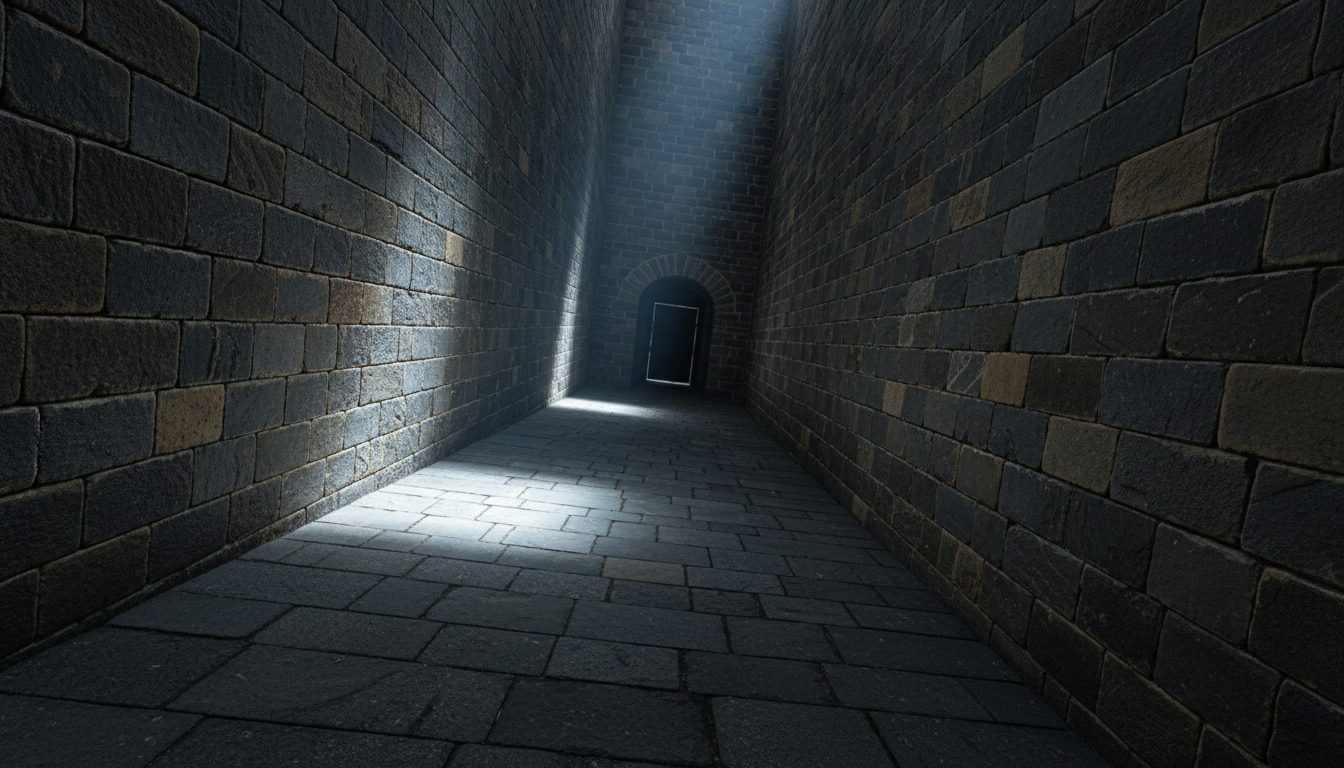
Walk into a corridor and something feels off. The walls appear straight, yet the far doorway seems to lean. The floor looks ordinary, but your body is not entirely convinced.
There may be nothing supernatural about the room. A slight slope, a skewed frame, or misleading visual cues can disturb our sense of orientation. But the feeling raises a larger question: how can a tiny angle produce consequences so much bigger than itself?
In navigation, engineering and perception, the answer depends less on the size of the angle than on the system in which it operates. And in paranormal fiction, that same uncertainty has become a language for fear.
One Degree, Seventeen Miles
Imagine a plane following a straight, uncorrected course for 1,000 miles. If its heading differs from the intended direction by just one degree, the sideways separation from the intended straight line would be about 17.45 miles.
This is a geometric illustration, not a prediction of what an actual flight would do. Real aircraft have navigation instruments, course corrections, winds and operational procedures. The point is that a small angular difference accumulates across distance.
A picture frame tilted by one degree is rarely a concern. A precision optical instrument or a navigation system may have much tighter tolerances. An angle is not dangerous on its own: the stakes depend on what the angle controls.
The Mathematics Behind the Mistake
For a straight path of length D that departs from the intended heading by an angle θ, the sideways displacement is:
Sideways error = D × sin(θ)
At one degree, sin(1°) is approximately 0.017452. The displacement is therefore about 1.745% of the distance traveled.
- After 10 metres: about 17.5 centimetres.
- After 100 metres: about 1.75 metres.
- After 1 kilometre: about 17.45 metres.
- After 100 kilometres: about 1.745 kilometres.
These numbers assume a fixed angular error, a straight path and no correction. For a different question—how far a tilted line rises across a fixed horizontal span—the appropriate expression is rise = horizontal distance × tan(θ). Sine and tangent are close for small angles, but they describe different geometries.
It is tempting to call this the mathematics of catastrophe. More precisely, it is the mathematics of amplification: the initial deviation stays small while its positional consequences grow.
What the Human Body Notices
Our sense of uprightness is not produced by eyesight alone. The brain combines visual information with signals from the vestibular system in the inner ear and information about body position. Usually these cues agree. When they conflict, a place can feel unexpectedly unstable.
Experiments on the rod-and-frame illusion show that a tilted surrounding frame can bias a person’s judgment of what is vertical. Research has also demonstrated that visual scenes influence postural adjustment and perceived orientation. These are measured effects, not evidence that a particular one-degree slope will frighten or disorient everyone.
The effect depends on lighting, surrounding objects, body position and individual differences. A subtly irregular building might contribute to an uneasy impression; that does not mean its geometry alone explains every strange experience reported inside it.
The Haunted House and the Ordinary Explanation
Old houses settle. Floors can slope, frames can move out of square, and perspective can be difficult to judge in dim light. In such surroundings, a visitor may experience a genuine sense that something is wrong before identifying a cause.
That makes architecture worth examining when someone reports an unsettling room. It does not justify dismissing witnesses, and it certainly does not prove a haunting. It simply provides a testable line of inquiry: measure the floor, examine the sightlines, check the lighting and compare accounts before introducing a supernatural explanation.
Responsible paranormal journalism can preserve the mystery without confusing a personal experience with proof of its cause.
Lovecraft and the Horror of Impossible Angles
H. P. Lovecraft understood the unease of spatial uncertainty. In his 1928 story The Call of Cthulhu, the fictional sunken city of R’lyeh is described through distorted surfaces and non-Euclidean geometry. The characters struggle to interpret structures that do not seem to obey familiar spatial expectations.
The association is literary, not experimental. Lovecraft’s imagined architecture offers a powerful metaphor: a frightening creature threatens the body, but an apparently impossible room threatens our confidence in the world itself.
Triangles, circles and other geometric figures also feature in occult traditions and supernatural storytelling. Their symbolic significance is a subject for cultural and historical study. There is no reliable, reproducible scientific evidence that a particular angle opens a portal, summons an entity or creates a supernatural force.
Non-Euclidean Does Not Mean Paranormal
In flat Euclidean geometry, a triangle’s interior angles total 180 degrees. On a sphere, a triangle formed from great-circle arcs can have a sum greater than 180 degrees. On negatively curved surfaces, the sum can be less than 180 degrees.
That is legitimate mathematics, not a breakdown of reality. Curved geometry has important applications in science. It does not imply that a crooked hallway connects to another dimension.
The distinction matters because the language of advanced mathematics can make an extraordinary paranormal claim sound scientific even when no evidence links the two.
What the Angle Really Reveals
A small deviation can change a destination. A tilted visual frame can change what appears upright. An unfamiliar room can make a person question the evidence of their own senses. These are three different phenomena, but they share an important lesson: the way we interpret space matters.
That may be why strange angles endure in ghost stories and cosmic horror. They unsettle something basic. We expect the ground beneath us to be level, the doorway ahead to be square, and the route we follow to lead where we intend.
Sometimes the difference between arriving safely and becoming lost is only one degree. The mystery is not that angles are secretly supernatural. It is that such a small change can matter so much.
Sources and further reading
- Li and Matin (2005), “The rod-and-frame effect: the whole is less than the sum of its parts,” Perception.
- “Fusion of visual and vestibular tilt cues in the perception of visual vertical,” Journal of Neurophysiology.
- “Postural adjustment as a function of scene orientation,” research indexed by PubMed.
- H. P. Lovecraft, The Call of Cthulhu (1928), Project Gutenberg.
Editorial note: The navigation figures are idealized trigonometric examples. The paranormal connections discussed here concern folklore and fiction; no supernatural mechanism is established by the cited research.
Leave a Reply