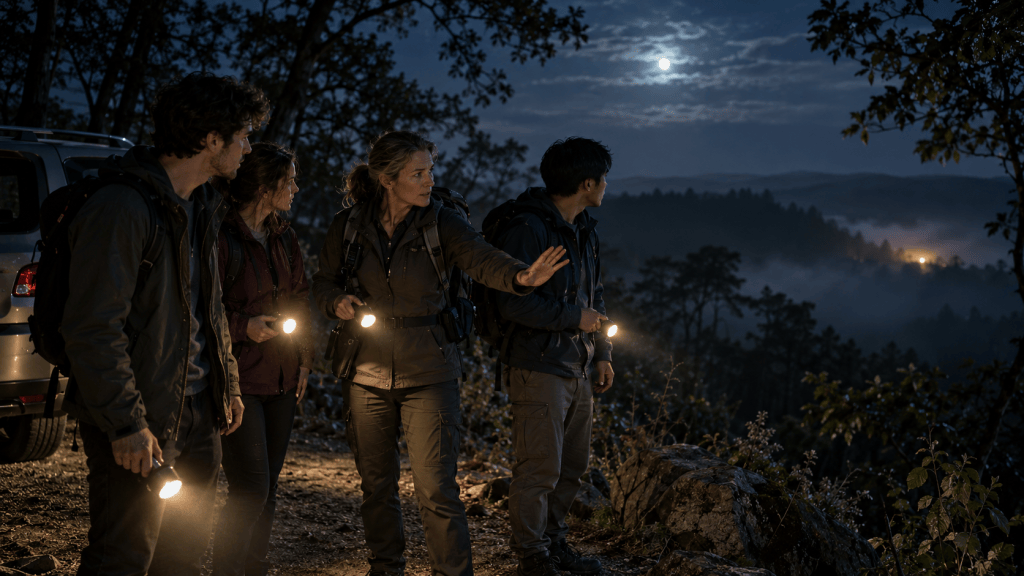
Age, authority, and the need for firm boundaries in paranormal groups
October 3, 2026
The Sayama encounter
On October 3, 1978, Hideichi Amano reportedly drove to an elevated location near Sayama, Japan, to use his amateur radio. His two-year-old daughter accompanied him. According to the account published in UFO literature, an ordinary outing became a frightening encounter involving an unusually bright light inside the car and a strange humanoid figure beside it.
The story remains an alleged paranormal encounter. Retellings differ, and its extraordinary claims should not be treated as established facts. Yet one detail offers a useful starting point for a discussion of responsibility: an adult and a very young child were present in the same situation, with profoundly different capacities to understand it or respond.
Being together does not mean being equally prepared.
Sharing a setting, facing different risks
That distinction matters whenever people gather for paranormal investigations, séances, occult discussions, or activities built around fear and uncertainty. A group may include teenagers, young adults, older participants, different sexes, and people from very different religious or cultural backgrounds. Each arrives with different expectations. Each may understand authority, privacy, danger, and consent differently.
Those differences demand clear rules. Shared curiosity cannot substitute for them.
Protecting minors and younger adults
For participants under eighteen, I would draw a firm boundary: no adult-led exercises designed to frighten, isolate, or pressure them into supposed contact with an entity. Any age-appropriate educational activity should have accountable supervision, parent or guardian involvement, clear limits, and an immediate way to leave. A young person should never be told that stopping will anger a spirit, endanger the group, or reveal spiritual weakness.
Young adults deserve attention too. Eighteen to twenty-four is not a single level of maturity, and twenty-five is not a magical threshold of safety. Nevertheless, an inexperienced adult joining an established circle can face a substantial imbalance of authority. Someone claiming special knowledge may control the explanation of every noise, emotion, or disagreement. When questioning the leader becomes evidence that a participant is “unready,” the group has created a rule that protects authority from scrutiny.
Rules that hold leaders accountable
Strictness should therefore apply first to the conduct of leaders.
No unwanted touching. No sexual pressure disguised as spiritual instruction. No private tests of loyalty. No demands for secrecy from trusted people outside the group. No punishment for refusing an exercise. These boundaries should apply regardless of anyone’s sex, background, status, or claimed abilities.
Different backgrounds also affect how an experience is interpreted. One person hears a sound and thinks of a loose pipe. Another thinks of a deceased relative. A third fears something hostile. A responsible group records what happened before insisting on what it means. It does not turn someone’s beliefs into a tool for frightening or controlling them.
From simple activities to complex situations
Even a simple activity needs limits. Sitting in a dark room and asking questions can become intimidating if participants are pressured to continue. More complex activities—overnight visits, remote locations, elaborate rituals, or prolonged sessions—need stronger practical safeguards. Complexity is a reason to increase accountability.
The responsibility to stop
The Sayama account does not prove that mixed groups attract paranormal danger, nor does it establish misconduct by Amano. Its relevance is narrower: the youngest person present could not assess the situation or independently choose an exit.
For an October 3 reflection, that is the question to carry forward. Who has the least power to understand, refuse, or leave—and what has the group done to protect them?
Any group exploring the unknown should be able to answer that plainly. Curiosity may bring people together. Responsibility determines whether they should proceed.
References and source note
Gross, Patrick. “October 3, 1978, Sayama, Saitama, Japan, Hideichi Amano and his 2-year-old daughter.” URECAT — UFO Related Entities Catalog. The entry reproduces and compares reporting attributed to Jun-Ichi Takanashi and later accounts.
Source note: The encounter is presented as an allegation recorded in UFO literature. Retellings differ, and the source does not independently establish a paranormal cause. The discussion of group boundaries and protection is editorial commentary; it is not a finding that mixed groups caused the reported incident.


Leave a comment