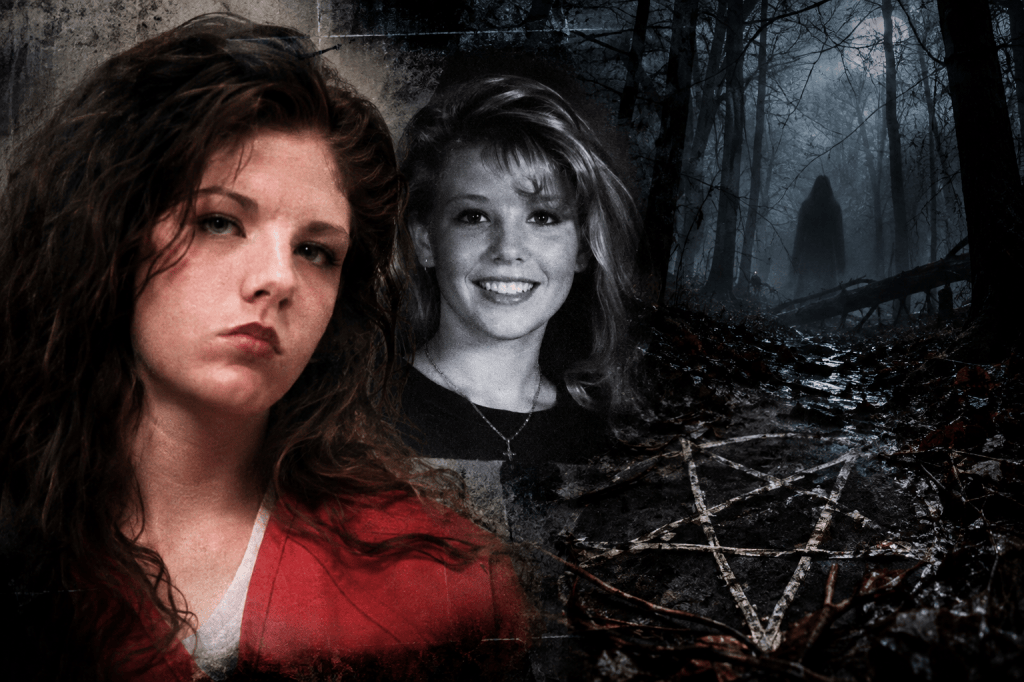
Murder, Mystery, and the Darkness Beneath Knoxville
October 2, 2026
KNOXVILLE, Tenn. — On September 30, the State of Tennessee attempted to execute Christa Gail Pike for the 1995 murder of 19-year-old Colleen Slemmer. After more than three decades on death row, Pike was prepared for the punishment imposed upon her for a crime committed when she was 18 years old.
But Christa Pike did not die.
The execution was halted after the lethal-injection procedure failed to produce the intended result, and Pike was eventually transported for medical treatment. The extraordinary event added another disturbing chapter to a case already marked by extreme violence, troubled young lives, allegations of abuse, occult symbolism and questions that have persisted for more than thirty years.
For ChillX Zone, the failed execution raised another question. If we trace this story backward—from the execution chamber to the murder, from the murder to the young people involved, and from those young people to the place where their lives converged—what exactly do we find in Knoxville?
What emerged was not evidence of anything supernatural. It was something more complicated: a convergence of documented violence, psychological trauma, youthful instability, occult imagery, local history and a region already surrounded by stories of restless places and restless dead.
A Note From ChillX Zone
ChillX Zone investigates unusual history, unexplained events, paranormal claims, folklore and mysteries, but we do not present speculation as established fact. A coincidence remains a coincidence unless evidence demonstrates otherwise. A ghost story is not scientific evidence, and the presence of occult symbolism does not establish supernatural influence.
This investigation moves between documented history, court records, allegations made during legal proceedings, psychological interpretations, local folklore and paranormal theories. Those categories are not interchangeable. Trauma does not make someone a murderer. Mental illness does not make someone a murderer. Interest in Satanism, pentagrams or occult subjects does not make someone violent. Likewise, there is no scientific evidence that supposedly haunted land caused the murder examined here.
Nothing in this investigation is intended to excuse the murder of Colleen Slemmer or diminish what happened to her. Understanding the background of a convicted murderer is not the same as absolving that person of responsibility. Our purpose is to follow the story wherever the documented record takes us, identify where fact ends and speculation begins, and examine whether seemingly small factors can accumulate until they become something catastrophic.
Two Young Women
The case is commonly remembered as the Christa Pike case. That description risks allowing another young woman to disappear from her own story.
Colleen Slemmer was 19. Christa Pike was 18.
Both young women were enrolled in the Job Corps program in Knoxville. On January 12, 1995, Pike, her boyfriend Tadaryl Shipp and Shadolla Peterson accompanied Slemmer to an isolated wooded area near the University of Tennessee agricultural campus.
What happened there was not paranormal. It was human, and it was horrific.
Court records describe a prolonged assault in which Slemmer was beaten, cut and prevented from escaping. She suffered devastating injuries, and a pentagram was carved into her chest. Pike admitted directly participating in the attack.
No responsible examination of this case can sanitize those facts.
Colleen suffered. Colleen died. She was 19 years old, and whatever questions may now surround Pike’s background, mental state, relationships, punishment or failed execution, Slemmer cannot be reduced to a supporting character in someone else’s mystery.
Justice for Colleen must remain part of this investigation from beginning to end.
Before Knoxville
To understand how four young people eventually walked into those woods, however, we have to examine what came before them.
Pike’s attorneys and advocates have described a deeply troubled childhood involving allegations of sexual abuse, rape, neglect and abandonment. Later legal proceedings also introduced evidence concerning psychological disorders, trauma and dissociation.
These claims require careful treatment. Looking backward after an atrocious crime creates a temptation to turn every earlier misfortune into a cause. Human behavior does not work that neatly.
Millions of people survive abuse without becoming violent. Trauma does not predetermine murder, and psychological illness should never be casually associated with homicidal behavior. Yet ignoring a person’s developmental history entirely creates another problem. There is a difference between attempting to understand why something happened and claiming that the explanation excuses it.
Christa Pike did not suddenly appear in those woods on January 12, 1995. Neither did Tadaryl Shipp. They arrived in Knoxville carrying histories that had begun elsewhere.
An Environment Worth Examining
The young people met through Job Corps, a federal residential education and vocational-training program. It would be irresponsible to suggest that Job Corps caused the crime. The more useful question concerns what happens when vulnerable teenagers and young adults, some potentially carrying substantial histories of trauma or instability, begin forming intense relationships in a residential environment.
What safeguards existed in Knoxville at the time? What warning signs were visible? What did adults know about conflicts developing among these young people? Were episodes of jealousy, threats or instability interpreted as ordinary adolescent drama when something more dangerous was developing underneath?
Those questions require historical evidence before conclusions can be drawn.
They also point toward something frightening about many disasters. Catastrophe does not always begin with one enormous event. Sometimes danger accumulates through seemingly manageable incidents: an unstable relationship, jealousy, anger, threats, fascination with violence, impulsive decisions and friends reinforcing one another rather than walking away.
One thing happens. Then another.
Eventually the situation becomes something nobody appears capable of stopping.
The Satanic Element
Then there is the detail that helped transform the Pike case into something darker in the public imagination: Satanism.
Tadaryl Shipp reportedly described an interest in Satanism, while he and Pike were associated with pentagram imagery. The symbol became especially significant because a pentagram was carved into Slemmer’s body.
For an American public still familiar with the so-called Satanic Panic of the preceding decades, the narrative almost constructed itself: troubled teenagers, Satanism, a pentagram and murder.
But paranormal investigators should be especially suspicious of explanations that fit together too easily.
Later testimony attributed the actual carving of the pentagram to Shipp. Accounts surrounding the case also complicate the idea that the killing began as an organized satanic sacrifice.
That does not make the occult imagery irrelevant. It makes its meaning less certain.
Was Satanism a sincerely held belief? Teenage rebellion? Shock imagery? A shared fascination with forbidden subjects? Did violent symbolism become incorporated into violence already underway?
Or did later retellings transform disturbing imagery into a simple supernatural explanation for an extraordinarily complicated human crime?
A pentagram establishes that someone used a pentagram. It does not establish the presence of Satan, demons or supernatural influence.
Still, its presence gives investigators legitimate reason to examine what these young people believed and what those symbols meant to them.
When Psychology Meets the Paranormal
There is another boundary in this case that deserves careful examination.
For centuries, people have described individuals behaving as though they were no longer themselves. Older cultures sometimes attributed extreme changes in behavior to possession or outside spiritual influence. Modern psychology instead examines phenomena such as dissociation, trauma responses, emotional flooding and altered states of awareness.
Pike’s later legal case included psychological evidence concerning trauma and dissociation. That does not establish that she was dissociating during Slemmer’s murder, and it certainly does not establish anything supernatural.
We cannot travel backward into Pike’s mind on a particular night in 1995 and determine precisely what she experienced.
Nevertheless, the comparison raises a fascinating historical question for paranormal research. When witnesses throughout history described someone as being “taken over,” what were they actually observing? In some cases, were they witnessing psychological phenomena for which their era lacked a medical vocabulary? In others, were they simply witnessing rage, intoxication, deception or violence?
And are there cases that remain genuinely difficult to explain?
Those are legitimate subjects for investigation. They are not permission to diagnose Pike retrospectively or declare her possessed.
Whatever her mental condition that night, Colleen Slemmer remained a human being trying to survive.
Then We Looked at Knoxville
This is where the investigation takes a different turn.
Knoxville and East Tennessee possess a long tradition of ghost stories, strange locations and folklore associated with death. The University of Tennessee area itself has accumulated stories of alleged apparitions and reportedly haunted buildings. The surrounding region carries Civil War history, old cemeteries, violent frontier history and generations of local legends.
None of that proves any connection to the Slemmer murder.
But it gives ChillX Zone something worth investigating.
The important question is not whether somebody invented a ghost story after a notorious murder. Tragedies routinely generate legends. The more interesting question is whether unusual stories associated with the same general area existed before January 1995.
Which Knoxville ghost stories can actually be documented?
How old are they?
Which locations acquired reputations before the Pike case?
What violent events occurred on or around the land generations earlier?
Which stories are supported by historical records, and which appeared much later on websites, message boards and paranormal tours?
If a legend appeared only after the murder, that tells us something. If it can be traced decades earlier, that tells us something different.
Neither result proves the paranormal.
But one makes for a much more interesting investigation.
Does Land Remember?
Paranormal literature contains an old idea: that places experiencing extreme emotion, violence or death may somehow retain an impression of what occurred there.
The concept appears in various forms, including what paranormal investigators sometimes call a residual haunting. The theory proposes that an event can somehow be “recorded” by an environment and later perceived by people occupying the same location.
There is no established scientific evidence demonstrating such a mechanism.
Psychology provides less exotic possibilities. Human beings are enormously influenced by suggestion, expectation and knowledge. Enter a building after being told someone died there, and every unexplained sound acquires a different meaning. Visit the same building knowing nothing of its history and the experience may be entirely ordinary.
Memory can haunt a place without ghosts doing so.
But that creates an interesting question of its own.
Why do particular locations accumulate stories generation after generation?
Sometimes there is an obvious answer: something terrible happened there.
And Knoxville has seen its share of terrible things.
The Woods
There is something uniquely disturbing about woods associated with violent crime. Buildings change owners and are renovated. Roads are widened. Institutions close. Cities rebuild themselves.
The land remains.
In 1995, a 19-year-old woman entered the woods outside Knoxville with people she knew and never returned alive.
Whatever happened there was caused by human beings.
But for a paranormal investigation, the land raises questions beyond the crime itself. What was there before 1995? What happened in the broader area before Job Corps, before the University of Tennessee expanded, before modern Knoxville existed?
East Tennessee has witnessed indigenous history, frontier settlement, warfare, disease, executions, family tragedies and Civil War bloodshed. Much of that history has become intertwined with folklore.
The responsible approach is not to declare the ground cursed.
It is to investigate whether there is anything behind the stories.
Justice for Colleen
Eventually every road in this investigation returns to Colleen Slemmer.
Whatever happened in Christa Pike’s childhood, Colleen did not cause it. Whatever psychological problems Pike experienced, Colleen was not responsible for them. Whatever occurred between Pike and Shipp, Colleen did not deserve to become the target of it.
She was 19 years old.
She deserved to leave those woods alive.
She deserved birthdays that never came, relationships she never had and ordinary mornings that were taken from her. Her family has lived with an absence that no court and no execution can reverse.
That is why arguments for mercy toward Pike cannot simply dismiss the demand for punishment as vengeance.
There is a genuine moral question here. Someone participated in deliberately taking another person’s life. For some people, the appropriate punishment for such an act is death.
An eye for an eye.
A death for a death.
Then came September 30, 2026.
The Execution That Failed
Tennessee eventually attempted to carry out Pike’s sentence.
She was prepared for execution and subjected to the state’s lethal-injection procedure.
Yet she survived.
The circumstances of the failed execution immediately created questions about the procedure and ultimately prompted official scrutiny. Those questions should be examined medically and procedurally before anyone reaches for a paranormal explanation.
Yet the symbolism is difficult to ignore.
For more than thirty years, the state maintained that Christa Pike must die for what happened to Colleen Slemmer. When the appointed day finally arrived, Tennessee attempted to make that happen.
It could not complete the task.
That does not make Pike innocent. It does not erase her sentence. It does not restore Colleen.
But if Pike survives the consequences of that attempt, Tennessee confronts an uncomfortable question that did not exist in quite the same form beforehand.
Must the state eventually strap her down and try again?
Mercy Is Not Innocence
There is room in this story for two forms of compassion without pretending they are equivalent.
Compassion for Colleen means refusing to allow fascination with Pike, Satanism, paranormal theories or a failed execution to eclipse the young woman who was murdered.
Compassion for Pike means recognizing that the 18-year-old who committed an atrocious crime was also a human being with a history, and asking whether decades of imprisonment followed by a failed attempt to kill her have changed what justice now requires.
Mercy does not declare Pike innocent.
Understanding trauma does not excuse murder.
Questioning execution does not diminish the victim.
Perhaps the hardest part of the case is accepting that two propositions can exist beside one another: Colleen Slemmer deserved to live, and Christa Pike’s life can still possess human value.
What follows from those propositions is a moral question readers must answer for themselves.
What Was Already Haunting Knoxville?
This investigation began with a failed execution.
It led backward to a murder, then to Job Corps, unstable relationships, allegations of childhood trauma, Satanic imagery, a pentagram and finally the history of the place where these young lives collided.
Perhaps there is nothing paranormal here.
Perhaps every component of this story can ultimately be explained through psychology, history, human cruelty, institutional shortcomings, coincidence and the tendency of later generations to surround terrible events with legends.
That possibility should not disappoint anyone investigating the paranormal.
It should frighten us.
Because if there was no demon, no curse, no supernatural influence and nothing lurking beneath the Tennessee soil, then human beings accomplished all of this by themselves.
Colleen Slemmer deserved better than what happened to her in 1995. Christa Pike may have deserved better long before she became capable of participating in something so terrible. Recognizing one does not require forgetting the other.
Now, after more than thirty years, Tennessee has attempted to close the story with another death.
Instead, Christa Pike survived.
ChillX Zone will not call that a miracle. We will not call it supernatural intervention, and we will not pretend that surviving an execution somehow erases the reason Pike was there.
But we will ask questions.
We will go back through Knoxville’s history, separate documented events from folklore, examine the legends that predate the murder and follow the strange stories attached to the land.
Because before deciding whether anything unusual surrounds the Christa Pike case, there is one question that has to be answered first:
What was already haunting Knoxville before Christa Pike ever arrived?


Leave a comment