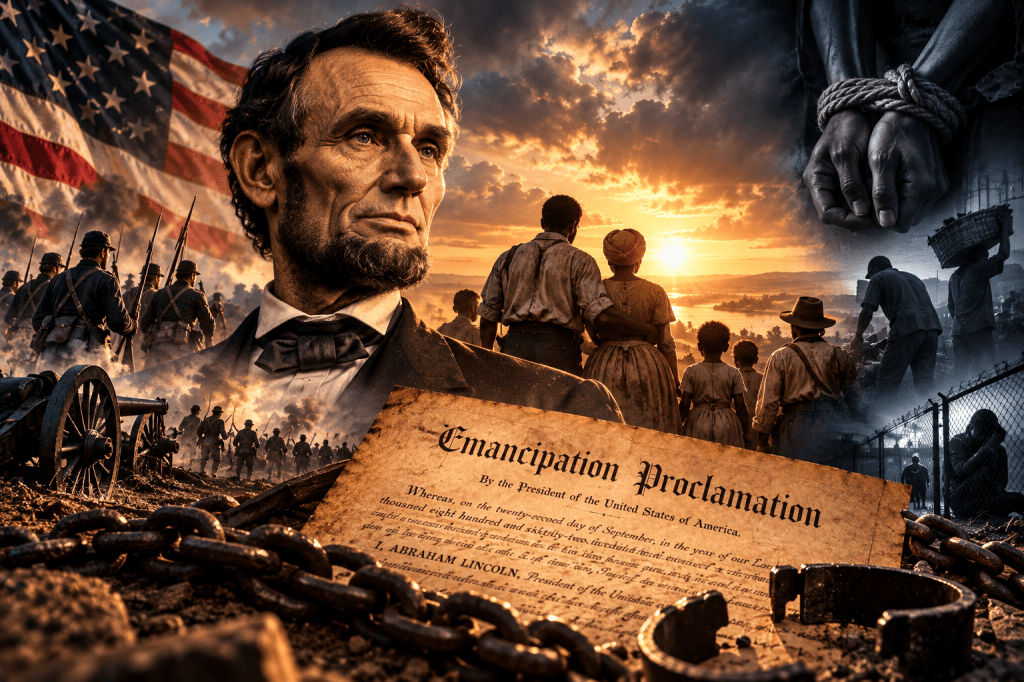
From Lincoln’s struggle against slavery to the forms of coercion that persist today, the enduring question is where necessary sacrifice ends and the loss of human liberty begins.
September 23, 2026
One hundred and sixty-four years ago yesterday, Abraham Lincoln placed his government on a road from which there could be no comfortable retreat.
On September 22, 1862, five days after the terrible fighting at Antietam, Lincoln issued the preliminary Emancipation Proclamation. He announced that enslaved people in states remaining in rebellion on January 1 would be declared free.
The final proclamation followed on January 1, 1863.
It did not immediately abolish slavery everywhere in America. It applied to areas in rebellion rather than loyal slaveholding border states, and its practical reach depended upon Union military success.
But something fundamental had changed.
A war that had begun with preservation of the Union as the federal government’s primary objective was becoming explicitly connected to human freedom.
The conflagration consuming America was no longer only about whether a nation could survive.
It was increasingly about what kind of nation deserved to survive.
Before Emancipation
We should be careful when discussing slavery.
The word has become so powerful that people sometimes apply it casually to almost anything they dislike.
Historical American slavery was not merely difficult work, low wages, taxation or an intrusive government.
It was ownership.
Human beings could be bought and sold.
Families could be separated.
Labor could be compelled.
Freedom of movement could be denied.
The enslaved person’s own wishes were subordinate to the claimed property rights of another human being.
That distinction matters.
Because if everything becomes slavery, we eventually lose the language necessary to recognize slavery when it actually appears.
Lincoln himself did not begin the Civil War claiming that emancipation was the federal government’s overriding war objective. His publicly stated paramount objective in 1862 was preserving the Union, even while expressing his personal wish that people everywhere could be free. His position and the circumstances of the war evolved, and emancipation became both a military measure and an increasingly central moral purpose of the Union cause.
The final Emancipation Proclamation would eventually authorize Black men to serve in the Union armed forces. By the end of the war, nearly 200,000 Black soldiers and sailors had fought for the Union and freedom.
Men who had been treated as property were now participating in their own liberation.
There are few reversals in American history more profound than that.
Freedom Was Not Free
There is another uncomfortable truth.
Civilization requires contribution.
Roads do not build themselves.
Schools require teachers.
Courts require judges.
Armies require soldiers.
Communities require people willing to perform duties that may not always be convenient.
Progress frequently requires work, cooperation and sacrifice.
A society in which every individual demands benefits but refuses every obligation will eventually discover that freedom cannot operate without responsibility.
But contribution is not the same thing as ownership.
Sacrifice is not automatically slavery.
Working for a living is not slavery.
Paying lawful taxes is not slavery.
Obeying ordinary laws is not slavery.
Performing legitimate civic obligations is not slavery.
There is an enormous moral distance between asking citizens to contribute to the civilization they share and treating human beings as instruments whose lives belong to somebody else.
The International Labour Organization still recognizes versions of that distinction today. Its definition of forced labor centers on work extracted under threat of penalty when the person has not voluntarily offered it, while recognizing limited categories such as normal civic obligations under specified conditions.
The crucial question is not simply:
“Did somebody have to sacrifice?”
Civilization has always required sacrifice.
The more disturbing question is:
“Did that person remain a human being with rights, choices and a meaningful path to freedom?”
Slavery Did Not Simply Become Ancient History
The chains did not vanish from the world when the American Civil War ended.
They changed shape.
Today there are people trapped in forced labor.
There are trafficking victims.
There are workers controlled through threats, withheld documents, fraudulent debts, violence and intimidation.
There are people exploited sexually against their will.
There are people whose vulnerability becomes another person’s business model.
The ILO currently estimates that 27.6 million men, women and children are in forced labor worldwide. Its broader terminology distinguishes slavery, trafficking and forced labor because those concepts overlap but are not legally identical.
That distinction is important.
Modern slavery should not become a rhetorical expression for every unfair situation.
It describes extreme forms of exploitation in which coercion and control deprive people of meaningful freedom.
The chains may be financial.
They may be psychological.
They may involve immigration status.
They may involve threats against family members.
They may involve physical confinement.
The iron shackle is no longer required.
The principle remains recognizable.
Another human being has obtained power over your ability to say no.
The More Subtle Danger
There is, however, another lesson from emancipation that reaches beyond literal slavery.
It concerns government itself.
Good government necessarily possesses power.
That power can protect.
It can prosecute traffickers.
It can defend workers.
It can punish violence.
It can maintain courts in which the weak may confront the powerful.
It can protect contracts, property and individual rights.
But power possesses an ancient temptation:
It rarely believes it has enough of itself.
A government may begin by asking citizens to contribute to a common purpose.
That is normal.
A government may regulate conduct to prevent people from harming one another.
That is necessary.
But there is a point beyond which government stops regarding citizens as people whose liberty it exists to protect and begins regarding them as resources to be managed.
That is dangerous.
Not because every regulation is slavery.
It plainly isn’t.
Not because every tax is tyranny.
It isn’t.
The danger is more fundamental.
A government can gradually forget who exists for whom.
The citizen does not exist merely to sustain the state.
The state exists to serve a society composed of citizens.
The Evil That Good Government Must Fear
Perhaps there is a name for the evil we are circling.
Dehumanization.
Slavery requires it.
Before you can comfortably own a human being, you must somehow persuade yourself that his freedom matters less than your purposes.
Before exploitation becomes routine, somebody must become a number.
A unit of labor.
A cost.
A problem.
A category.
A resource.
History repeatedly demonstrates how dangerous that transformation can become.
And governments are not immune to it.
The moment any institution begins viewing human beings exclusively according to their usefulness, productivity, race, religion, class, political loyalty or economic value, something essential has gone wrong.
Good government must therefore do more than produce economic development.
It must remember why development matters.
We build prosperous societies so human beings can live better lives.
We do not manufacture human beings so prosperous societies can have more efficient machinery.
That order cannot be reversed.
Lincoln’s Difficult Transformation
It is tempting to turn historical figures into marble statues.
Lincoln deserves something better.
His relationship to emancipation developed amid constitutional questions, military realities, political pressures and his own evolving judgment. The Library of Congress documents how he wrestled with the scope of presidential authority, the border states and emancipation as a wartime measure.
That makes the story more interesting, not less.
On September 22, 1862, Lincoln told his cabinet that his decision had been made.
The preliminary proclamation followed.
One hundred days later came the final declaration.
Its immediate legal reach was limited, but its direction was unmistakable.
The National Archives describes it as fundamentally transforming the character of the war. Every Union advance into territory where the proclamation operated extended the reach of freedom, while Black Americans entered Union military service in large numbers.
The proclamation was not the end.
The 13th Amendment would be required to abolish slavery throughout the United States.
Freedom came through stages.
Perhaps it usually does.
The New Plantation Must Never Be Built
We should therefore be cautious with historical analogies.
A citizen frustrated with taxes is not Frederick Douglass.
An employee irritated with his boss is not automatically enslaved.
A regulation we dislike is not an auction block.
Those comparisons diminish the brutality experienced by people who actually lived under chattel slavery.
But refusing careless comparisons does not require us to stop looking for the deeper warning.
The warning is about control without meaningful consent.
It is about reducing human beings to instruments.
It is about institutions convincing themselves that their objectives are so important that the individual may be consumed in pursuit of them.
That temptation can appear in governments.
It can appear in corporations.
It can appear in criminal organizations.
It can appear in families.
It can appear anywhere one person acquires enough power to decide that another person’s humanity has become inconvenient.
The architecture changes.
The moral danger does not.
Emancipation Is an Unfinished Verb
Perhaps emancipation should not be understood only as something Americans accomplished in the nineteenth century.
Perhaps it should also be understood as a continuing responsibility.
To emancipate is to release from bondage.
That requires us first to recognize bondage when we see it.
Sometimes it is obvious.
A trafficking victim cannot leave.
A worker is threatened with violence.
A passport is confiscated.
A debt is manipulated so that repayment becomes impossible.
Those are recognizable forms of coercion.
Other questions require greater caution.
Where does legitimate authority become domination?
Where does necessary sacrifice become exploitation?
Where does economic dependence become coercion?
Where does protection become control?
There will not always be easy answers.
But a free society must continue asking the questions.
After the Fire
The Emancipation Proclamation emerged from a nation literally tearing itself apart.
Its achievement should not be romanticized into simplicity.
Freedom required blood.
It required political courage.
It required enslaved people who escaped bondage and demanded recognition of their own freedom.
It required Black soldiers who entered the fight.
It required constitutional change after the proclamation itself.
And it required Americans to confront a terrible contradiction between a nation speaking the language of liberty while permitting human beings to be owned.
The contradiction could not endure forever.
That is the lasting warning of the emancipation conflagration.
Progress requires contribution.
Civilization requires responsibility.
Government requires authority.
But none of those things requires surrendering the fundamental proposition that a human being is a person, not property; a citizen, not a possession; an end worthy of dignity, not merely a means toward somebody else’s objective.
Good government must never forget that distinction.
Because slavery begins long before the chain is locked.
It begins when somebody with power decides another person’s freedom no longer matters.
And emancipation begins when somebody finally says:
It does.


Leave a comment