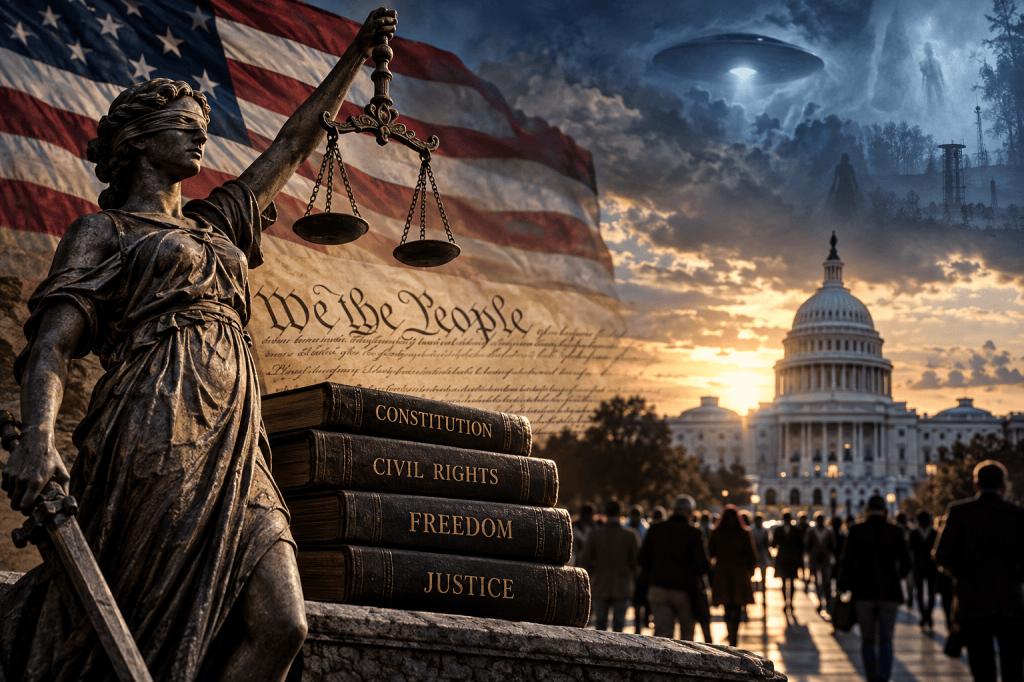
September 25, 2026
There was a time when the words life and liberty seemed almost too familiar to require explanation.
They appeared in schoolbooks, political speeches and courthouse inscriptions. They were repeated on the Fourth of July and invoked whenever Americans attempted to explain what was different about their experiment in self-government. The individual possessed certain rights, the argument went, and government existed not to grant those rights according to its pleasure, but to protect them.
It was an attractive proposition.
It was also a difficult one.
As another September draws toward its close, Americans find themselves confronting an old question dressed in distinctly modern clothing: How does a free society protect innocent life and individual liberty when the moral agreement that once held communities together appears increasingly uncertain?
The question is not merely academic.
Technology has given governments, corporations and ordinary citizens powers of observation that would have sounded like science fiction to a newspaper reader thirty years ago. Information can travel around the world before a reporter has finished checking his first source. Rumor travels faster still. Private lives can become public spectacles overnight, while institutions entrusted with enormous authority increasingly find themselves answering questions about where legitimate protection ends and intrusion begins.
And yet the essential problem is considerably older than the computer.
It is the problem of power.
The Thin Line Between Protection and Control
Civil government has always operated on a paradox.
We surrender a measure of freedom to preserve freedom.
We permit police officers to make arrests because murderers cannot simply be asked to behave. We maintain courts because disputes cannot always be settled peacefully between neighbors. We build prisons because some people demonstrate that they will continue harming others unless physically prevented from doing so.
The purpose, at least in the American constitutional tradition, is not to create perfect citizens.
Government cannot accomplish that.
Its more modest responsibility is to establish a boundary: your liberty extends remarkably far, but it does not include the liberty to destroy the life or equal liberty of another person.
That distinction becomes increasingly important when society itself loses confidence about where moral boundaries lie.
A government powerful enough to protect citizens can also become powerful enough to frighten them. A police force capable of stopping violence can abuse its authority. Intelligence gathered in the name of security can become surveillance. A law written to punish dangerous conduct can, under different leadership, become a convenient instrument against unpopular people.
Those possibilities are not arguments for anarchy.
They are arguments for vigilance.
The Bill of Rights is filled with such vigilance. Speech. Religion. The press. Due process. Protection against unreasonable searches. Trial by jury.
They amount to a remarkable admission by the founders of the American system: government is necessary, but government is operated by human beings, and human beings cannot safely be trusted with unlimited power.
That observation feels particularly relevant in 2026.
Questions surrounding press access, due process, immigration enforcement, privacy and government databases are once again being argued in American courts. Recent disputes have included litigation over White House press access and judicial battles concerning government databases and voter information. The parties disagree sharply over the government’s authority and the constitutional implications.
The particulars will be decided by courts and debated by citizens.
The underlying question will remain.
Who watches the watchers?
An Older Warning
Long before constitutional lawyers argued over electronic databases, religious writers approached the same problem from another direction.
The Bible’s thirteenth chapter of Romans describes civil authority as serving a legitimate purpose in restraining wrongdoing. It is a passage frequently cited by Christians defending the necessity of government.
But Scripture contains another story as well.
Pharaoh had authority.
Nebuchadnezzar had authority.
Herod had authority.
Rome had authority.
The biblical writers therefore present an uncomfortable tension. Human authority may preserve order, yet human authority can itself become corrupt.
That is where the American concept of limited government intersects unexpectedly with an ancient religious understanding of human nature.
Neither assumes perfection.
Both begin with the considerably less fashionable proposition that people are capable of wrongdoing.
If citizens were perfectly moral, we would scarcely need police.
If rulers were perfectly moral, we would scarcely need constitutional restraints upon them.
We have both because history suggests neither assumption is particularly wise.
And Then There Is the Stranger Question
There is another aspect of the modern world that respectable newspapers generally approach with considerable caution.
Perhaps they should.
For as long as human beings have recorded their experiences, people have reported encounters they could not explain.
Apparitions.
Premonitions.
Prophetic dreams.
Voices.
Unidentified objects in the sky.
Claims of communication with the dead.
Most such stories eventually disappear into the enormous warehouse of folklore, mistaken perception, fraud and exaggeration.
Some refuse to leave quite so easily.
The sensible reporter must resist two temptations.
The first is believing everything.
The second is believing that everything has already been explained.
Neither is journalism.
A witness may sincerely describe something that never happened as he remembers it. A photograph may have an ordinary explanation. A supposed psychic may simply be an unusually talented fraud.
But dismissing testimony before investigating it is no more intellectually respectable than accepting it without evidence.
The paranormal therefore presents a curious test of liberty.
What happens when citizens believe something their government, church, university or newspaper considers ridiculous?
The answer in a free society should be remarkably simple.
They remain free citizens.
A man may believe he saw something impossible in the woods. A woman may believe a dream warned her of an event before it occurred. Another person may believe both are mistaken.
Government has little legitimate business deciding which of them possesses the correct metaphysics.
Its responsibility begins when belief becomes conduct that harms another person.
A citizen is free to believe in ghosts.
He is not free to defraud an elderly widow by claiming her dead husband demands that she surrender her savings.
A religious leader may preach prophecy.
He may not imprison followers who attempt to leave.
A skeptic may ridicule superstition.
He may not assault the believer.
Liberty protects belief. Law restrains harmful conduct.
That distinction may become more important rather than less important as our technological world grows stranger.
When Reality Becomes Difficult to Verify
The greatest threat may not be that Americans begin believing in ghosts.
It may be that Americans cease believing they can determine what is real at all.
We now possess machines capable of manufacturing convincing voices, photographs and moving images. A person can encounter something extraordinary on a screen and reasonably wonder whether it happened.
That changes the old paranormal equation.
Thirty years ago, a fuzzy photograph of a strange object invited the question, What is that?
Today it invites another:
Is there an object at all?
Once a population loses confidence in its ability to distinguish evidence from fabrication, power shifts toward whoever controls the most convincing narrative.
That is dangerous territory for a republic.
Freedom of speech assumes something deeper than the legal ability to speak. It assumes citizens capable of hearing competing claims, examining evidence and reaching conclusions without requiring an authority to determine reality for them.
That responsibility belongs not merely to journalists.
It belongs to everyone.
The Moral Foundation of Liberty
Perhaps this is where the question of morality finally returns.
Liberty cannot survive indefinitely as nothing more than permission.
A society requires citizens who understand that possessing a right does not automatically make every possible exercise of that right wise, decent or honorable.
The law can prohibit theft.
It cannot create honesty.
The law can punish murder.
It cannot manufacture respect for human life.
The Constitution can protect speech.
It cannot make citizens truthful.
Courts can protect religious liberty.
They cannot produce faith.
Police can restrain violence.
They cannot create compassion.
Those things originate somewhere beyond legislation — in families, communities, conscience, philosophy and faith.
When those institutions weaken, government inevitably receives demands to fill the vacuum.
And therein lies another danger.
The more responsibilities citizens surrender to government, the more powerful government must become to perform them.
Eventually a society may discover that it traded responsibility for security and received neither.
The Watchman and the Gate
There is an old image worth remembering.
A watchman stands at the city gate.
His duty is not to command every household within the walls. He does not determine what families eat for supper, what books they read or what prayers they whisper before sleeping.
He watches the gate.
He sounds the alarm when danger approaches.
He protects the people inside because their lives are worth protecting.
Perhaps that remains a useful description of legitimate government.
Protect the innocent.
Punish genuine wrongdoing through lawful processes.
Preserve the citizen’s liberty.
Restrain those entrusted with power.
Allow conscience to remain conscience.
And when someone makes an extraordinary claim — political, religious, scientific or paranormal — demand evidence before surrendering either belief or disbelief.
The world has always contained darkness. Whether our age is uniquely immoral is something historians will eventually decide.
Our responsibility is closer to home.
A free people must defend life without becoming careless with liberty. They must preserve liberty without becoming indifferent to evil. They must question authority without abandoning lawful authority altogether.
And perhaps most importantly, they must retain the courage to ask questions.
Because once citizens become afraid to ask what is true, who possesses power, and where the boundary of that power lies, the gate may still be standing.
But the watchman has fallen asleep.


Leave a comment