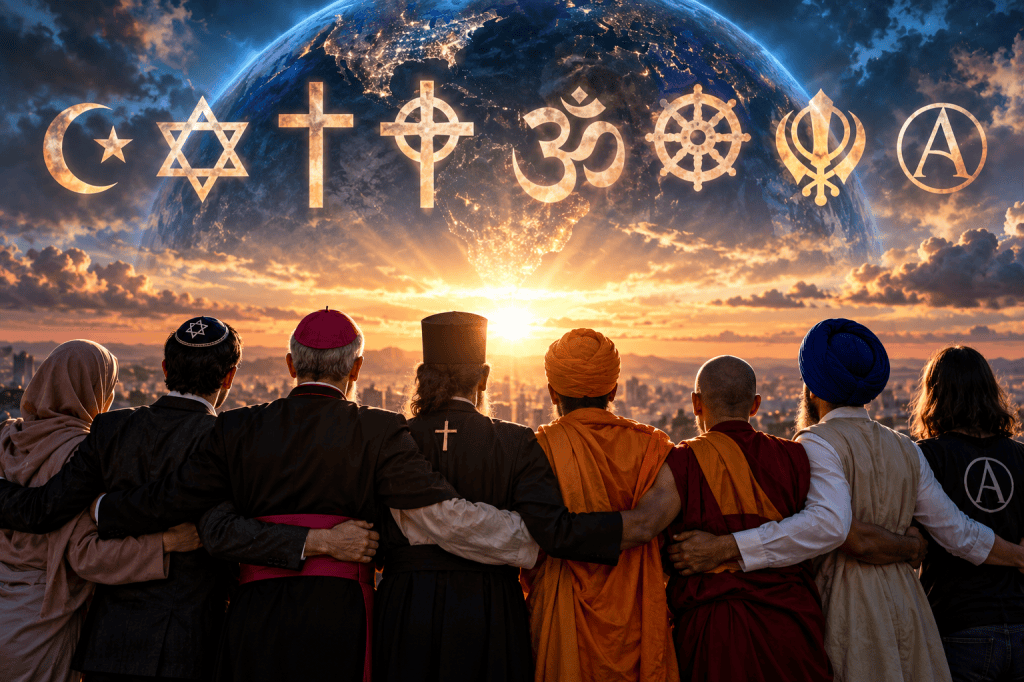
If dignity and freedom of conscience belong to one of us, they must belong to all of us—even when our deepest beliefs disagree.
September 22, 2026
At ChillX Zone, fresh perspectives sometimes require entering subjects others would rather leave untouched. Islamophobia, antisemitism, anti-Catholicism and other forms of religious hostility test a simple proposition: if human dignity is universal, we cannot defend it selectively.
There are subjects that arrive already surrounded by warning signs.
Religion is one of them.
Islamophobia. Antisemitism. Anti-Catholicism. Anti-Christian prejudice. Hostility toward Hindus, Buddhists, Sikhs, Jews, Muslims, atheists and people whose beliefs do not fit neatly inside any familiar category.
Even mentioning these subjects together can make people uncomfortable.
Here at ChillX Zone, that discomfort is not necessarily a reason to turn away.
We try to bring fresh perspectives and ideas to even the most sensitive subjects. We look for light in places that can seem impossibly dark, because darkness does not disappear simply because respectable people decide not to discuss what is inside it.
Some ideas will be unpopular.
Some will be uncomfortable.
Some may initially sound wrong.
But an idea should not be denied the breath of day merely because considering it requires us to examine our own assumptions.
And one particularly uncomfortable idea deserves consideration:
If we demand respect for the humanity of one religious group, can we morally deny that same respect to another?
Different Histories, One Principle
We should begin with an important distinction.
Islamophobia, antisemitism and anti-Catholicism are not historically identical phenomena.
They have different origins, different histories and different manifestations. Antisemitism carries centuries of persecution, expulsions, conspiracy theories, pogroms and ultimately the Holocaust. Anti-Catholicism has appeared in different forms across countries and periods, including discrimination and political suspicion. Muslims likewise encounter prejudice, stereotyping and hostility that can be tied to ethnicity, immigration, geopolitics and terrorism.
Combining these histories into one convenient category can erase important differences.
But recognizing their differences does not prevent us from recognizing a common moral principle.
A Muslim should not be treated as responsible for the actions of every Muslim.
A Jew should not be treated as responsible for the actions of every Jew or for every decision made by the Israeli government.
A Catholic should not be treated as personally responsible for every action committed by the Catholic Church throughout its long history.
A Protestant is not every Protestant.
A Hindu is not every Hindu.
An atheist is not every atheist.
Human beings are individuals before they become representatives of somebody else’s category.
That principle sounds obvious.
Reality suggests otherwise.
If You Negate One, You Negate Them All
There is a temptation in public debate to defend tolerance selectively.
We condemn prejudice against people we understand while quietly tolerating contempt toward people we dislike.
That is not a principle.
It is preference.
If religious liberty belongs to Muslims, it belongs to Catholics.
If it belongs to Catholics, it belongs to Jews.
If it belongs to Jews, it belongs to Protestants, Hindus, Sikhs and Buddhists.
And if freedom of conscience means anything, it must also protect the atheist, agnostic, convert, apostate and person who remains uncertain what he believes.
Negate the principle for one and eventually you weaken it for all.
That does not mean every belief deserves agreement.
Ideas are not human beings.
Ideas can be questioned.
Religions can be criticized.
Sacred texts can be examined.
Churches and religious institutions can be investigated.
Clergy can be held accountable.
Historical conduct can be condemned.
Political movements inspired by religion can be debated as vigorously as secular political movements.
A free society requires that freedom.
But criticizing an idea and degrading a person are not the same act.
We must preserve enough intellectual maturity to understand the difference.
Respect Does Not Mean Agreement
This may be where modern discussions of tolerance become confused.
To respect a Muslim does not require becoming Muslim.
To oppose antisemitism does not require agreeing with every Jewish religious belief.
To reject anti-Catholic prejudice does not require accepting Catholic theology.
To defend an atheist’s freedom does not require rejecting God.
Tolerance becomes meaningless if it applies only after agreement has been reached.
Real tolerance begins precisely where agreement ends.
It says:
I believe you are wrong, and I still recognize your humanity.
That is considerably more difficult than celebrating people who already think as we do.
It is also considerably more important.
The Darker Depths
Religious hatred rarely announces itself by saying, I am hatred.
It finds justification.
People convince themselves that this group is different.
This group is dangerous.
This group secretly controls things.
This group cannot be trusted.
This group doesn’t belong here.
This group is responsible for what happened.
This group deserves whatever comes next.
History contains enough graves to tell us where such thinking can lead.
That does not mean every criticism of a religious community is hatred. Calling every disagreement “phobia” can itself damage serious discussion. Genuine prejudice must be distinguished from criticism, satire, historical investigation and disagreement with doctrine.
Otherwise we risk replacing one form of intolerance with another: the belief that certain ideas have become too sacred even to question.
ChillX Zone should have no interest in that kind of intellectual darkness either.
Everything may be examined.
But everyone remains human.
Beyond the Familiar Names
The principle becomes clearer when we extend it beyond the groups dominating today’s headlines.
Sikhs have sometimes been targeted because attackers mistakenly perceived them as Muslim.
Hindus can experience religious hostility.
Buddhist communities can become targets of persecution.
Christians remain minorities in many parts of the world and can experience discrimination or violence.
Jews continue to encounter antisemitism.
Muslims encounter anti-Muslim prejudice.
People who leave religions can face rejection, threats or worse in some communities.
Atheists can encounter hostility simply because they do not profess belief.
And smaller religions may face perhaps the oldest accusation of all:
They’re strange.
The names change.
The underlying human impulse does not.
We divide the world into us and them, and then gradually convince ourselves that they deserve protections only when we find them agreeable.
That is precisely backward.
Rights matter most when protecting someone unpopular.
A Treatise on Mutual Dignity
If we were forced to reduce the whole argument to a small moral treatise, perhaps it would look something like this:
No person should be hated merely for being Muslim.
No person should be hated merely for being Jewish.
No person should be hated merely for being Catholic or Christian.
No person should be hated merely for being Hindu, Sikh, Buddhist, atheist, agnostic or a member of another faith.
But there must be another line beneath all of those:
No belief is exempt from peaceful examination merely because somebody holds it sacred.
Those principles are not enemies.
They need each other.
Protect people.
Question ideas.
Oppose violence.
Permit disagreement.
Defend conscience.
Demand evidence.
Allow belief.
Allow disbelief.
And never mistake another person’s humanity for an argument you are required to defeat.
Bringing Light Into the Room
The purpose of examining dark subjects should not be to make them darker.
It should be to turn on a light.
Sometimes that means examining ideas that polite conversation avoids. Sometimes it means discovering that an assumption we carried for years does not survive serious examination.
And sometimes it means defending the humanity of someone whose worldview we profoundly reject.
That may be the harder test.
It is easy to demand tolerance for ourselves.
Civilization begins when we extend it to somebody else.
At ChillX Zone, we will continue entering uncomfortable territory. We will consider ideas others dismiss. We will question assumptions—including our own—and distinguish between protecting people and protecting ideas from criticism.
Because if dignity depends upon belonging to the correct religion, ethnicity, philosophy or political tribe, it isn’t dignity at all.
It is membership.
And if we negate the fundamental humanity and freedom of conscience of one group because we dislike what it believes, we establish the argument that someday can be used against every other group—including our own.
The darkness does not need our silence.
It needs examination.
And sometimes the smallest light begins with an extraordinarily simple proposition:
You do not have to believe what your neighbor believes to believe your neighbor deserves to be free.


Leave a comment