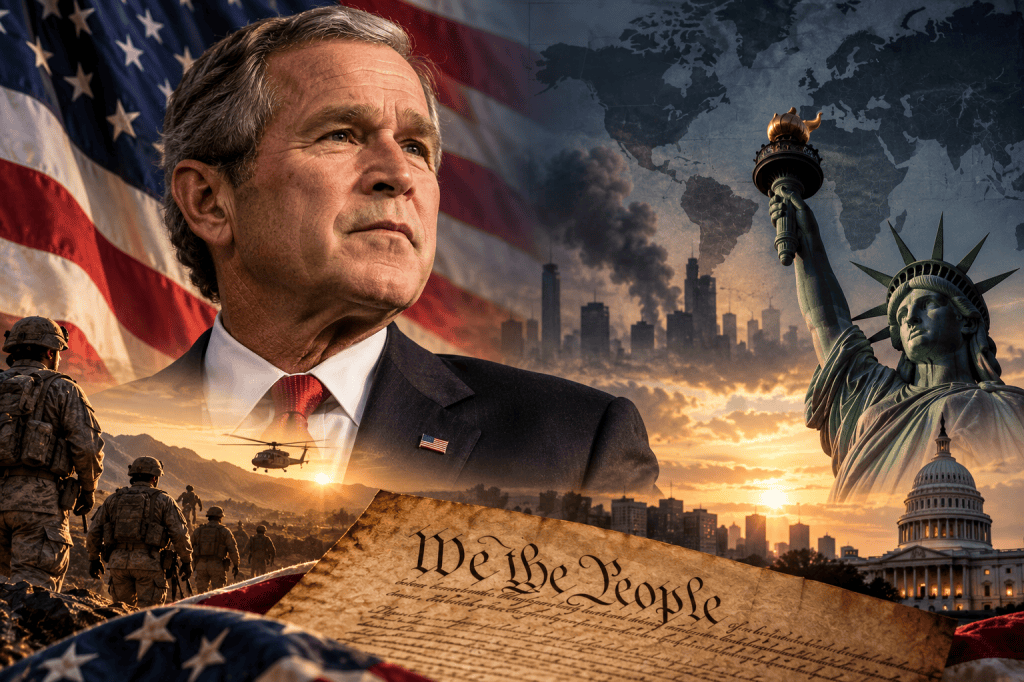
In a world filled with danger, defending liberty means protecting people without taking away the freedom we set out to defend.
September 21, 2026
There are presidents remembered for prosperity, presidents remembered for scandal, and presidents remembered because history placed something terrible on their desk.
George W. Bush belongs unmistakably to the last category.
For the purpose of this reflection, we can leave aside the arguments surrounding what happened before and during September 11, 2001. Those questions have filled books, investigations, documentaries and arguments for a quarter-century.
There is another question worth asking.
What happens to freedom when a nation becomes afraid?
The world Americans confronted in the opening years of this century could be a dark and frightening place. There were people who intended to cause Americans harm. That was not merely political rhetoric. International terrorist organizations existed, violence crossed borders, and governments faced the genuine responsibility of protecting their citizens.
Bush responded by making freedom itself part of the argument.
Speaking to Congress on September 20, 2001, he described America as a country “awakened to danger and called to defend freedom.” He distinguished the enemy from Muslims and Arabs generally and identified the conflict with terrorist extremists. He concluded with an extraordinarily ambitious proposition: this would not become an age defined by terror, but an age of liberty.
Whether one agrees with everything subsequently done in pursuit of that objective is an entirely different question.
And perhaps that distinction matters most.
Two Wrongs Never Make a Right
There is an old expression most of us heard before we were old enough to understand politics:
Two wrongs don’t make a right.
It sounds almost childish until nations are frightened.
Then it becomes considerably harder.
If someone wishes to murder innocent people, a government has a responsibility to stop him. If an organization is planning violence, authorities cannot simply wait politely for the crime to occur.
Freedom does not require helplessness.
But neither does danger automatically justify every action taken in the name of preventing it.
That is the uncomfortable territory in which every free government eventually finds itself.
How much authority should government possess to protect us?
How much privacy should citizens surrender?
When does surveillance become unreasonable?
When does security become control?
And perhaps the most difficult question of all:
If protecting freedom requires eliminating freedom, what exactly have we protected?
There are no bumper-sticker answers to these questions.
Bush’s own rhetoric eventually developed into what his administration called a freedom agenda. In his second inaugural address in January 2005, he argued that America’s security was increasingly connected to liberty elsewhere and that democratic movements and institutions should be supported around the world. Importantly, he also said freedom had to be chosen and sustained through law and protection of minorities rather than simply imposed in an American form.
It was an enormous proposition.
History continues to argue about its consequences.
But buried inside it was an idea considerably older than the Bush administration:
Human beings should have a choice.
The Greater Wrong
This is where the argument becomes interesting.
Two wrongs do not make a right.
But denying a human being any meaningful choice at all can constitute another profound wrong.
A dictator may maintain order.
A prison is orderly, too.
The absence of disorder does not prove the presence of liberty.
Freedom is messy because people are messy. They disagree. They vote badly sometimes. They change their minds. They criticize their leaders. They practice different religions. They publish foolish ideas alongside brilliant ones.
They occasionally make choices we wish they would not make.
That is the price.
The alternative is somebody else making those choices for them.
Bush repeatedly argued that liberty was not exclusively American. In 2005 he said that no person was fit to be another’s master and that no person deserved to be a slave. His administration presented democratic government as an alternative to tyranny and extremism.
One can examine that philosophy without accepting every policy undertaken beneath its banner.
Indeed, a free society should demand exactly that distinction.
A president can believe sincerely in liberty and still make decisions citizens should scrutinize.
A government can confront a genuine enemy and still possess powers that deserve limits.
A nation can have legitimate reasons to defend itself without receiving a blank check from history.
Those propositions can all be true simultaneously.
Freedom Includes the Right to Say No
Perhaps this is the point we have forgotten.
Freedom doesn’t mean choosing correctly.
It means being allowed to choose.
If government permits only approved opinions, there is no freedom of speech.
If religion is permitted only when authorities approve the religion, there is no freedom of religion.
If an election offers only the choice acceptable to those already holding power, there is no meaningful political freedom.
And if citizens may question government only when government finds their questions convenient, there is no serious freedom of inquiry.
This principle becomes especially important during frightening times.
Fear changes people.
It changes governments, too.
A frightened population will tolerate powers it would reject during peaceful years. Citizens naturally want somebody to promise that another catastrophe will never happen.
But government cannot make that promise.
No government can guarantee perfect safety.
It can only pursue greater safety.
The question is what we are prepared to surrender in exchange.
The Man Behind the Presidency
Twenty-five years later, George W. Bush remains a complicated figure in American history.
That is probably as it should be.
Presidents should not become saints or demons simply because enough time has passed.
They were human beings making consequential decisions with imperfect information, political pressures, personal convictions and enormous institutional power.
Bush clearly placed freedom near the center of his public philosophy. His second inaugural address described liberty as something belonging ultimately to individuals rather than governments and argued that lasting freedom depended upon citizens, law and institutions.
Whether particular actions of his administration fulfilled those ideals is a separate historical and political debate.
But the ideal itself deserves attention.
A government should protect its people.
A government should confront people who deliberately seek to harm the innocent.
But government should remember what it is protecting.
Not merely territory.
Not buildings.
Not institutions.
People.
Their lives.
Their families.
Their consciences.
Their right to speak.
Their right to disagree.
And their right, within the boundaries necessary to protect the equal rights of others, to determine the course of their own lives.
Freedom Cannot Be Saved by Destroying It
This may be the lesson worth carrying from the Bush years into 2026.
The world contains dangerous people.
Pretending otherwise does not make us enlightened. It makes us unprepared.
But fear is dangerous, too.
It can persuade a free population that liberty is an inconvenience reserved for peaceful times.
That is precisely when liberty matters most.
The Constitution is easy to admire when nobody is frightened.
Principles are easy when they cost nothing.
The real test comes when a society has something to lose.
Bush once framed the struggle as freedom against fear. Whatever judgment history ultimately makes about the policies pursued during his presidency, that phrase identifies a conflict considerably larger than one administration.
It is a conflict inside every free society.
We want protection.
We need liberty.
Sometimes the two pull in opposite directions.
And when they do, we should remember that two wrongs never make a right—but taking away every choice in the name of protecting people from making the wrong one may leave us with a greater wrong still.
Freedom carries risk.
It always has.
The answer cannot be to pretend evil does not exist.
Neither can the answer be to build such high walls against evil that one morning we wake up and discover we have built the walls around ourselves.
A free country must be capable of defending itself.
But the final measure of that defense is not simply whether the country survived.
It is whether, when the danger passed, the people were still free.


Leave a comment