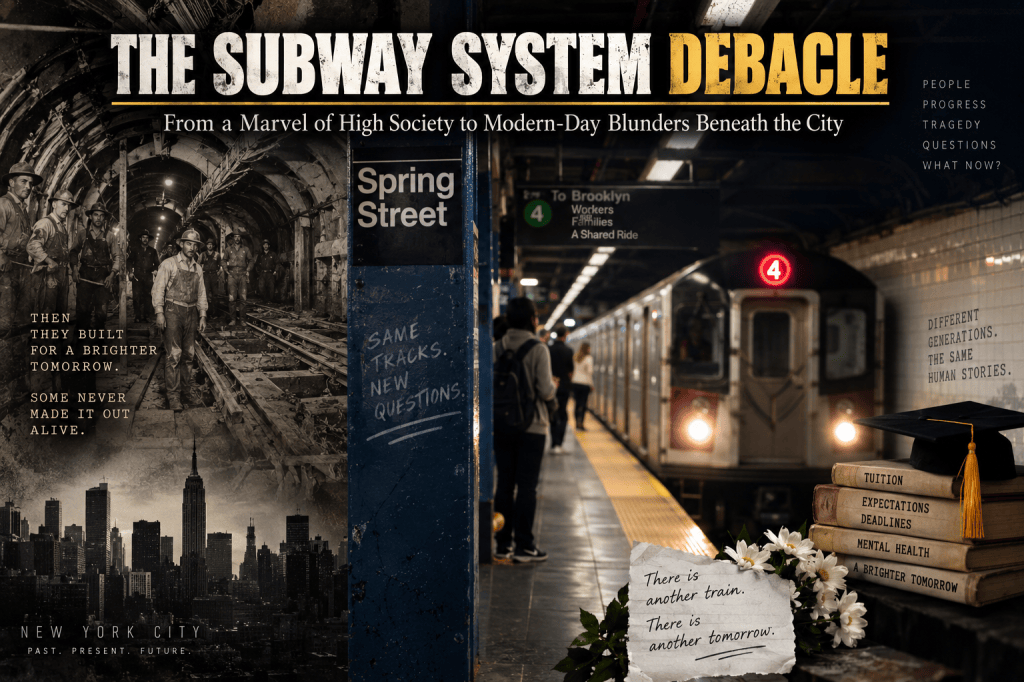
From a Marvel of High Society to Modern-Day Blunders Beneath the City
September 15, 2026
There was a time when going underground was considered progress.
At the turn of the twentieth century, American cities were choking on their own success. Streets groaned beneath horses, wagons, streetcars, elevated trains and an exploding urban population. The fashionable city was getting bigger, richer and considerably harder to cross.
The answer was audacious:
Put the railroad beneath the street.
Boston opened America’s first subway in 1897. New York followed in 1904, although experiments with underground transportation in Manhattan stretched back decades earlier. What began as an engineering gamble became one of the defining inventions of American urban life.
New York’s first subway promised something almost magical: downtown and uptown connected at unprecedented speed without surrendering another inch of Manhattan’s increasingly valuable surface.
But there was another story beneath the celebration.
There were men underground with drills and dynamite.
And some never came back up.
THE PRICE OF GOING UNDERGROUND
Building America’s underground railways was dangerous industrial work.
New York’s early subway construction required workers to excavate enormous stretches of a living city while traffic, buildings, utilities and everyday life continued overhead. Men worked around explosives, compressed air, unstable earth, machinery and immense quantities of rock.
Historical engineering records put the death toll associated with construction of New York’s original subway contracts at dozens of workers and bystanders, with hundreds more injured.
In January 1902, a dynamite accident near the Murray Hill Hotel killed six people and injured scores more. In October 1903, a massive rock collapse during tunnel construction at Fort George killed ten workers.
New York got its underground railroad.
Someone paid for it.
Then came the dangers of operating one.
The 1918 Malbone Street wreck in Brooklyn became the worst rapid-transit disaster in New York City’s history. A train entered a sharp curve at excessive speed, derailed and smashed into the tunnel structure.
Transportation history has often progressed this way:
Engineering achievement.
Catastrophe.
Investigation.
Correction.
Then another generation arrives and forgets why the correction became necessary.
MORE THAN A CENTURY LATER
Today’s subway would be almost unrecognizable to a passenger stepping aboard in 1904.
The trains are more sophisticated.
Communications are better.
Cameras watch stations.
Computers monitor large portions of the railroad.
Dispatchers can follow trains moving through the system in ways the original subway builders could scarcely have imagined.
Yet one fundamental danger remains remarkably primitive:
A human being can still end up on the tracks in front of a moving train.
People enter subway tracks for many reasons.
Someone can trip.
Someone can faint.
Someone can become disoriented.
A passenger can become intoxicated.
A person may jump down to retrieve a telephone or another valuable object.
Someone may attempt to rescue another person.
A worker may be required to enter the roadbed as part of the job.
A person experiencing a mental-health crisis may intentionally enter the tracks.
And occasionally someone is pushed.
Whatever the reason, the result can become the same horrifying equation:
A person on the tracks.
A train approaching.
Seconds remaining.
THE SPRING STREET TRAGEDY
That danger returned to public attention this month following a tragedy at the Spring Street subway station in Lower Manhattan.
Two 24-year-old longtime friends and recent Rutgers University graduates, Malaika Chitre and Navam Kaul, were struck and killed by a southbound No. 4 train during the early morning hours of September 13.
Initial reports described surveillance footage showing the pair on or near the roadbed before the train arrived.
Some accounts described them interacting and apparently laughing shortly before the collision.
Those details naturally produce questions.
But questions are not answers.
As of September 15, the circumstances leading them onto the tracks had not been established publicly with enough certainty to declare what happened or what either person intended.
A few seconds of surveillance footage cannot tell us what two human beings were thinking.
Nor can apparent laughter establish a person’s state of mind.
People confronted by danger do not always behave according to the neat logic imagined afterward by someone watching a recording.
There can be confusion.
Disbelief.
Alcohol.
Panic.
A mistaken judgment of distance.
A momentary freeze response.
Or simply failure to comprehend how quickly a train is approaching.
What this tragedy unquestionably leaves behind is another question:
Why must the train operator be the last line of defense?
THE PHYSICS DON’T CARE
A subway train cannot stop like an automobile.
Once an operator visually recognizes a person directly ahead and activates the emergency brakes, hundreds of tons of train are still moving forward.
Steel wheels meet steel rails.
Momentum continues.
The crucial opportunity may therefore exist before the operator can see the danger.
Imagine a sensor recognizing that a human-sized object has entered the roadbed.
Imagine that information immediately reaching the signaling system, dispatch center and approaching train.
TRACK OCCUPIED — PERSON DETECTED.
The technology required to detect unusual objects is no longer science fiction.
The Metropolitan Transportation Authority has investigated track-intrusion detection, automated analysis of surveillance video, forward-facing cameras and physical barriers as possible methods of reducing track incidents.
That leads to an uncomfortable question.
Why isn’t some form of automatic protection everywhere?
A SUBWAY SHOULD EXPECT HUMAN ERROR
Good engineering does not assume perfect human beings.
It assumes somebody eventually makes a mistake.
People become distracted.
People trip.
People become intoxicated.
People panic.
People attempt rescues.
Workers misunderstand instructions.
Someone drops something expensive and makes the terrible decision to retrieve it.
A transportation system carrying millions of people cannot eliminate human error.
It can attempt to make human error less fatal.
Platform barriers are one possibility.
Automatic track detection is another.
Improved emergency communications are another.
There may be stations where structural limitations make conventional platform doors extremely difficult to install. New York’s system contains different train lengths, platform configurations, curves and infrastructure dating from different eras.
Those are legitimate engineering complications.
But engineering complications are not necessarily permanent excuses.
The subway itself was once considered an extraordinary engineering problem.
New York dug it anyway.
FROM HIGH SOCIETY TO EVERYBODY’S RAILROAD
The irony is difficult to miss.
Underground transportation was once presented as evidence that a sophisticated society could conquer urban chaos through engineering.
Subways represented speed, modernity and metropolitan ambition.
Eventually they became something even more important.
Ordinary.
Millions of people stopped thinking about the remarkable machinery beneath them and simply depended upon it.
A nurse finishing a night shift.
A student going to class.
A construction worker carrying his lunch.
A banker headed downtown.
A tourist staring at the map.
A teenager going home.
That ordinariness is the subway’s greatest achievement.
It also means safety failures cannot simply be dismissed as the unavoidable price of riding an old railroad.
AND WHAT ABOUT THE PRESSURE ABOVE GROUND?
The fact that the Spring Street victims were young university graduates inevitably raises another subject, although it must be separated carefully from the investigation itself.
There was no established evidence as of September 15 that academic pressure caused their deaths.
Their tragedy should therefore not be transformed into proof of a theory about universities.
But the larger question of student pressure exists independently of this particular case.
College today can mean tuition.
Housing.
Books.
Debt.
Employment.
Examinations.
Deadlines.
Internships.
Competition.
Family expectations.
Social expectations.
And the persistent fear that falling behind for one semester could alter the trajectory of an entire life.
Education is supposed to expand a person’s future.
It should not consume the person attempting to build one.
THE STRANGE INSTITUTION CALLED HOMEWORK
Perhaps the examination of pressure should begin long before college.
Consider the word homework.
Home is not an empty extension of school.
A student may have younger siblings to watch.
Dinner to help prepare.
A part-time job.
Family responsibilities.
Religious obligations.
Exercise.
Personal interests.
Or simply the biological necessity of sleeping.
Yet a student with six teachers can effectively have six separate bosses assigning work without any one of them necessarily knowing what the other five assigned that afternoon.
Twenty minutes becomes forty.
Forty minutes becomes two hours.
Then comes studying.
Then a project.
Then tomorrow.
The educational question should not merely be:
How much work can we assign?
It should be:
How much work actually produces additional learning?
There is a point where repetition reinforces knowledge.
There may also be a point where additional work merely consumes additional hours.
Those are not necessarily the same thing.
HOME IS ALSO A PLACE TO LIVE
Perhaps more schoolwork should simply remain at school.
That does not mean eliminating reading, independent study or every assignment completed outside the classroom.
Education requires effort.
Students sometimes need to practice something repeatedly before understanding it.
But there is a difference between intellectual rigor and institutional overload.
Schools should remember that theirs is not the only demand upon a child’s existence.
Teachers should remember that theirs is not the student’s only class.
Universities should remember that a student is not merely a machine for converting assignments into grades.
And parents, administrators and politicians should be willing to ask whether more work necessarily means more education.
Sometimes it may.
Sometimes it may not.
We should be willing to measure the difference.
COLLEGE CANNOT BECOME ENDURANCE TRAINING
A demanding university education can be enormously worthwhile.
Difficulty itself is not evidence that something is wrong.
Deadlines, independent study, examinations and sustained intellectual effort are legitimate parts of higher education.
But difficulty should serve learning.
Students should not be taught that chronic exhaustion is evidence of ambition.
Universities can examine overlapping deadlines, access to counseling, financial stress, advising, course loads and whether students know how to obtain help before a difficult semester becomes an apparently impossible one.
And society should be particularly careful about the language it uses around failure.
Failing an examination is not failing at life.
Dropping a course is not dropping out of existence.
Changing schools is not the end of a future.
Taking another year is still taking another year.
A diploma is valuable.
A human life is more valuable.
WHEN PEOPLE BEGIN TO FEEL LEFT OUT
There is another question larger than schools or subways.
How does a society containing millions of people allow an individual to feel completely alone?
Modern America is extraordinarily connected technologically and can still be astonishingly isolating socially.
A person can possess hundreds of online contacts and have nobody they believe they can telephone at three in the morning.
A student can sit inside a lecture hall containing 300 people and feel invisible.
A passenger can stand shoulder-to-shoulder with strangers beneath Manhattan and remain entirely unknown.
That is not an argument that society can prevent every suicide.
It cannot.
Nor should every tragedy automatically be interpreted as suicide when the evidence does not establish it.
But when somebody is contemplating suicide, society should communicate something without ambiguity:
Suicide is not an acceptable solution to an academic, financial, romantic, professional or personal crisis.
There is another option.
Sometimes that option is withdrawing from a course.
Sometimes it is calling home.
Sometimes it is leaving school.
Sometimes it is entering treatment.
Sometimes it is telling another human being exactly what is happening.
Sometimes it is simply surviving tonight and deciding what to do tomorrow.
The terrible characteristic of a temporary crisis is that, while inside it, temporary can feel permanent.
It isn’t.
NOBODY SHOULD BECOME INVISIBLE IN A CROWD
There is a peculiar loneliness possible in a city of millions.
One can ride shoulder-to-shoulder with strangers and remain completely unknown.
Our transportation systems should therefore be designed for the moment when somebody falls through the cracks—sometimes figuratively and sometimes literally.
Our schools should notice when achievement has turned into exhaustion.
Friends should be able to say something when someone is deteriorating.
Families should listen.
Institutions should make asking for help easier than pretending everything is fine.
And our infrastructure should assume that occasionally a human being will make a terrible mistake.
None of this means society can prevent every tragedy.
It means society should refuse to become accustomed to preventable ones.
FROM 1904 TO TOMORROW
The original subway builders worked with picks, timber, compressed air and dynamite.
They accepted dangers that would horrify a modern engineer.
Every generation looks backward and wonders how previous generations tolerated conditions that appear obviously unacceptable in retrospect.
Yet every generation has its own blind spots.
Ours may be believing that because an old system functions remarkably well, its oldest dangers must simply be tolerated.
They need not be.
A twenty-first-century subway should increasingly be capable of detecting a human being where no human being is supposed to be.
A twenty-first-century school should understand that students have lives beyond an assignment sheet.
A twenty-first-century university should challenge its students without convincing them that exhaustion is the definition of success.
And a twenty-first-century society should be capable of telling somebody who believes one terrible night, semester, bill, grade or mistake has closed every door:
There is another train.
There is another semester.
There is another morning.
The builders of America’s underground railways spent more than a century solving problems once thought impossible.
There are still problems beneath our feet.
And above them.
REFERENCES
Federal Transit Administration. History of the National Transit Database and Transit in the United States.
Historic American Engineering Record. Interborough Rapid Transit Subway.
New York Transit Museum. Malbone Street Wreck.
Metropolitan Transportation Authority. Addressing Track Trespassing.
American College Health Association. National College Health Assessment.
Contemporary reporting available through September 15, 2026 concerning the Spring Street subway deaths and investigation.
 The ChillX Zone
Leave a comment