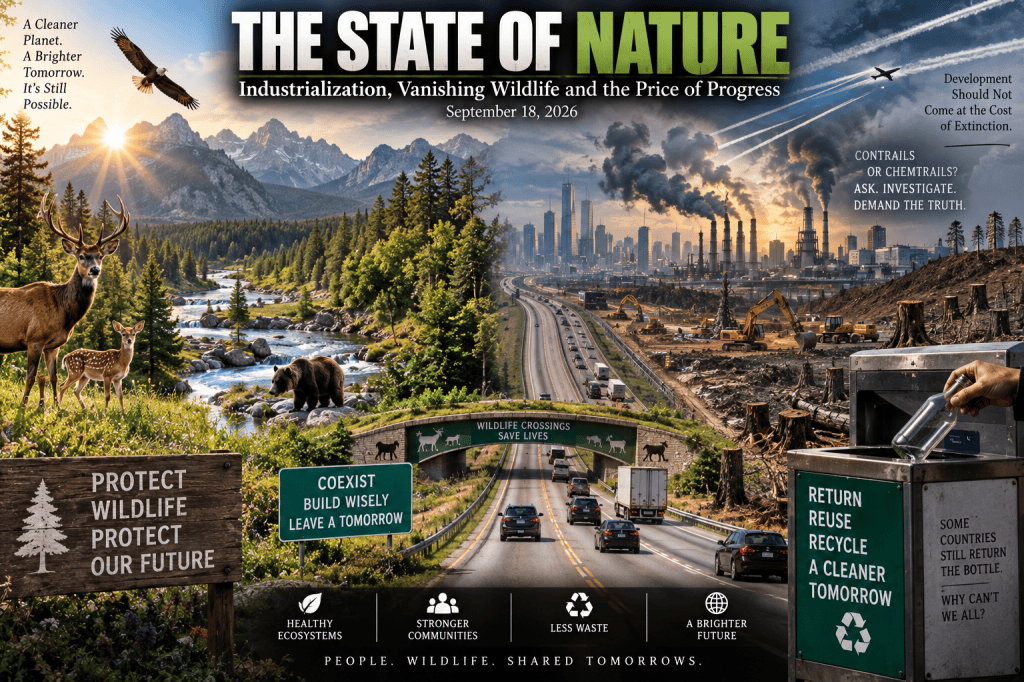
Industrialization, Vanishing Wildlife and the Price of Progress
September 18, 2026
As a child, there was a strange way to measure nature from the back seat of a car.
Roadkill.
A rabbit here. A raccoon farther down the highway. Birds, squirrels, deer and other animals appearing along roads that cut through their habitats.
Nobody wanted to see animals dead.
But their presence demonstrated something easily forgotten: there were animals everywhere around us.
Today, on many drives, the roads can seem strangely empty.
That observation alone does not prove wildlife populations have collapsed. Better fencing, wildlife crossings, faster cleanup, scavengers and changing animal behavior can all affect what motorists see.
But it raises a legitimate question:
Where has the wildlife gone?
WE KEEP BUILDING
Human civilization requires roads, factories, houses, farms, power plants and cities.
The problem is not that humanity builds.
The problem is that we often build as though nothing existed there before us.
A highway may connect two cities while dividing a forest in half.
A subdivision may provide hundreds of homes while eliminating habitat.
A factory may provide thousands of jobs while adding pollution to the air or water.
Development solves human problems while sometimes creating ecological ones.
The question is whether we are becoming sophisticated enough to acknowledge both sides of the equation.
THE WORLD BENEATH THE HIGHWAY
A road is more than asphalt.
Land is cleared. Rock is blasted. Soil is excavated. Water drainage changes. Concrete and asphalt are manufactured and transported.
Then traffic arrives.
To us, the road means mobility.
To an animal, it may become a wall.
Ecologists describe this larger process as habitat fragmentation. Forests and grasslands can remain visible while being divided into smaller pieces that are increasingly difficult for wildlife to navigate.
Nature may still look green from the highway.
That does not necessarily mean the ecosystem beneath it remains healthy.
WHATEVER HAPPENED TO RETURNING THE BOTTLE?
Some countries and regions maintain deposit systems in which beverage containers are returned rather than simply discarded.
It is an old idea that suddenly seems modern again.
Buy the drink.
Use the bottle.
Return it.
Reuse or recycle the material.
Compare that with the disposable economy:
Make it.
Ship it.
Use it once.
Throw it away.
Make another.
Humanity has built an enormous economy around the word away.
But there is no place called away.
The bottle, plastic bag, tire, chemical waste or electronic device eventually goes somewhere.
CORPORATE POLLUTION IS REAL
There is no need to invent environmental conspiracies to demonstrate that powerful institutions sometimes damage nature.
The historical record already provides documented cases of companies contaminating rivers, groundwater, soil and air.
Environmental violations have resulted in prosecutions, cleanup orders, settlements and enormous penalties.
The important questions are therefore specific ones.
Who polluted?
What was released?
Was it legal?
Was the danger known?
Was information concealed?
Who paid for the cleanup?
Those questions can be investigated.
And when breaking environmental law becomes cheaper than following it, fines risk becoming little more than another business expense.
Pollution should never be more profitable than prevention.
WHAT ABOUT “CHEMTRAILS”?
Then there are the white lines stretching across the sky.
People see them.
Sometimes they disappear quickly.
Sometimes they persist and spread.
Sometimes several intersect until large sections of the sky appear hazy.
The phenomenon itself is not imaginary.
Aircraft commonly produce contrails when water vapor associated with jet exhaust freezes into ice crystals under suitable atmospheric conditions.
Aviation also produces genuine emissions and has measurable environmental and climate effects.
Those facts deserve scrutiny.
But they are different from the popular claim that ordinary contrails demonstrate a secret large-scale chemical-spraying program.
Credible evidence has not established that claim.
Environmental skepticism should therefore work in both directions.
Do not automatically dismiss unusual observations.
But do not automatically accept an extraordinary explanation either.
Observe first. Measure second. Conclude last.
WHERE DID EVERYTHING GO?
Wildlife decline is not imaginary either.
Around the world, species face pressure from habitat loss, pollution, climate change, invasive species, exploitation and expanding infrastructure.
But nature is complicated.
Some populations decline.
Some remain stable.
Some recover because conservation works.
That is why childhood memories of fewer butterflies, insects, birds or roadside animals should be treated as starting questions rather than scientific measurements.
Our memories tell us what we noticed.
Science helps determine why.
HUMANITY AND ANIMALS
Human beings have always lived alongside animals.
We have domesticated them.
Protected them.
Eaten them.
Hunted them.
Studied them.
Feared them.
Loved them.
There is no contradiction in believing humanity has a right to use natural resources while also believing humanity has a responsibility to preserve the natural world.
Even hunting and conservation are not necessarily opposites.
Regulated hunting can coexist with wildlife management and habitat conservation. Poaching, uncontrolled exploitation and driving species toward extinction are entirely different matters.
The important principle is sustainability.
Take without destroying the source.
PROGRESS SHOULD LEAVE SOMETHING BEHIND
Humanity is not going to stop building.
Nor should it.
People need housing.
People need transportation.
People need electricity.
People need employment.
But perhaps the next stage of industrialization should be measured not merely by what we can construct, but by what survives around it.
Build the road—and provide wildlife crossings where necessary.
Build the factory—and control its pollution.
Sell the bottle—and make returning it worthwhile.
Build the neighborhood—and preserve connected habitat.
Produce energy—and continue reducing unnecessary environmental damage.
Progress should not require ecological silence.
NATURE IS NOT DECORATION
Nature is not simply something outside the city that we visit on vacation.
It is the water entering our homes.
The soil producing our food.
The insects pollinating plants.
The atmosphere receiving our emissions.
The forests protecting watersheds.
The animals attempting to cross the roads we constructed through their territory.
Humanity is not standing outside nature.
We are inside it.
Perhaps that is what those childhood road trips were quietly showing us.
The rabbit beside the road was not living in our world.
We were driving through its world too.
Human civilization has accomplished astonishing things.
We can tunnel through mountains.
Bridge enormous rivers.
Construct cities containing millions.
Send machines beyond Earth.
Surely a civilization capable of all that can figure out how to return a bottle.
Surely it can build roads without cutting every ecosystem apart.
Surely corporations can be expected to clean up what they contaminate.
And surely progress does not have to mean waking up one morning and realizing that everything else has quietly disappeared.
We have a right to live here.
So do the creatures living beside us.
REFERENCES
Intergovernmental Science-Policy Platform on Biodiversity and Ecosystem Services (IPBES). Global Assessment Report on Biodiversity and Ecosystem Services.
International Union for Conservation of Nature (IUCN). The IUCN Red List of Threatened Species.
United Nations Environment Programme. Research concerning pollution, biodiversity and waste.
U.S. Environmental Protection Agency. Environmental enforcement and compliance information.
Federal Aviation Administration. Scientific information concerning aircraft contrails.
 The ChillX Zone
Leave a comment