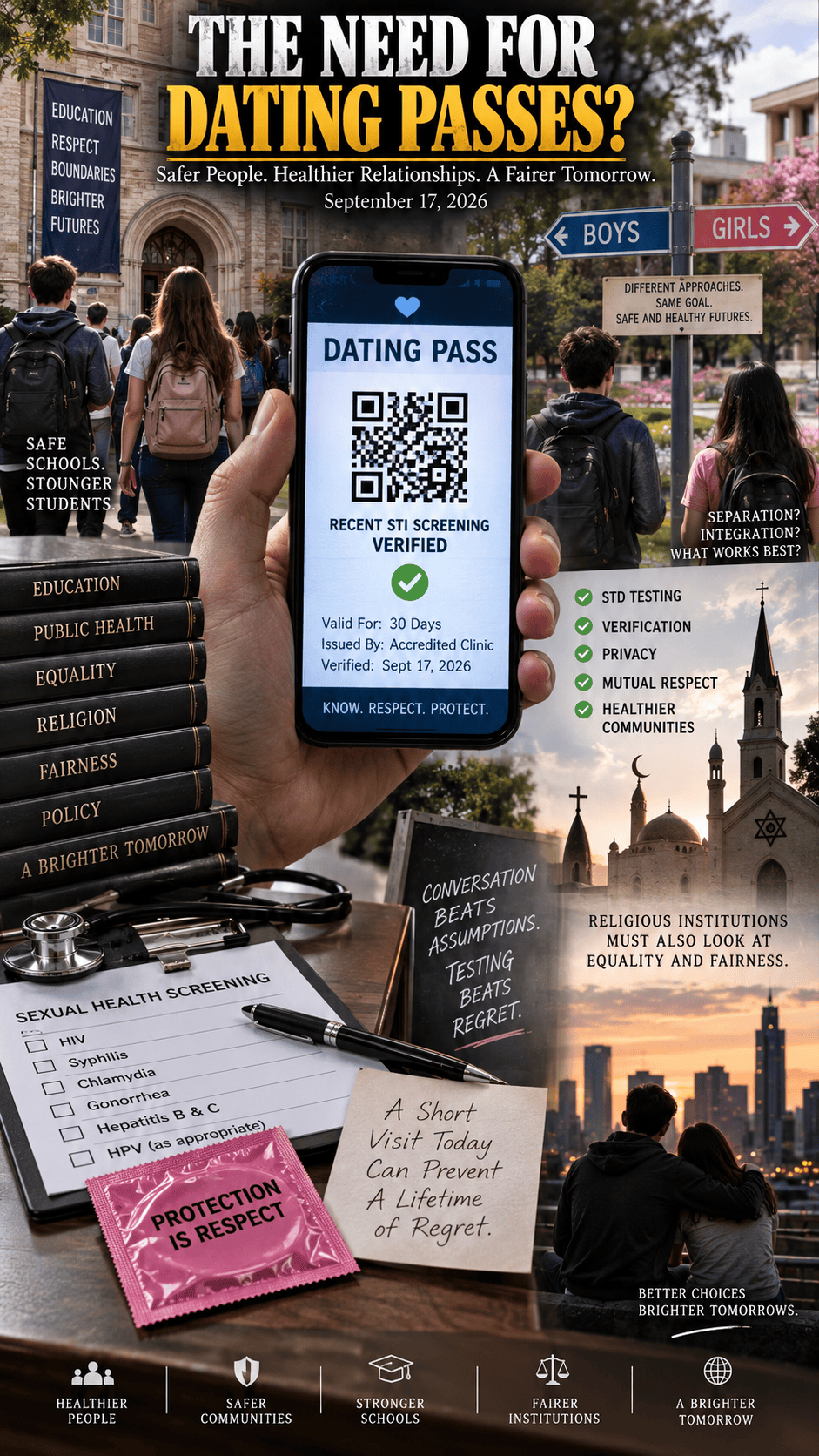
Sex, Schools, Religion and Whether Modern Dating Needs a Better System of Trust
September 17, 2026
We require paperwork for remarkably ordinary things.
Drive a car.
Enter another country.
Work in certain professions.
Enroll in school.
Prove vaccination against particular diseases in particular settings.
Yet when two people enter one of the most intimate relationships human beings can have, society frequently relies upon something considerably less sophisticated:
“Trust me.”
Perhaps it is worth asking whether modern dating needs a better system.
Not permission from government to fall in love.
Not morality police.
Not a database announcing everyone’s sexual history.
But a voluntary, privacy-preserving way for adults to demonstrate that they recently completed recommended sexual-health screening—and to know exactly what that screening does and does not establish.
Call it, for purposes of discussion, a dating pass.
The name may sound strange.
The underlying question is not.
THIRTY DAYS DOES NOT MEAN “SAFE”
Imagine a voluntary credential lasting 30 days.
Or perhaps another medically appropriate period determined by the tests involved rather than an arbitrary calendar.
A participating clinic performs agreed-upon screening. The individual receives a digitally verifiable credential confirming something narrow:
SCREENING COMPLETED — DATE VERIFIED
The credential would not need to expose laboratory results publicly.
It would not list someone’s partners.
It would not disclose unrelated medical records.
And most importantly, it should never say:
DISEASE FREE.
Medicine cannot honestly make that promise.
Different sexually transmitted infections have different testing windows. An infection acquired recently may not yet be detectable. Some tests are recommended only for particular populations or exposures. A person can also acquire an infection after testing.
A dating credential could therefore verify a recent screening event.
It could never certify the future.
That distinction is everything.
THE DISEASE DOES NOT CARE ABOUT THE AWKWARD CONVERSATION
Sexually transmitted infections are not moral judgments.
They are infections.
Some are curable.
Some are manageable.
Some can produce serious long-term consequences when untreated.
HIV can become a lifelong infection, although modern treatment can allow people with HIV to live long and healthy lives, and effective treatment that maintains an undetectable viral load prevents sexual transmission.
Untreated chlamydia and gonorrhea can contribute to pelvic inflammatory disease and infertility.
Syphilis can progress through stages and cause serious complications if untreated.
Certain strains of human papillomavirus are associated with cancers.
Hepatitis B can become chronic and damage the liver.
Against those consequences, a short visit to a clinic does not seem like an extraordinary burden.
The difficult part is designing a system that encourages testing without creating another form of discrimination.
A PASS SHOULD NEVER BECOME A SCARLET LETTER
Here is where the proposal becomes dangerous if badly designed.
Imagine employers demanding to see dating credentials.
Landlords asking for them.
Schools recording students’ results.
Insurance companies obtaining the data.
Partners photographing private medical information and posting it online.
Religious communities using it to identify people they consider sexually active.
Governments building permanent databases of intimate behavior.
That would not be public health.
That would be surveillance.
A defensible system would therefore need strict boundaries.
Participation would have to be voluntary.
Verification should reveal the minimum information necessary.
Medical results should remain confidential.
A credential should expire.
It should not reveal the number, identity or gender of previous partners.
And declining to participate should not become evidence that somebody has an infection.
Privacy cannot be an afterthought.
It has to be part of the architecture.
VERIFY THE TEST, NOT THE PERSON’S MORALITY
The most useful credential might actually be remarkably boring.
A QR code could verify that an accredited provider performed specified screening on a certain date.
Nothing more.
No green heart.
No red warning symbol.
No purity score.
No ranking of human beings.
No permanent record visible to strangers.
Two adults considering intimacy could decide whether that information is sufficient for them.
They could still discuss condoms.
Vaccination.
Contraception.
Exclusive relationships.
Previous exposure.
PrEP for HIV prevention where appropriate.
And whether additional testing makes sense.
Technology would support the conversation.
It would not replace it.
WHAT ABOUT STUDENTS?
This discussion becomes considerably more complicated when schools enter the picture.
For generations, societies have experimented with separating male and female students.
Some schools remain single-sex.
Some religious institutions strongly favor separation.
Other education systems emphasize coeducation.
The question deserves more sophistication than:
Boys over here. Girls over there. Problem solved.
It isn’t that simple.
Separating students can reduce some opportunities for sexual interaction during the school day.
It can also create unintended consequences.
Students still encounter one another outside school.
Universities, workplaces and adult society generally require people of different sexes to communicate and cooperate.
And a system built around the assumption that boys and girls become dangerous merely by sharing a classroom risks teaching suspicion rather than responsibility.
THE TOXIC ENVIRONMENT CAN RUN BOTH DIRECTIONS
Coeducational environments can certainly produce problems.
Sexual harassment.
Rumors.
Dating conflicts.
Jealousy.
Pressure to appear attractive.
Social-media humiliation.
Unwanted advances.
Distraction.
But separation can create problems too.
Stereotypes can become stronger when people rarely interact normally.
Ordinary conversation between sexes can acquire unnecessary mystery.
Students may enter adulthood with less experience navigating boundaries, rejection, friendship and professional cooperation.
There is also a larger problem.
Not every student fits neatly into assumptions about heterosexual attraction.
Separating boys from girls does not magically eliminate sexuality, harassment or relationship problems.
The better question is not simply whether students should be separated.
It is:
What environment produces respect?
OTHER CULTURES HAVE ANSWERED DIFFERENTLY
There is no universal human answer to sex separation.
Different societies have reached dramatically different arrangements.
Some religiously conservative communities maintain extensive separation between men and women in schools and social settings.
Other societies educate boys and girls together from childhood.
Still others use hybrid arrangements—coeducational institutions with some separate classes, housing, athletics or religious activities.
Each system reflects history, religion, law and social expectations.
That diversity itself should make us cautious about claiming that one arrangement automatically produces morality or equality.
The results depend upon what students are taught alongside the structure.
Separation without respect can produce inequality.
Integration without boundaries can produce harassment.
Neither architecture eliminates the need for education.
RELIGION HAS TO ASK THE FAIRNESS QUESTION TOO
Religious institutions have every reason to discuss sexual ethics.
For billions of people, religion provides a framework for marriage, family, responsibility and intimate behavior.
But institutions that establish different expectations for men and women should also be willing to examine whether those expectations are being applied fairly.
If modesty matters, why should responsibility fall primarily upon women?
If premarital sexual restraint matters, why should the standard differ for men?
If fidelity matters, why should violations by one sex be treated differently from violations by another?
If education matters, why should either sex receive less of it?
A moral standard gains credibility when the institution imposing it is prepared to apply the underlying principle consistently.
Equality does not require identical lives.
But fairness requires that one person’s dignity not become less valuable because of sex.
TESTING SHOULD NOT BECOME PUNISHMENT
Public health works poorly when people fear the health system.
If obtaining an STI test creates a permanent mark against someone, fewer people may want to be tested.
That would defeat the entire purpose.
Testing should instead become ordinary.
Routine.
Private.
Responsible.
Something people can discuss without shame.
A person who gets tested is not admitting misconduct.
They are obtaining healthcare.
The same principle applies to someone who receives a positive result.
An infection is not a character assessment.
It is medical information requiring appropriate treatment, counseling or management.
THERE IS NO PERFECT PASS
Even the best-designed credential would have limitations.
A test reflects a moment in time.
There are window periods.
Not every screening panel covers every infection.
A credential can expire while behavior changes immediately.
Fraud has to be prevented.
Medical privacy has to be protected.
People without easy access to healthcare must not be excluded from relationships or stigmatized.
And nobody should interpret a recent test as replacing condoms, vaccination, communication or medical advice.
That means the phrase “dating pass” may ultimately be less useful than something like:
RECENT SCREENING VERIFICATION.
Less romantic.
More accurate.
THE CLERK’S OFFICE VERSUS YEARS OF CONSEQUENCES
Still, the underlying comparison deserves attention.
We tolerate paperwork when the stakes involve automobiles, employment, travel and property.
Why does sexual health become uniquely embarrassing?
If two adults voluntarily decide that before beginning a sexual relationship they will both obtain testing, that is not distrust.
It can be mutual responsibility.
If technology allows them to verify that the screening actually occurred without exposing the underlying medical record, perhaps the process could become easier.
Ten minutes of awkwardness may be preferable to months or years of uncertainty.
But the credential should facilitate informed consent.
It should never manufacture false certainty.
EDUCATION BEFORE SEGREGATION
Schools facing unhealthy dating cultures should first examine the culture itself.
Are students taught consent?
Do they understand harassment?
Can they report misconduct without retaliation?
Do they understand contraception and infection prevention?
Do they know where confidential healthcare is available?
Are boys taught that rejection must be respected?
Are girls taught that they have equal responsibility for respecting boundaries?
Are LGBTQ students included in safety policies?
Are administrators responding consistently regardless of who is accused?
Those questions may matter more than which students sit beside one another in algebra.
THE GOAL IS NOT LESS HUMAN CONTACT
Human beings are social creatures.
We form friendships.
We fall in love.
We make mistakes.
We marry.
We separate.
We build families in many different forms.
No bureaucracy can make intimacy risk-free.
Nor should government attempt to regulate every romantic decision.
The goal should instead be better information and greater responsibility.
A voluntary dating credential might be one tool worth studying.
So might inexpensive testing.
At-home testing where medically appropriate.
Vaccination.
Condom availability.
PrEP.
Confidential clinics.
Better sexual-health education.
And perhaps most importantly, a culture in which asking a potential partner about testing is considered responsible rather than insulting.
TRUST—BUT GIVE TRUST SOMETHING TO STAND ON
Relationships will always require trust.
No database can replace it.
No medical test can measure loyalty.
No QR code can guarantee honesty.
No school arrangement can eliminate attraction.
No religious rule can eliminate human complexity.
But trust does not have to mean deliberate ignorance.
Two people can care about each other and still ask questions.
They can respect each other and still get tested.
Schools can encourage interaction while enforcing boundaries.
Religious institutions can preserve beliefs while examining whether rules are applied fairly.
And governments can support public health without constructing systems of intimate surveillance.
Perhaps the future of dating does not need permission slips.
Perhaps it needs something considerably simpler:
Better information.
Equal standards.
Medical privacy.
Mutual responsibility.
And the understanding that protecting someone you care about should never be embarrassing.
REFERENCES
Centers for Disease Control and Prevention. Sexually Transmitted Infections — Prevention, Testing and Treatment Guidance.
Centers for Disease Control and Prevention. HIV Treatment as Prevention.
World Health Organization. Sexually Transmitted Infections (STIs).
World Health Organization. HIV and AIDS.
UNESCO. Research and guidance concerning gender equality and education.
U.S. Department of Education. Guidance and legal materials concerning sex discrimination and educational opportunity.
 The ChillX Zone
Leave a comment