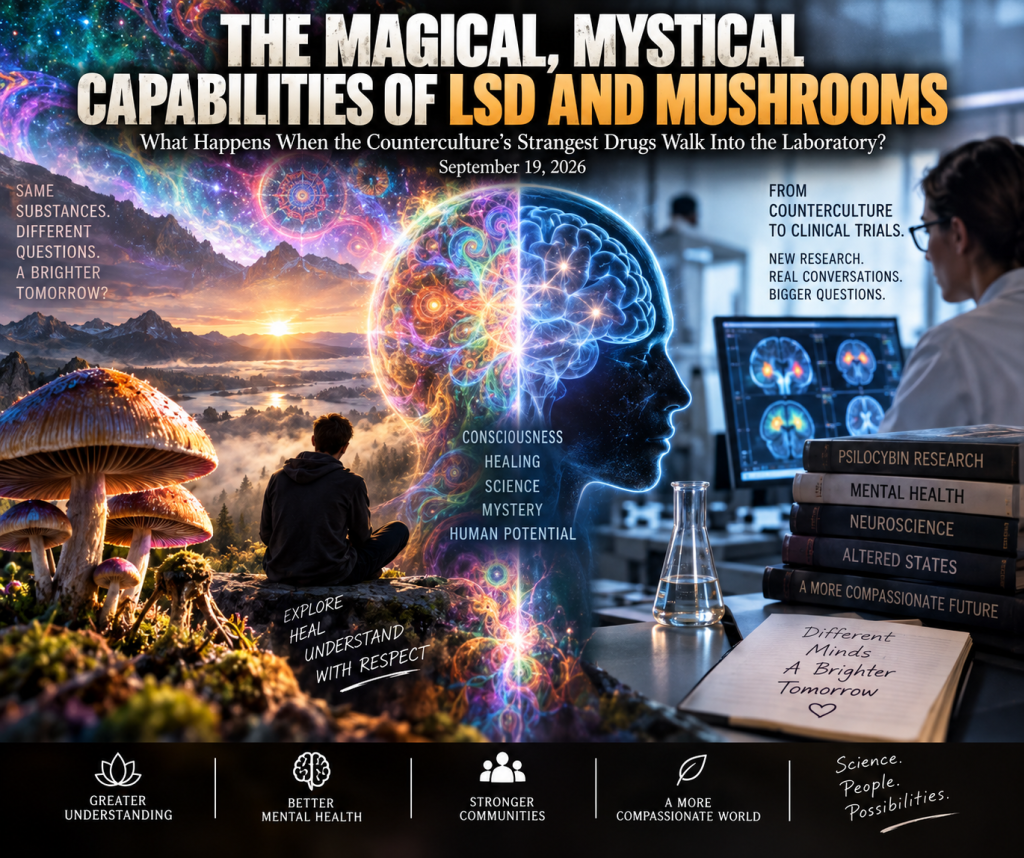
What Happens When the Counterculture’s Strangest Drugs Walk Into the Laboratory?
September 19, 2026
For decades, the image was almost impossible to separate from the drug.
Tie-dye.
Woodstock.
Melting walls.
Strange music.
People staring at their hands and insisting they had discovered the meaning of the universe.
LSD and psychedelic mushrooms became symbols of the counterculture long before modern medicine decided exactly what to make of them.
Then something unexpected happened.
The scientists came back.
And in 2026, psychedelics are once again being discussed in laboratories, medical journals and regulatory meetings—not simply dorm rooms and music festivals.
That makes this an interesting moment to reconsider one of the strangest questions in medicine:
What exactly happens to the human mind on psychedelics?
WHEN “MAGICAL” IS THE ONLY WORD PEOPLE CAN FIND
People describing powerful psychedelic experiences frequently use language that sounds more religious than medical.
Unity.
Infinity.
Rebirth.
Connection.
A presence.
The disappearance of the self.
Some describe feeling connected to nature or the universe. Others report confronting memories, fears or grief with extraordinary intensity.
To the person experiencing it, the event may feel completely real.
But science has to make an important distinction.
A mystical experience does not necessarily prove a mystical reality.
Someone can genuinely experience the sensation of leaving their body without proving that consciousness actually departed it.
Someone can feel connected to the universe without demonstrating a previously unknown physical connection.
That does not make the experience meaningless.
It simply gives us two questions instead of one:
What did the person experience?
And:
What caused it?
A MUSHROOM CHANGES THE MACHINE
Magic mushrooms contain psilocybin, which the body converts into psilocin.
LSD and psilocin strongly affect serotonin-related signaling in the brain.
But the interesting part is what happens next.
The brain does not simply record reality like a video camera.
It filters.
Predicts.
Organizes.
Interprets.
Psychedelics can disrupt those familiar processes.
Colors intensify.
Patterns appear to move.
Time stretches or collapses.
Music can become overwhelmingly emotional.
Memories can suddenly feel present again.
And sometimes the familiar boundary between “me” and everything outside of me begins to disappear.
Researchers call one version of this experience ego dissolution.
The person may temporarily stop feeling like an isolated individual observing the universe and instead feel like part of something much larger.
That can be terrifying.
It can also be profound.
FROM TRIP TO TREATMENT?
This is where the story becomes medically interesting.
Researchers have been investigating psilocybin-assisted therapy for conditions including depression, particularly when conventional treatments have not worked adequately.
That does not mean mushrooms are a miracle cure.
It means the results have been interesting enough to keep studying.
And there may be something unusual happening here.
With ordinary medicine, the experience of taking the drug is often irrelevant.
Swallow the pill.
The chemistry does the work.
Psychedelics may be different.
The environment matters.
Preparation matters.
The person’s psychological state matters.
Professional supervision may matter.
And the actual experience—the frightening, beautiful, confusing or deeply emotional “trip”—may itself be connected to what researchers are trying to understand.
Scientists may therefore be studying more than a chemical.
They may be studying an experience.
BUT WONDER HAS A DARK SIDE
This is where psychedelic romanticism becomes dangerous.
Not every trip is beautiful.
People can experience panic.
Paranoia.
Confusion.
Overwhelming fear.
Dangerous behavior.
And certain individuals may face greater psychiatric risks, which is one reason clinical studies carefully screen participants.
There is also an enormous difference between receiving a known substance in a controlled clinical environment and buying something illegally without knowing exactly what it contains.
The scientific question is therefore not:
“Are psychedelics good?”
It is:
Who might benefit, under what conditions, with what supervision—and at what risk?
That question is less exciting.
It is also the one that matters.
THE ANCIENTS WERE THERE FIRST
Human beings did not discover psychedelic experiences in the 1960s.
Various cultures have used psychoactive plants and fungi in ceremonial, spiritual and healing traditions for centuries.
They did not talk about serotonin receptors.
They talked about spirits.
Healing.
Visions.
Death.
Rebirth.
The sacred.
Traditional explanations should not automatically be accepted as scientific fact.
But traditional observations should not automatically be dismissed either.
Ancient people noticed that certain substances could radically transform consciousness.
Modern neuroscience is studying the same basic phenomenon with different instruments and vocabulary.
Perhaps both were looking at something genuinely remarkable.
WHAT IF “MYSTICAL” IS A HUMAN CAPABILITY?
Here is where things become fascinating.
Suppose mystical experiences are reproducible states of human consciousness.
That would not prove God.
It would not disprove God.
It would demonstrate that the human brain possesses the ability to experience something that feels like transcendence.
Religion might call it revelation.
Psychology might call it altered consciousness.
Neuroscience might describe changing brain networks.
The person experiencing it might simply say:
“You had to be there.”
Different descriptions.
Same mysterious human brain.
WHY WRITE ABOUT THIS NOW?
Because psychedelics have moved back into serious scientific discussion.
Researchers continue studying psilocybin for depression and other psychiatric conditions, while regulators have been considering how psychedelic medicines could be properly tested and potentially used within supervised settings.
That represents an extraordinary cultural reversal.
Substances once associated almost entirely with rebellion are being investigated using clinical trials, brain imaging and modern pharmacology.
The counterculture has entered the laboratory.
And perhaps that is exactly where these claims belong.
Measure them.
Challenge them.
Replicate them.
Find out what is real.
MAYBE THE STRANGEST DISCOVERY IS US
LSD and mushrooms may never reveal another dimension.
They may not uncover the secret architecture of the universe.
And somebody seeing extraordinary patterns on a wall has not necessarily discovered hidden physics.
But psychedelics have already demonstrated something remarkable.
Change a small part of the brain’s chemistry and the entire experience of reality can change with it.
Time.
Identity.
Memory.
Fear.
Music.
Color.
Meaning.
Even the boundary between the self and the world.
That should make us cautious about claiming we completely understand consciousness.
Perhaps the greatest mystery was never inside the mushroom.
Perhaps it was inside us.
The hippies called it a trip.
Scientists call it an altered state of consciousness.
Whatever name eventually survives, the laboratory lights are back on.
And one of the strangest chapters in modern medicine is being reopened.
REFERENCES
U.S. Food and Drug Administration. Psychedelic Drugs: Considerations for Clinical Investigations. 2026.
U.S. Food and Drug Administration. Considerations for Potential Future Therapeutic Use of Psychedelic Drugs Public Hearing. September 2026.
National Institutes of Health and PubMed. Contemporary clinical research concerning psilocybin-assisted therapy, depression and psychedelic neuroscience.
Johns Hopkins Center for Psychedelic and Consciousness Research. Research concerning psilocybin, mystical-type experiences and altered states of consciousness.
 The ChillX Zone
Leave a comment