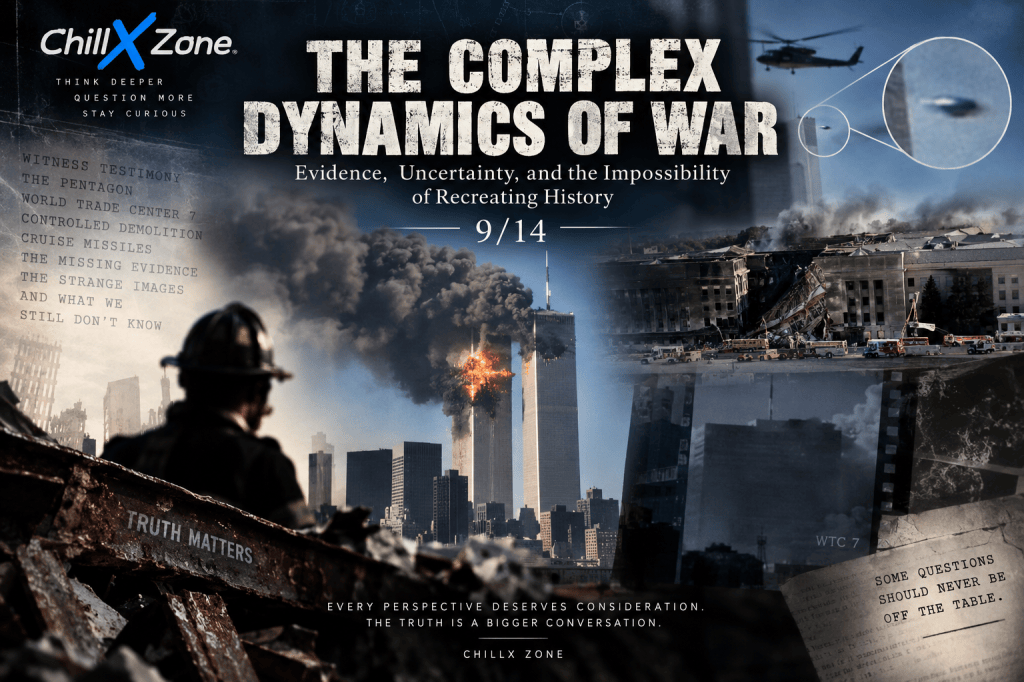
Evidence, Uncertainty, and the Impossibility of Recreating History
September 14
There is an uncomfortable fact at the center of every investigation into war, catastrophe, and political violence: history cannot be rerun.
We cannot restore every person to the same position, reconstruct every building molecule for molecule, reproduce the weather, communications, decisions, mechanical conditions, and countless other variables of a particular morning, then press a button and see whether history happens exactly the same way.
That limitation matters.
At ChillX Zone, our approach is deliberately cautious. We try to examine extraordinary events fairly and scientifically. Any proposition that can be stated in testable terms deserves consideration proportional to the evidence supporting it.
Considering a proposition, however, does not mean accepting it.
A hypothesis is not the be-all and end-all simply because it challenges an official explanation, any more than an official explanation becomes infallible merely because an institution published it.
September 11 is perhaps the clearest modern example of why those distinctions matter.
Testimony, Memory, and the Language of Explosions
There are accounts from people at the World Trade Center describing booms, blasts, flashes, shaking, and events they interpreted as explosions. Such testimony belongs in the historical record.
But eyewitness testimony presents an immediate scientific problem. A witness can reliably report, “I heard a tremendous boom.” That does not necessarily establish, “I heard a planted demolition charge.”
Inside a catastrophically damaged skyscraper, floors can fail, transformers and electrical equipment can malfunction, fuel can ignite, elevators and mechanical systems can be destroyed, structural components can fracture, and debris can strike other parts of the building. Several of those events can produce violent sounds and sensations.
The distinction is fundamental:
The observation and its proposed cause are two different things.
That does not mean witnesses should be dismissed. It means their testimony should become one component of an investigation alongside photographs, video, structural evidence, physical debris, timelines, seismic records, and engineering analysis.
The Pentagon and the Missing-Image Problem
The Pentagon has generated a different species of controversy.
The official account identifies American Airlines Flight 77, a Boeing 757, as the aircraft that struck the Pentagon. Yet the relatively limited publicly familiar imagery of the moment of impact helped create persistent arguments that the visual record does not resemble what people expected an airliner crash to look like.
That distinction matters too.
Saying “the images available to me do not clearly show what I expected to see” is not the same as demonstrating that no aircraft struck the building.
Alternative propositions have ranged from another type of aircraft to a missile or cruise-missile strike. Some versions go further and propose that the attack was internally orchestrated.
Those are extraordinary propositions. They therefore require evidence capable of distinguishing them from the conventional explanation—not merely gaps, ambiguities, or strange-looking frames.
The same standard has to run in both directions.
Evidence for the accepted account should withstand scrutiny. Evidence offered for an alternative account should face exactly the same scrutiny.
Suspicion is the beginning of an investigation, not its conclusion.
World Trade Center 7
Then there is World Trade Center 7.
No commercial aircraft struck the 47-story building, yet it collapsed late in the afternoon. Its appearance during collapse has consequently remained one of the most persistent sources of controlled-demolition arguments.
To an ordinary viewer, that reaction is understandable. People have seen footage of engineered demolitions. They see a tall building descend rapidly and make a visual comparison.
But resemblance is not mechanism.
A controlled-demolition hypothesis would require more than the observation that the collapse looks controlled. Investigators would want evidence concerning preparation of structural columns, explosive residues, blast signatures, characteristic sound levels, wiring or initiation systems, access required to prepare the structure, and a failure sequence consistent with explosives.
Claims have also circulated connecting demolition specialists with a prearranged demolition operation. The fact that demolition and debris-removal specialists participated in the aftermath cannot by itself establish that they prepared a building for destruction beforehand. Those are radically different propositions requiring radically different evidence.
The official engineering investigation ultimately concluded that uncontrolled fires produced a progressive structural failure in WTC 7 and reported finding no evidence that explosives caused the collapse.
That conclusion deserves to be represented accurately even in an article examining alternatives.
And it remains legitimate to examine the assumptions, simulations, evidence, and reasoning behind such conclusions. Science does not require reverence. It requires reproducibility where possible, transparent reasoning where reproduction is impossible, and a willingness to distinguish what is directly observed from what has been reconstructed.
The Strange Images in the Sky
There is another, much stranger corner of the visual record.
Footage associated with helicopter coverage of the World Trade Center has circulated in which viewers have claimed to see an unusual object apparently near—or protruding from—the building before rapidly crossing the field of view.
Depending upon the interpretation, it has been described as a UFO, an anomalous aerial vehicle, an unknown projectile, or an object apparently traveling at extraordinary speed.
The imagery can certainly look bizarre when isolated, slowed down, or replayed.
But here the evidentiary bar has to rise rather than fall.
A video artifact, compression error, foreground object, debris, bird, aircraft, editing artifact, or error in judging distance can produce apparent velocities radically different from an object’s actual velocity.
Without dependable information about distance, camera position, frame rate, lens characteristics, original-generation footage, and an unbroken chain of custody, calculating something like “Mach speed” from appearance alone becomes extremely hazardous.
If original footage and technical metadata survived, the scientifically interesting question would not initially be:
“Was this a UFO?”
It would be:
“What does the recording actually permit us to determine?”
Only after answering that question should anyone attempt to identify the object.
War Produces Bad Laboratories
This brings us to the larger problem.
Wars and mass-casualty events are terrible laboratories.
Evidence disappears. Cameras point in the wrong direction. Recordings begin seconds too late. Witnesses contradict one another. Governments classify information. News organizations make mistakes. Rumors enter the record almost immediately. Physical scenes are altered by rescue operations. Debris is moved. Memories change. Political interests appear.
Later investigators inherit only an incomplete collection of what once existed.
And nobody can restore the original conditions exactly.
This does not mean that all explanations become equally probable.
It means certainty must be earned.
Imagine three propositions:
A: the conventional explanation.
B: an alternative involving deliberate demolition, another aircraft, or another weapon.
C: an explanation nobody has proposed yet.
Finding a weakness in A does not automatically prove B.
Finding a weakness in B does not automatically prove A.
And the existence of C reminds us why intellectual humility matters.
A responsible investigation asks which proposition explains the greatest amount of reliable evidence while requiring the fewest unsupported assumptions.
Then it asks the more dangerous question:
What evidence would prove us wrong?
If the answer is nothing, we have left science and entered belief.
The Difference Between Asking and Declaring
There should be room to ask whether eyewitness reports were interpreted correctly.
There should be room to examine unusual footage.
There should be room to investigate World Trade Center 7.
There should be room to question government investigations, private investigators, journalists, engineers—and people questioning all of them.
But there must also be room to conclude that an intriguing proposition has not accumulated sufficient evidence.
The official investigations concluded that hijacked commercial aircraft struck the World Trade Center and Pentagon and that the WTC tower collapses followed aircraft impacts, structural damage, and fires. The later engineering investigation of WTC 7 attributed its collapse to fire-induced progressive structural failure rather than explosive demolition.
Alternative propositions—including cruise missiles, planted explosives, controlled demolition, and anomalous aerial objects—remain propositions unless independent evidence can establish them.
That distinction may frustrate people seeking a final answer.
It should remind us why these events are so difficult to reconstruct.
History is messy. War is messier. Catastrophe destroys evidence at precisely the moment evidence becomes most important.
The ChillX Zone Standard
The scientific position is neither believe everything nor question nothing.
It is to keep the categories straight:
What did we observe?
What do we infer from it?
What alternative explanations could produce the same observation?
What evidence would distinguish between them?
And finally:
How certain are we really entitled to be?
That is the standard we intend to maintain at ChillX Zone.
Every serious proposition may enter the room.
None gets to bypass the evidence.
References
National Commission on Terrorist Attacks Upon the United States. The 9/11 Commission Report.
National Institute of Standards and Technology. World Trade Center Investigation.
National Institute of Standards and Technology. Final Report on the Collapse of World Trade Center Building 7.
 The ChillX Zone
Leave a comment