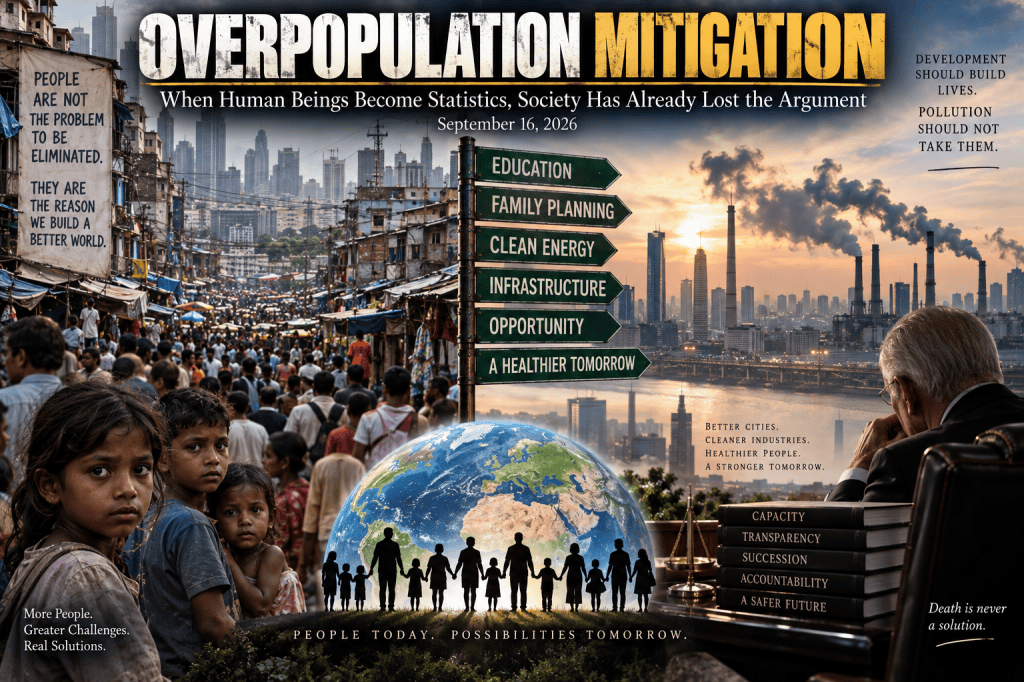
When Human Beings Become Statistics, Society Has Already Lost the Argument
September 16, 2026
There is an ugly idea hiding behind some discussions of overpopulation.
It rarely announces itself plainly.
Instead, it arrives disguised as inevitability.
Too many people.
Not enough housing.
Not enough food.
Not enough water.
Too much traffic.
Too much pollution.
Too many elderly people.
Too many poor people.
Too many children.
And somewhere along the line, a society begins accepting premature death as though it were another mechanism for balancing an equation.
It is not.
Causing death—or knowingly treating preventable death as population management—is never an acceptable solution to overpopulation.
A government that cannot accommodate its population has an administrative, economic, environmental or infrastructure problem.
It does not have an excess-human-being problem.
WHEN LEADERS OUTLIVE THEIR SOLUTIONS
This brings us to an uncomfortable political question.
Should societies reconsider how they determine whether powerful officials remain capable of carrying the extraordinary responsibilities of office?
The question should not simply be age.
An 80-year-old can be intellectually sharp. A 45-year-old can exercise catastrophic judgment. A person living with a serious illness may remain fully capable of governing, while an apparently healthy leader may not.
But government cannot pretend that leadership is immune from ordinary human limitations.
Where offices control armies, nuclear weapons, enormous budgets, emergency powers and decisions affecting millions of lives, transparent succession procedures and legitimate mechanisms for addressing incapacity matter.
No leader should become institutionally irreplaceable.
And no population should be expected to absorb destructive policy merely because a political system is incapable of replacing leadership when necessary.
The standard should be capacity and accountable government—not prejudice against age or illness.
THE POPULATION QUESTION
The world population debate has changed considerably.
Population is still increasing globally, but growth is not uniform. Some countries are aging and confronting declining fertility, while parts of the developing world—particularly rapidly urbanizing regions—face continued population and city growth.
That distinction matters.
There is no single worldwide condition called “overpopulation.”
There are places where infrastructure has not kept pace with population.
There are places where enormous concentrations of people compete for housing.
There are places with insufficient sanitation.
There are places with inadequate electrical grids.
There are places where jobs have not kept pace with the working-age population.
And there are wealthy cities where the physical resources exist but affordability and distribution remain enormous problems.
Population pressure is therefore partly a question of numbers.
But it is also a question of organization.
THE INDUSTRIAL LANDSCAPE
Look at the skyline of a rapidly developing industrial city.
Factories.
Apartment towers.
Highways.
Power stations.
Warehouses.
Construction cranes.
Truck depots.
Informal settlements.
Smoke.
Thousands upon thousands of people moving toward the economic opportunities concentrated inside a relatively small geographical area.
Industrialization has lifted enormous numbers of people from poverty.
Cities create jobs, education, medicine, transportation and opportunities that isolated communities frequently cannot provide.
But industrial growth has a darker side when infrastructure and environmental protections arrive years behind factories and population.
The World Health Organization estimates that air pollution contributes to millions of premature deaths every year. Its 2026 assessment puts the global toll at roughly 6.6 million deaths annually, with poorer populations among those facing the greatest risks.
That is not population control.
That is pollution.
Calling those deaths an unavoidable consequence of development would merely disguise a solvable problem as destiny.
THE DEVELOPING WORLD’S IMPOSSIBLE BARGAIN
Developing countries are frequently asked to accomplish in several decades what today’s wealthiest nations accomplished over more than a century.
Industrialize.
Build roads.
Build hospitals.
Build schools.
Create electrical grids.
Provide sanitation.
Increase wages.
Construct housing.
Protect forests.
Reduce emissions.
And somehow accomplish all of it while cities absorb enormous numbers of additional residents.
The World Bank notes that more than four billion people already live in cities and projects that nearly seven in ten people worldwide will be urban by 2050. It estimates that low- and middle-income countries could require as much as $2.7 trillion annually in green urban infrastructure and services.
That is the scale of the problem.
But the answer cannot be allowing pollution, unsafe factories, inadequate medical care or miserable living conditions to quietly remove people from the equation.
DEATH IS NOT DEMOGRAPHIC POLICY
History has repeatedly demonstrated the danger of reducing populations to arithmetic.
Once policymakers begin speaking only in millions, individuals become remarkably easy to lose.
A million people need housing.
A million need food.
A million need transportation.
A million need employment.
The spreadsheet becomes intimidating.
But turn the equation around.
That million is one person multiplied a million times.
One child.
One mother.
One mechanic.
One teacher.
One farmer.
One engineer.
One grandmother.
One student.
Population policy has to remember the unit from which every population is constructed:
a human being.
THERE ARE BETTER TOOLS
Population growth does not require coercive population reduction.
Societies have other tools.
Education—particularly education and economic opportunity for girls and women—can affect family size and the timing of childbirth.
Voluntary access to contraception allows families to determine whether and when they want children.
Lower childhood mortality changes the economic and social conditions surrounding family size.
Urban planning can increase the number of people a city can accommodate safely.
Mass transit can move millions without requiring millions of automobiles.
Modern agriculture can increase output.
Clean energy can reduce pollution.
Wastewater treatment prevents disease.
Housing construction reduces overcrowding.
Healthcare increases survival.
Economic development changes demographic patterns over time.
None requires deciding that somebody else should disappear.
THE REAL PROBLEM MAY BE DENSITY WITHOUT DESIGN
There is an important difference between population density and dysfunction.
A dense city can be extraordinarily productive.
Put housing near transportation.
Put employment near housing.
Build sufficient schools.
Construct sewer capacity before neighborhoods overwhelm it.
Build electrical infrastructure before demand exceeds supply.
Protect drinking water.
Provide parks.
Create reliable waste collection.
Enforce building codes.
Density can work.
But put millions of people into an urban region without adequate housing, transit, sanitation, electricity or employment and density begins to feel like overpopulation.
The number of people may be identical.
The difference is planning.
POLLUTION SHOULD NOT BECOME A SILENT EXECUTIONER
One statistic deserves particular attention.
The WHO has estimated that nearly 90 percent of deaths attributed to outdoor air pollution occur in low- and middle-income countries. Industrial processes, transportation, fossil-fuel energy production, waste burning and household energy all contribute to the problem.
Think about what that means.
Economic development is supposed to improve human life.
Yet development conducted without sufficient environmental safeguards can simultaneously shorten it.
A factory creates employment.
Its emissions can create disease.
A highway creates mobility.
Its exhaust can worsen urban air.
A coal-fired power station provides electricity.
Its pollution imposes health costs somewhere else.
The rational response is not to abandon development.
It is to develop better.
Cleaner power.
Cleaner transportation.
Cleaner factories.
Cleaner household energy.
Better monitoring.
Better enforcement.
WHO GETS TO CALL A PLACE OVERPOPULATED?
This question is rarely asked.
A wealthy neighborhood can contain thousands of people per square mile and be called vibrant.
A poor settlement containing the same density may be called overcrowded.
Sometimes the distinction is physical space.
Often it is infrastructure.
One has reliable electricity.
One does not.
One has functioning sewers.
One does not.
One has parks.
One does not.
One has hospitals nearby.
One does not.
One has political influence.
One does not.
Before declaring that a community contains too many people, perhaps governments should ask whether they have simply provided those people with too little infrastructure.
THE AGING WORLD CREATES THE OPPOSITE PROBLEM
There is another contradiction in the overpopulation debate.
While some societies worry about having too many people, others worry about having too few young people.
Population growth rates have been declining across regions, and many countries face aging populations with implications for healthcare, retirement systems, labor forces and infrastructure.
That should tell us something.
Demography changes.
Today’s population boom can become tomorrow’s aging society.
Today’s enormous school-age population eventually becomes tomorrow’s enormous retirement-age population.
Policies created out of panic can survive long after the demographic conditions that produced them have disappeared.
Population policy therefore requires patience.
GOVERNMENT SHOULD PLAN BEYOND ONE GENERATION
Perhaps one of modern politics’ greatest weaknesses is its short clock.
An election may be four years away.
A city may need a fifty-year water plan.
A politician may want an accomplishment before the next campaign.
A subway may need thirty years of construction.
A government may want immediate economic growth.
Pollution created today may produce illness decades later.
Population planning therefore demands institutions capable of thinking beyond individual politicians.
Infrastructure should not begin only when catastrophe arrives.
If demographic projections show that a city will gain millions of residents, governments should begin planning transportation, water, electricity and housing before those millions arrive.
If projections show population decline, governments should not endlessly construct infrastructure for growth that will never occur.
Planning should follow reality.
LEADERSHIP MUST BE TEMPORARY
This returns us to leadership.
Political office should never become personal property.
A healthy democracy or constitutional system requires succession.
It requires institutions stronger than individual personalities.
It requires mechanisms for dealing with incapacity.
It requires transparency when a leader’s ability to perform essential duties is legitimately in question.
But those safeguards should apply according to functional requirements and law—not simply because someone has reached a particular birthday or received a frightening diagnosis.
The deeper principle is simpler:
Nobody should be indispensable to government.
If removing one individual causes the state to collapse, the state was already dangerously designed.
MITIGATION WITHOUT DEHUMANIZATION
Overpopulation mitigation should ultimately mean reducing the pressures associated with population—not reducing the value of people.
Build more housing.
Improve agriculture.
Expand clean water.
Develop public transportation.
Educate girls and boys.
Provide voluntary family planning.
Improve maternal healthcare.
Reduce childhood mortality.
Build cleaner industries.
Reduce pollution.
Plan cities before informal settlements become permanent emergencies.
Create economies in which parents can make decisions about family size without desperation dictating the answer.
Those solutions are slower than brutality.
They are more expensive than neglect.
They require competent institutions.
But civilization is supposed to make difficult humane solutions possible.
THE MOST DANGEROUS WORD IS “INEVITABLE”
When thousands die from dirty air, someone will call it inevitable.
When workers die in unsafe factories, someone will say development has a price.
When children become sick from contaminated water, someone will explain that infrastructure takes time.
Sometimes limitations are real.
But inevitability can become an extraordinarily convenient word.
It can transform failure into fate.
Every preventable death should force the question:
Could we reasonably have done something differently?
If the answer is yes, then population size alone is not an explanation.
PEOPLE ARE NOT THE PROBLEM TO BE ELIMINATED
Humanity will continue confronting population pressures.
Some cities will grow.
Others will shrink.
Some countries will become extraordinarily young.
Others extraordinarily old.
Migration will rearrange populations.
Technology will alter how many people particular regions can support.
Climate change may make some places more difficult to inhabit.
None of this gives society permission to treat death as demographic management.
The purpose of government is not to determine which inconvenient people the future can do without.
Its purpose is to construct a future in which as many people as reasonably possible can live safely, productively and freely.
Perhaps that is the simplest test of civilization.
When confronted by another human being, do we see a burden?
A statistic?
A mouth to feed?
A unit of pollution?
Or do we see the reason all this infrastructure, government, technology and economic development was created in the first place?
Population mitigation should mitigate suffering.
Not people.
REFERENCES
World Health Organization. Health Effects of Air Pollution: Evidence and Implications. 2026.
World Health Organization. Air Pollution: Tackling a Critical Driver of the Global NCD Crisis.
World Bank. Demographic Trends and Urbanization.
World Bank Group. Urban Development.
United Nations population and urbanization data, as incorporated into World Bank demographic indicators.
 The ChillX Zone
Leave a comment