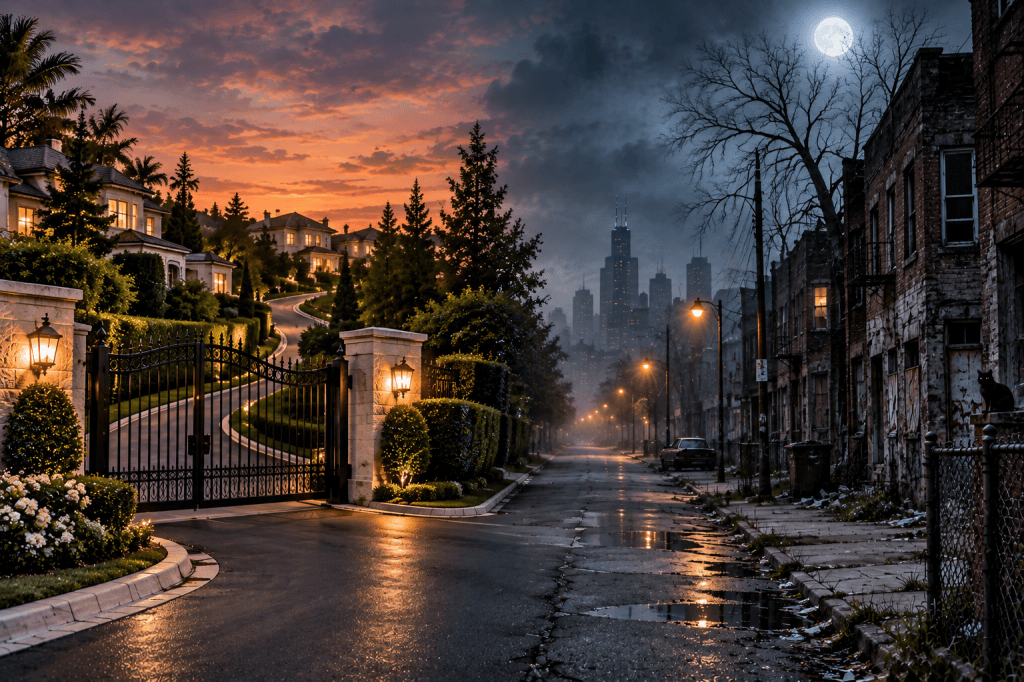
Some neighborhoods have gates. Others absorb everything that passes through. But what if they absorb more than we realize?
September 7, 2026
There was a generation of Americans who learned about their cities from the ten o’clock news.
Another shooting. Another robbery. Another drug bust. Another fire. Another grieving family standing behind police tape.
Night after night, the message seemed obvious:
There goes the neighborhood.
Eventually, whole sections of cities became known as “bad neighborhoods.” And once that label stuck, we didn’t ask many questions about how they got that way.
Were the people simply bad?
Or was something happening to the places where they lived?
Maybe that question is more complicated than we thought.
Two Different Neighborhoods
Drive through almost any metropolitan area and you can cross from one world into another without traveling very far.
In one neighborhood, the lawns are manicured. Streets are quiet. Houses sit back from the road. Cameras watch the driveways. Cars disappear into garages at night.
Sometimes there is an actual gate.
Visitors stop at a guardhouse, give a name and wait for permission to enter. Residents have codes, cards or stickers identifying them as people who belong there.
The message is simple:
Not everyone gets in.
A few miles away, another neighborhood operates very differently.
There may be no gate, no guard and sometimes not much of a boundary between private life and the public street.
Apartment buildings open onto sidewalks. Houses sit close together. Alleys run behind them. People come and go at every hour. Delivery drivers, strangers, neighbors, police cars, ambulances and anyone else traveling through the city can pass within feet of somebody’s bedroom window.
One neighborhood controls access.
The other absorbs traffic from the world around it.
We usually think about that difference in terms of money and crime.
But maybe there is something else worth considering.
What Does a Gate Actually Do?
Obviously, a gate cannot guarantee safety.
Crime happens behind gates. Violence happens in wealthy homes. Addiction, suicide, abuse and tragedy do not check someone’s bank account before entering a neighborhood.
But gates create something human beings have valued for thousands of years:
a boundary.
Walls around cities. Fences around farms. Doors on houses. Locks on bedrooms.
We have always separated inside from outside.
And that separation changes the character of a place.
A gated community limits the number of strangers passing through it. There is less random foot traffic. Fewer people use the streets as shortcuts. Residents are more likely to notice somebody who doesn’t belong.
The environment becomes controlled.
Now consider the opposite.
What happens to a neighborhood that has remained open for generations?
Thousands upon thousands of people pass through.
Families arrive and leave. Businesses open and disappear. Buildings change owners. Apartments turn over again and again.
And life leaves behind more than footprints.
There are marriages and births and birthday parties.
But there are also arguments.
Fear.
Addiction.
Loneliness.
Violence.
And death.
The History Inside a Building
Think about an old apartment building.
Perhaps it has been standing for eighty or a hundred years.
How many people have slept inside those rooms?
How many children were born there?
How many couples fell in love there?
How many people received the worst telephone call of their lives there?
How many died there?
Someone can die in an apartment on Monday.
Eventually the body is removed. The room is cleaned. The walls are painted. The carpet is replaced.
Months later, somebody else moves in.
To the new tenant, it is Apartment 4B.
But Apartment 4B already has a history.
We generally assume that history doesn’t matter unless someone tells us about it.
But what if places remember?
Can a Neighborhood Be Haunted?
This is where the conversation crosses into paranormal territory.
For generations, people have reported houses where footsteps seem to repeat, doors open without explanation, voices are heard in empty rooms or occupants experience the same strange sensation in the same location.
One paranormal theory describes some of these experiences as residual hauntings.
The idea is that an intense event somehow leaves an imprint on a location. What people later experience isn’t necessarily an intelligent ghost trying to communicate. It may be more like a recording being played again.
There is no established scientific evidence demonstrating that buildings can record traumatic human experiences this way.
But it raises an interesting question.
If a house could supposedly retain an imprint, why couldn’t an apartment building?
And if an apartment building could, why couldn’t a block?
Why couldn’t an entire neighborhood?
The Neighborhood That Feels Different
Most of us have experienced a place that simply felt wrong.
Sometimes we can explain it.
Poor lighting.
Abandoned buildings.
Broken windows.
Unfamiliar people watching us.
A street that becomes strangely quiet.
Our brains are extraordinarily good at detecting environmental clues before our conscious minds understand exactly what triggered the warning.
That explanation deserves to come first.
But sometimes there doesn’t seem to be an obvious reason.
You walk into a room and want to leave.
You enter a building and immediately feel uncomfortable.
You drive down a street you’ve never visited and something about it feels heavy.
Then someone tells you what happened there.
And suddenly the feeling seems different.
Coincidence?
Suggestion?
Our subconscious noticing things we didn’t consciously recognize?
Probably, in many cases.
But paranormal history keeps asking the same uncomfortable question:
Could a place carry something from its past?
Open Neighborhoods, Closed Neighborhoods
Now the gated-community comparison becomes more interesting.
A wealthy development doesn’t merely purchase expensive homes.
It purchases separation.
There are walls, landscaping, distance between houses, controlled entrances and fewer outsiders moving through the environment.
Meanwhile, older urban neighborhoods may have spent a century absorbing humanity at full volume.
Thousands of residents.
Thousands of visitors.
Businesses.
Factories.
Bars.
Churches.
Schools.
Hospitals.
Crime.
Celebrations.
Funerals.
Violence.
Love.
Fear.
Generations of emotional experience concentrated into a relatively small geographic area.
If paranormal phenomena are somehow connected to people, places and intense human experiences, then perhaps the question isn’t simply whether a house is haunted.
Maybe density matters.
Maybe history matters.
Maybe repetition matters.
Maybe some neighborhoods have simply experienced more.
What the Ten O’Clock News Didn’t Show
Those old news broadcasts showed us the shooting.
They didn’t show us everything that had happened on that corner during the previous fifty years.
They showed the police carrying someone away.
They didn’t show the thousands of ordinary lives that had passed through the same buildings.
After enough reports, we stopped seeing individual events.
We saw a bad neighborhood.
And perhaps that description was too simple.
Neighborhoods aren’t merely collections of buildings.
They are collections of experiences.
People leave.
Businesses close.
Buildings are demolished.
New families arrive.
The street remains.
Some communities put gates around themselves and carefully control what enters.
Others remain open, taking in generation after generation of humanity and everything that comes with it.
Maybe nothing supernatural happens as a result.
Maybe every strange sensation can ultimately be explained by psychology, environment and coincidence.
But if even a small part of paranormal folklore about places retaining human experiences turns out to be true, then perhaps we’ve been thinking about hauntings on too small a scale.
We keep asking whether the old house at the end of the street is haunted.
Maybe we should occasionally ask about the street itself.
Because before we say “there goes the neighborhood,” perhaps there is another question worth asking:
What has that neighborhood absorbed—and did all of it really leave?
 The ChillX Zone
Leave a comment