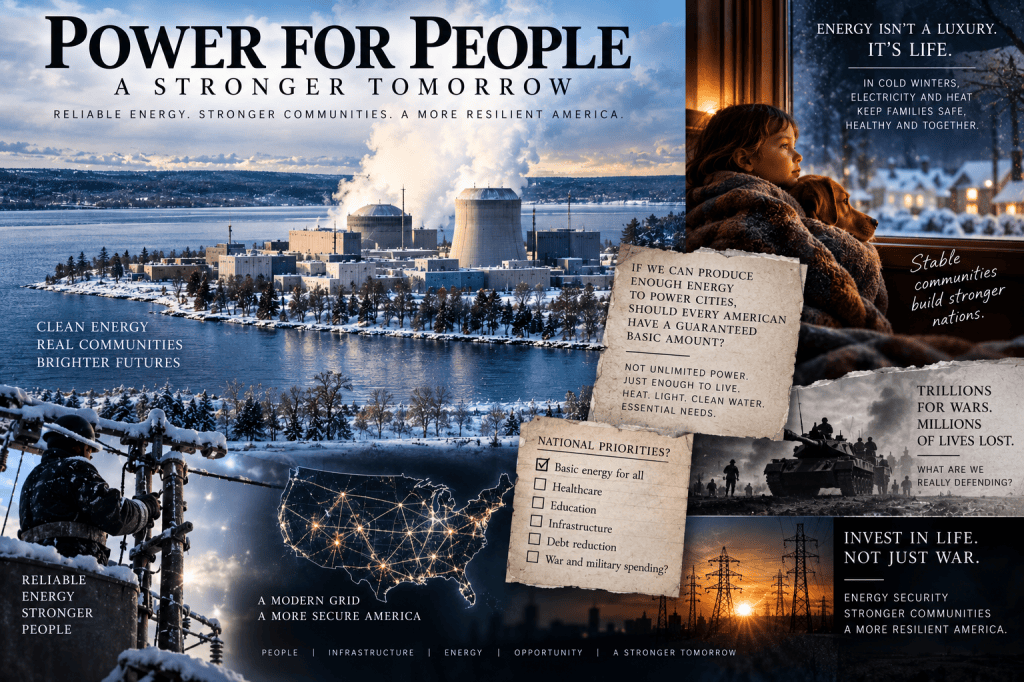
A small community in Upstate New York helps produce enormous amounts of electricity. If energy is essential to surviving an American winter, should every American be guaranteed enough of it to live?
September 12, 2026
Drive north through New York State toward Lake Ontario and eventually you reach Oswego County.
It isn’t New York City.
There are no skyscraper canyons or millions of people packed onto an island.
There are small towns, farms, forests, old industrial communities and a lake so enormous that standing on its shore can sometimes feel like standing beside an ocean.
And then there is winter.
People who have never lived near Lake Ontario may underestimate what that means.
Snow can arrive by the foot.
Wind comes off the lake.
Temperatures fall below freezing.
Homes have to be heated not merely for comfort, but for survival.
Pipes freeze.
Roads disappear beneath snow.
Cars refuse to start.
And for elderly people, children, people with disabilities and families struggling financially, losing electricity or heat during severe weather can become dangerous very quickly.
Yet only a few miles northeast of the city of Oswego sits something remarkable.
One of America’s major concentrations of nuclear power.
Three Reactors Beside One Lake
Near Oswego, in the town of Scriba, stand the two reactors of the Nine Mile Point Nuclear Station and the James A. FitzPatrick Nuclear Power Plant.
Nine Mile Point Unit 1 began commercial operation in 1969.
FitzPatrick followed in the 1970s.
Nine Mile Point Unit 2 came later.
Three operating nuclear reactors eventually stood along this relatively small stretch of Lake Ontario shoreline.
Think about the contrast.
A relatively small Upstate New York community sits beside machinery capable of producing enormous amounts of electricity day and night.
That electricity doesn’t belong only to the people who can see the cooling tower.
It enters a much larger electrical system.
It becomes part of the grid.
And that gives us an interesting question.
What can Oswego teach the rest of America?
Electricity Is Different From Most Products
We talk about electricity as something we purchase.
Use more, pay more.
Use less, pay less.
Economically, that makes sense.
Producing electricity costs money.
Power plants must be constructed.
Workers must be paid.
Transmission lines must be maintained.
Fuel must be acquired.
Nuclear waste must be managed.
Safety systems must be maintained for decades.
Nothing about electricity is actually free.
But electricity is also unlike many ordinary consumer products.
If someone cannot afford a new television, that’s unfortunate.
If someone cannot afford electricity during a bitter January night in Upstate New York, that can become a health emergency.
A refrigerator needs electricity.
Medical equipment may need electricity.
Water systems need power.
Communications depend upon it.
Heating systems often require electricity even when the heat itself comes from natural gas, oil or another fuel.
Modern life doesn’t merely use electricity.
Modern civilization is built around it.
Perhaps we have been asking the wrong question.
Instead of asking:
How much electricity can people afford?
Maybe government should also ask:
How much electricity does a person need in order to safely participate in modern society?
Power as Essential Infrastructure
America has already accepted this principle in other areas.
We build public roads because society functions better when people can move.
We maintain fire departments because waiting until someone’s house is burning to negotiate the price of extinguishing it would be absurd.
We maintain water systems because clean water is essential to public health.
We provide emergency services because some infrastructure becomes too important to treat as an ordinary purchase.
Perhaps energy belongs somewhere in that discussion.
Not unlimited electricity.
Not a blank check.
Not free power for every luxury imaginable.
A household running a swimming pool, charging five vehicles and heating a mansion obviously isn’t the same thing as a family trying to keep the temperature inside their apartment above a dangerous level.
So perhaps the principle should be based on need and essentials.
Every household receives access to a protected baseline amount of energy necessary for heating, refrigeration, lighting, communication and essential medical needs.
Consumption beyond that level remains something people pay for normally.
That would change the question from “free electricity” to something much more practical:
Should America establish an energy floor below which no household is allowed to fall?
Why Nuclear Power Enters the Conversation
This is where Oswego becomes especially interesting.
Nuclear plants are expensive and complicated to build.
They require serious regulation.
Accidents, although rare, can have enormous consequences.
Radioactive waste requires long-term management.
Construction of new plants can take years and sometimes becomes extraordinarily expensive.
Those objections shouldn’t be ignored.
But nuclear energy also has an unusual advantage.
A reactor contains an extraordinary amount of energy in a relatively small amount of fuel.
And once operating, a nuclear plant can generate enormous quantities of electricity around the clock without depending upon whether the sun is shining or the wind is blowing.
That makes nuclear particularly interesting for something civilization needs every hour of every day.
The electrical grid doesn’t get to sleep.
Hospitals don’t stop requiring electricity because it is cloudy.
Homes don’t stop needing heat because the wind stopped blowing.
A modern energy system can combine nuclear, hydroelectricity, solar, wind, storage, natural gas and other technologies.
The question doesn’t have to be which one source should power everything.
The better question is:
What combination gives people the most reliable, affordable and sustainable supply?
America Has Done Public Power Before
There is an especially interesting historical detail about FitzPatrick.
The plant was originally constructed by the New York Power Authority.
In other words, a public authority built a nuclear generating station.
That matters because the idea of government participating directly in large-scale electricity generation isn’t hypothetical.
It already happened.
Public power has a long American history.
The government has built dams.
Public authorities have constructed transmission systems.
Municipal utilities operate electrical networks.
Rural electrification helped bring electricity to places where private economics alone had left communities behind.
So perhaps the twenty-first-century debate shouldn’t be limited to:
Private power or government power?
Perhaps we should ask what each is good at.
Private companies can operate plants and compete for investment.
Government can finance infrastructure whose benefits may extend across generations.
Public authorities can build transmission.
Markets can help determine efficient generation.
And government can establish a minimum level of energy security beneath which citizens aren’t allowed to fall.
It doesn’t have to be one system or the other.
The Nuclear Highway
Imagine taking the Oswego idea much further.
Not one giant federal power company operating every electrical outlet in America.
Instead, imagine a national infrastructure program.
Modern nuclear plants where appropriate.
Existing reactors preserved when they remain safe and economically sensible.
Hydroelectric power where geography permits it.
Solar where sunlight is abundant.
Wind where conditions favor it.
Large-scale storage.
Modern transmission lines capable of moving electricity between regions.
Small modular reactors if that technology ultimately proves economical.
Microgrids around hospitals, emergency centers and critical infrastructure.
The objective would be redundancy.
If one source fails, another carries the load.
If one region experiences extreme cold, electricity can move toward it.
If another experiences extreme heat, the system responds in the opposite direction.
Energy becomes something closer to a national circulatory system.
And then establish a protected essential allowance.
Enough power to keep people alive and connected.
But Who Pays for It?
There is no escaping this question.
Someone always pays.
If government provides essential electricity, taxpayers pay.
If utilities provide it, ratepayers pay.
If government borrows the money, future taxpayers pay principal and interest.
There is no magical energy system without costs.
But that is true of every national priority.
Which means budgets are ultimately statements about values.
Every dollar spent in one place is a dollar that cannot simultaneously be spent somewhere else.
Infrastructure competes with defense.
Healthcare competes with debt service.
Energy competes with education.
Social programs compete with military programs.
And war can consume extraordinary resources.
That doesn’t mean every military expenditure is wasteful.
Countries require defense.
Threats exist.
Sometimes military action may be necessary.
But the existence of legitimate defense needs doesn’t eliminate the responsibility to ask what opportunity costs accompany decades of military commitments.
What Are We Defending?
This connects directly with the questions we’ve been asking over the last several days.
What is national security?
Usually we imagine soldiers.
Aircraft.
Ships.
Missiles.
Borders.
Intelligence agencies.
But suppose an elderly American freezes to death because the heat was disconnected.
Suppose a family loses electricity during a severe winter storm.
Suppose an electrical grid becomes so unreliable that hospitals require emergency generators to remain functional.
Suppose millions of households must choose between food and heating.
Is that merely an economic problem?
Or is it also a national-security problem?
A country isn’t secure simply because its military is powerful.
A secure country also needs food.
Water.
Energy.
Infrastructure.
Housing.
Communications.
Healthcare.
And people capable of surviving the climate where they live.
Maybe national security begins much closer to home than we sometimes imagine.
The Cost of War and the Cost of Life
Wars produce costs that are easy to understand in the abstract and almost impossible to comprehend individually.
Trillions can be spent.
Equipment can be destroyed.
Cities can be damaged.
Veterans can return with injuries that require lifelong care.
Civilians die.
Soldiers die.
Families on every side live with the consequences.
And borrowed money continues accumulating interest after the fighting ends.
Now compare that with another type of national investment.
A nuclear plant can operate for decades.
A transmission line can serve generations.
A modernized electrical grid can strengthen thousands of communities simultaneously.
Weatherization can reduce household energy consumption year after year.
Energy storage can make grids more resilient.
Those investments aren’t free either.
But they leave behind infrastructure.
That’s worth thinking about whenever governments decide where national resources should go.
What Could We Learn From Oswego?
Perhaps the lesson isn’t simply that America should build hundreds of nuclear reactors.
That would be too easy.
The lesson may be that enormous amounts of reliable energy can originate in places most Americans rarely think about.
A small community beside Lake Ontario can become part of the machinery keeping an entire region functioning.
And perhaps communities like Oswego should make us reconsider what electricity actually represents.
Commodity?
Utility?
Public resource?
National infrastructure?
Basic necessity?
Maybe it is all of them.
A Different Definition of National Security
There will always be arguments about nuclear energy.
There should be.
Safety matters.
Waste matters.
Cost matters.
Environmental impact matters.
Government accountability matters.
Private-sector accountability matters.
But beneath those arguments is a much simpler reality.
A person living through an Upstate New York winter doesn’t experience electricity as an economic theory.
They experience it when the furnace starts.
When the refrigerator stays cold.
When the lights come on.
When a phone charges.
When a medical device continues operating.
When a child sleeps through a freezing night in a warm room.
Perhaps that’s where our question needs to be refixed.
Not:
Should government give everyone free nuclear power?
And not:
Should government control the entire electrical system?
Instead:
If America possesses the technology, resources and wealth to produce enormous quantities of energy, should any American be denied the minimum energy necessary to safely live?
Then comes the harder question.
If the answer is no, we have to decide what we’re willing to build.
Reactors.
Transmission.
Renewables.
Storage.
Weatherization.
Emergency systems.
Whatever combination works.
And we have to decide what we’re willing to spend.
Because governments always find money for the things they define as essential.
Maybe the lesson from that small community beside Lake Ontario is that we need to reconsider what essential actually means.
Perhaps keeping the country powered isn’t merely an energy policy.
Perhaps keeping its people warm, alive and connected is one of the most basic forms of national defense there is.
 The ChillX Zone
Leave a comment