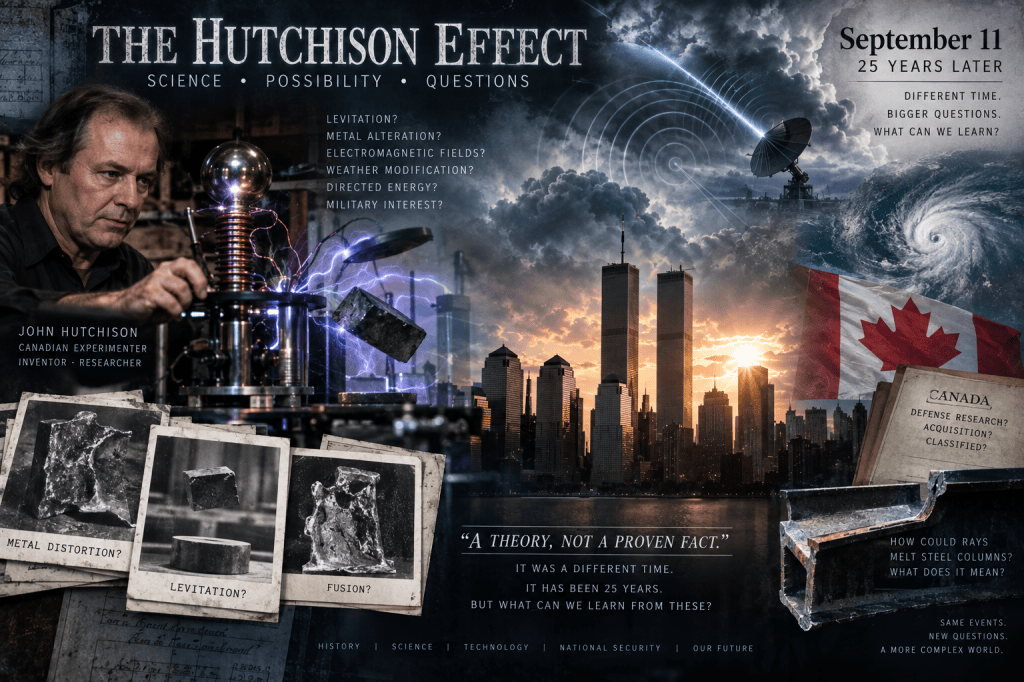
Levitation, distorted metal, electromagnetic fields and government interest became part of an extraordinary story. Twenty-five years after September 11, what can we actually learn from it?
September 11, 2026
Twenty-five years have passed since September 11, 2001.
For those old enough to remember that morning, twenty-five years can seem impossible.
It was a different technological world.
There were no smartphones in everyone’s pockets recording events from a dozen angles. Social media as we know it didn’t exist. Broadband internet was still spreading. YouTube didn’t exist. Information traveled differently, and extraordinary claims could circulate for years through television programs, VHS tapes, magazines, conferences and word of mouth.
That matters when examining one of the stranger technological stories sometimes connected—usually speculatively—to discussions surrounding September 11.
It is called the Hutchison Effect.
Before going further, we need to establish something clearly.
There is no established scientific evidence that the Hutchison Effect caused, contributed to, or explains the destruction of the World Trade Center.
There is also no established evidence that Hutchison developed a functioning weather-control weapon or a directed-energy system capable of producing the events witnessed on September 11.
Those ideas belong to theory and speculation.
But the Hutchison story itself is real enough to examine.
And it raises some fascinating questions about electromagnetic energy, unusual experiments, government interest and what science should do when confronted with extraordinary claims.
Who Was John Hutchison?
John Hutchison was a Canadian experimenter from British Columbia with a fascination for electricity, radio equipment and the work of Nikola Tesla.
Beginning around 1979, Hutchison assembled an unusual laboratory from high-voltage and radio-frequency equipment.
Accounts of his apparatus describe combinations of Tesla coils, Van de Graaff generators, radio-frequency sources, high-voltage transformers, signal generators and other electronics.
Rather than studying a single machine operating under carefully isolated conditions, Hutchison experimented with multiple electromagnetic sources operating in the same environment.
Then he claimed strange things began happening.
Objects allegedly moved without obvious physical contact.
Some reportedly lifted from surfaces.
Metal samples supposedly fractured or distorted.
Different materials appeared to fuse together.
Some samples were described as becoming unusually soft or undergoing strange structural changes.
Lights, fires and other electrical anomalies were also reported.
Collectively, these alleged phenomena became known as the Hutchison Effect.
The Metal Is Particularly Interesting
Of all the claims, the metal experiments attracted some of the most attention.
Photographs and videos attributed to Hutchison show metal samples twisted, fractured or strangely deformed.
Supporters claimed some specimens displayed changes that seemed difficult to produce through ordinary heating or mechanical force.
That naturally leads to questions about electromagnetic energy and metals.
We already know, without invoking anything paranormal, that electromagnetic energy can interact with conductive materials.
Induction heating is real.
Microwave heating is real.
Electrical arcs are real.
Lasers can heat and cut materials.
Powerful radio-frequency systems can produce interference and heating under appropriate circumstances.
Industrial systems can melt metal without putting it into a traditional flame.
None of that proves the Hutchison Effect.
But it establishes an important principle:
Energy does not have to look like fire to heat or damage material.
The scientific question is always about mechanism, energy, frequency, power, exposure time and reproducibility.
Could a “Ray” Melt Steel?
In principle, absolutely.
We already possess technologies capable of delivering enough concentrated energy to heat, cut or melt steel.
But that statement can easily become misleading.
Showing that some directed-energy technology can damage steel does not demonstrate that an unknown directed-energy weapon destroyed a particular building.
Those are completely different claims.
To establish the second proposition, investigators would need evidence identifying the energy source, its location, required power, delivery mechanism, characteristic effects on materials and measurements consistent with its operation.
That evidence has not established a Hutchison-type mechanism for the World Trade Center destruction.
So when photographs of unusual Hutchison metal samples are placed beside photographs of damaged structural steel, visual resemblance isn’t enough.
Science needs considerably more.
It needs a mechanism.
Interference
There is another reason the Hutchison experiments fit the subjects we’ve been exploring this week.
Interference.
Hutchison wasn’t claiming that one magical machine produced everything.
His story centered on multiple electrical and electromagnetic systems interacting.
Think about several waves traveling through the same environment.
At some locations they reinforce one another.
At others they partially cancel.
Complex combinations can create patterns considerably different from any individual source.
Interference itself is ordinary physics.
The extraordinary part of Hutchison’s claim was that his particular combination of fields supposedly produced macroscopic effects conventional physics would not predict from the apparatus as described.
Levitation.
Metal disruption.
Unusual fusion.
Objects moving violently.
That’s where evidence becomes essential.
Because the more extraordinary the effect, the more important controlled replication becomes.
Did Canada Investigate Him?
This part of the story becomes murky.
Hutchison and sources sympathetic to him describe visits and demonstrations involving people connected with Canadian defense and American military or government interests.
His own historical account claims that Canadian defense scientific personnel investigated his laboratory during the 1980s.
There are also longstanding stories about his equipment being seized or removed while he was outside Canada.
But we should be careful with the word “acquired.”
There is a major difference between government personnel examining an experiment, equipment being seized during a dispute, and a government secretly acquiring a working technology for military development.
The first two have been alleged with varying levels of documentation.
The third requires much stronger evidence.
And that distinction matters.
Government interest does not prove that a technology works.
Governments investigate strange ideas too.
Military organizations have a particularly good reason to investigate unusual technological claims.
Imagine someone tells a defense agency:
“I can make a 500-kilogram object levitate.”
There are two possibilities.
He’s wrong.
Or he isn’t.
If he’s wrong, an investigation might establish that fairly quickly.
But if there were even a small possibility he was right, the implications would be enormous.
Propulsion.
Transportation.
Materials science.
Weapons.
Aerospace.
Energy.
So government curiosity alone shouldn’t surprise us.
The important question is what investigators actually found.
And Then Comes Weather
The Hutchison story eventually became connected in alternative literature with an even larger family of ideas involving electromagnetic manipulation of the atmosphere.
This is where we need another important distinction.
Weather modification is real.
Cloud seeding has existed for decades.
Atmospheric research involving radar, radio waves, satellites and electrical phenomena is also real.
But real weather-modification research does not automatically validate claims about secret machines capable of steering hurricanes, creating earthquakes or generating destructive beams from the atmosphere.
Those are enormous additional claims.
The same scientific rule applies.
What is the mechanism?
Where is the energy coming from?
How much energy is required?
What measurements should the process produce?
Can those measurements be detected?
Can the experiment be repeated?
Why September 11 Became Attached to These Ideas
After September 11, people began trying to explain things they believed conventional explanations didn’t adequately address.
Some looked at explosives.
Others examined structural engineering.
Others investigated intelligence failures.
And still others began searching through unconventional technologies.
Directed energy.
Tesla-inspired systems.
Electromagnetic weapons.
Weather modification.
The Hutchison Effect.
Over time, separate subjects sometimes became woven together into one enormous theory.
But scientific investigation requires us to pull them apart again.
A technology existing does not establish that it was used.
A government studying something doesn’t establish that it works.
A witness seeing something unusual doesn’t establish its cause.
A strangely damaged piece of metal doesn’t identify what damaged it.
And a theory becoming popular doesn’t make it experimentally demonstrated.
The Experiment Hutchison Never Completed
This may be the most important part of the entire Hutchison story.
The great weakness isn’t that his claims were strange.
Science has encountered strange observations before.
The weakness is replication.
A genuine physical effect should eventually be reproducible under controlled conditions by researchers who don’t need Hutchison standing beside the equipment.
Write down the apparatus.
Document every frequency.
Measure every field.
Measure input power.
Control temperature.
Record continuously from multiple cameras.
Secure the test objects before and after experimentation.
Have independent laboratories analyze the materials.
Then give another laboratory the instructions.
If they reproduce the effect, things become extremely interesting.
If ten laboratories reproduce it, textbooks may need another chapter.
But the surviving Hutchison record has not produced that level of independent, controlled replication.
That doesn’t prove every video was fraudulent.
It means something more precise:
The claimed physical phenomenon remains unestablished.
And twenty-five years later, that distinction is important.
2001 Was a Different World
Perhaps this is something we sometimes forget when looking backward.
September 11 happened at the boundary between two technological eras.
In 2001, extraordinary footage might appear briefly on television and then become difficult for ordinary people to locate.
Government documents were harder to search.
Scientific papers weren’t instantly accessible from a phone.
Video manipulation existed, but today’s synthetic-media environment did not.
Independent researchers communicated through websites, mailing lists, radio programs, conferences and physical tapes.
Today we have vastly better tools.
High-speed cameras.
Thermal imaging.
Portable spectrum analyzers.
Sensitive magnetometers.
Air-quality sensors.
Radiation detectors.
Drones.
Satellite imagery.
Massive computing power.
And nearly everyone carries a high-resolution video camera.
If someone today claims to have discovered a Hutchison Effect, the standard should therefore be considerably higher.
Don’t show us a mysterious thirty-second video.
Show us the experiment.
What Can We Learn Twenty-Five Years Later?
Maybe that’s the appropriate September 11 question.
Not:
Which theory should we believe?
But:
What have twenty-five years taught us about investigating extraordinary events?
Preserve the evidence.
Record witness testimony.
Separate observation from interpretation.
Don’t confuse government interest with scientific validation.
Don’t confuse theoretical possibility with evidence that something actually occurred.
Don’t dismiss an anomaly merely because it is inconvenient.
And don’t accept an extraordinary explanation merely because it is exciting.
Most importantly:
Make it reproducible.
If an electromagnetic arrangement can levitate objects, demonstrate it.
If it can alter metal without conventional heating, measure it.
If atmospheric electromagnetic systems can substantially modify weather, quantify the mechanism.
If directed energy can produce a particular form of structural damage, calculate the required energy and identify the physical signatures it should leave behind.
Then invite independent scientists to try to prove you wrong.
That’s how an extraordinary claim becomes science.
Twenty-Five Years
Today isn’t the day to turn human tragedy into entertainment.
Nearly three thousand people died on September 11.
Thousands more have lived with its consequences.
Wars followed.
Technology changed.
Governments changed.
Surveillance changed.
And the way ordinary people encounter information changed almost beyond recognition.
Twenty-five years later, perhaps one lesson is that skepticism must work in both directions.
We shouldn’t automatically believe an extraordinary theory because it challenges an official explanation.
But neither should we be frightened by unconventional questions simply because they challenge what we already believe.
John Hutchison claimed that interacting electromagnetic fields could produce effects that appeared impossible.
Maybe his observations had ordinary explanations.
Maybe some were experimental artifacts.
Maybe some were misunderstood.
Maybe better-controlled experiments would have revealed something genuinely interesting.
After all these years, the evidence available publicly still doesn’t establish the extraordinary Hutchison Effect as reproducible physics.
And that itself is a lesson.
Science isn’t about believing Hutchison.
It isn’t about disbelieving Hutchison.
It is about constructing an experiment in which belief no longer matters.
Twenty-five years after September 11, perhaps that is something worth remembering.
Theories come and go.
Technology advances.
Governments change.
But the question remains the same:
What can we demonstrate?
 The ChillX Zone
Leave a comment