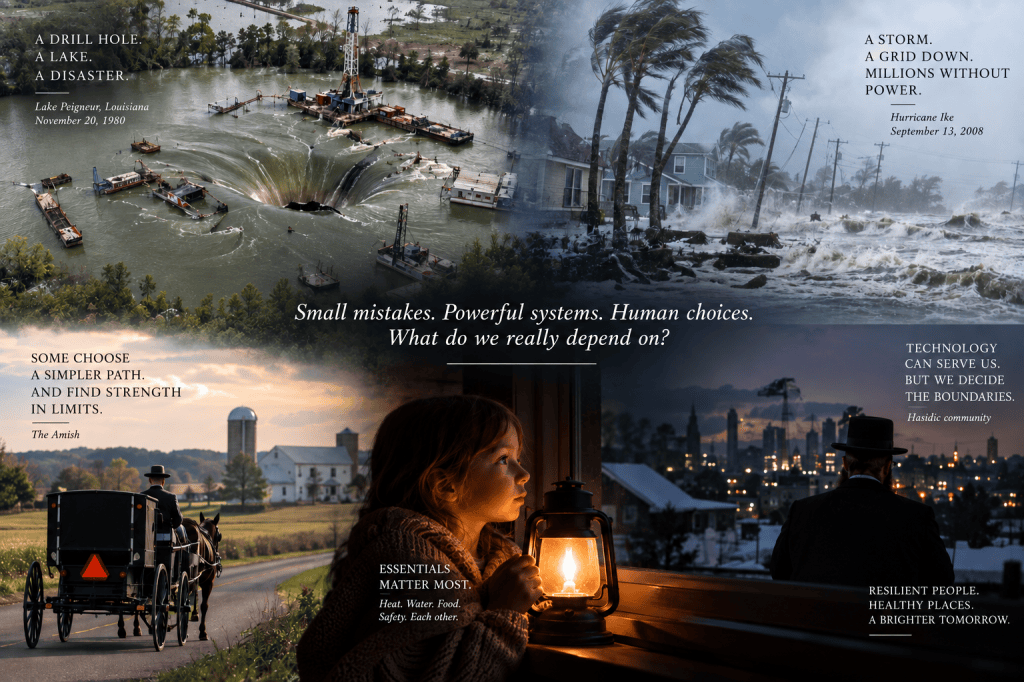
A misplaced drill drained a lake. A hurricane turned off millions of lights. Some communities deliberately limit technology before it can become indispensable. What do these very different stories teach us about the systems we depend upon?
September 13, 2026
Sometimes the biggest disasters begin with very small mistakes.
A measurement.
A coordinate.
A decision made in an office.
A hole drilled in the wrong place.
On November 20, 1980, workers were drilling for oil beneath Lake Peigneur in southern Louisiana.
Lake Peigneur was not an enormous lake.
It was a shallow freshwater lake near New Iberia, surrounded by a landscape where industry and nature had existed beside one another for decades.
Oil drilling occurred there.
And underneath the lake was something else.
Salt.
A great underground salt formation had been mined beneath Jefferson Island for decades.
Above was water.
Below were tunnels.
And between them was rock.
Until something went terribly wrong.
The Hole
The drilling operation penetrated the underground salt mine.
Water found the opening.
That sounds almost insignificant.
A drill hole.
A lake.
A mine.
But water and salt have a particularly important relationship.
Salt dissolves.
Once lake water began entering the mine, the opening didn’t necessarily remain the size of the original hole.
Water dissolved salt.
The passage enlarged.
More water entered.
More salt dissolved.
The opening became larger still.
A process that began on the scale of drilling equipment transformed into something vastly larger.
The lake began disappearing underground.
A vortex formed.
Equipment was swallowed.
Barges were pulled toward it.
The normal flow of the nearby Delcambre Canal eventually reversed as water from the Gulf of Mexico was drawn toward the rapidly draining lake.
For a time, Louisiana had something resembling a giant drain in the Earth.
The University of Louisiana at Lafayette’s historical collection dates the Lake Peigneur disaster to November 20, 1980 and preserves footage and accounts of the extraordinary event.
Remarkably, the miners escaped.
So did the drilling crew.
Despite the scale of the catastrophe, there were no reported human deaths.
But the landscape changed.
A shallow freshwater lake became a much deeper body of water connected to saltwater.
An industrial mistake had altered an ecosystem.
And it provides us with one of the strangest demonstrations of a principle we should probably think about more often:
Small actions can enter large systems.
And large systems can amplify them.
One Hole Was Enough
This is what makes Lake Peigneur so fascinating.
The disaster didn’t require somebody to deliberately drain a lake.
Nobody needed to construct an enormous machine capable of swallowing barges.
Nobody needed to design a whirlpool.
The system did most of the work.
Gravity already existed.
The water was already there.
The mine was already there.
The salt was already soluble.
The canal was already connected to another body of water.
All that was required was for things that were supposed to remain separated to become connected.
After that, physics took over.
That may be the real lesson.
Sometimes the danger isn’t the amount of energy contained in the original mistake.
It is the amount of energy already stored in the surrounding system.
A tiny failure can open the door.
The system supplies the catastrophe.
September 13, 2008
Twenty-eight years later, another enormous system was tested.
This time the system was electrical.
And the force wasn’t an industrial accident.
It was nature.
On September 13, 2008, Hurricane Ike made landfall near Galveston, Texas, as a Category 2 hurricane with winds around 110 miles per hour.
Transmission lines went down.
Generating units went offline.
Electrical infrastructure was damaged across the region.
ERCOT later reported that more than 100 high-voltage transmission lines and 36 generating units were initially knocked out of service, affecting approximately 2.1 million customers in the ERCOT region.
Millions of people suddenly discovered something most of us rarely consider.
Electricity is invisible when it works.
Its absence is impossible to ignore.
When Electricity Disappears
A modern house doesn’t merely contain electrical conveniences.
It is often designed around electricity.
The refrigerator requires it.
Communication requires it.
Internet equipment requires it.
Many heating systems require it even when natural gas, oil or propane supplies the actual heat.
Air conditioning requires it.
Medical devices may require it.
Water pumps may require it.
Traffic signals require it.
Stores require it.
Electronic payments require it.
Fuel stations generally require it.
Hospitals require enormous quantities of it and therefore maintain backup systems precisely because losing electricity can become a matter of life and death.
Take away electricity and modern civilization doesn’t instantly disappear.
But layers begin peeling away.
The longer the outage lasts, the more serious the consequences become.
A few minutes is annoying.
Several hours can become difficult.
Several days can become dangerous.
In extreme heat or extreme cold, the clock begins running much faster.
Two Disasters, One Principle
Lake Peigneur and Hurricane Ike seem unrelated.
One involved drilling.
The other involved weather.
One changed a lake.
The other damaged an electrical system.
But underneath both stories is the same problem.
Complex systems create dependencies.
At Lake Peigneur, the lake, salt mine, drilling operation and canal became accidentally connected.
During Hurricane Ike, millions of households and businesses discovered how many systems were connected to electricity.
The more interconnected a system becomes, the more powerful it can become.
But interconnection can also create vulnerability.
A failure in one place travels somewhere else.
That brings us to a group of Americans who have spent generations thinking about exactly that problem.
Why Don’t the Amish Simply Plug In?
The Amish are sometimes described as rejecting technology.
That’s too simplistic.
Different Amish communities permit different technologies.
Some use batteries.
Some use generators.
Some use pneumatic or hydraulic equipment.
Some use forms of solar power.
Rules differ considerably between communities.
The deeper question isn’t necessarily whether electricity itself is evil.
It is what happens when a community connects itself permanently to a technological system outside its control.
The electrical wire doesn’t bring only light.
Once connected, it can bring appliances.
Radio.
Television.
Computers.
The internet.
Entertainment.
Advertising.
Consumer culture.
And now smartphones, social media and artificial intelligence.
Technology rarely arrives alone.
It creates pathways for additional technologies.
The Amish recognized something modern society sometimes forgets:
Before adopting a technology, ask what else comes through the door with it.
The Hasidic Example Is Different
Hasidic and other observant Jewish communities provide another interesting example, although for completely different religious reasons.
They generally don’t reject electricity.
Modern electrical appliances can be present throughout the home.
But Shabbat establishes boundaries around human interaction with technology.
Lights may be prepared beforehand.
Timers may operate electrical systems automatically.
Heating and cooling can continue.
Refrigeration can continue.
The technology doesn’t necessarily disappear.
Instead, human interaction with it changes.
For roughly one day each week, a boundary appears.
And perhaps there is something worth considering in that idea even outside religion.
Not every technology needs to be available every second merely because it can be.
Sometimes civilization benefits from saying:
Enough.
The Question Isn’t Whether Electricity Is Bad
Electricity isn’t the villain in this story.
Neither is drilling.
Neither is industry.
Neither is technology.
Modern energy systems have saved and improved countless lives.
Electricity refrigerates food and medicine.
It operates hospitals.
It pumps clean water.
It heats and cools buildings.
It enables emergency communication.
Industrial technology produces materials that make modern civilization possible.
Oil and gas helped build the industrial world.
Nuclear power can produce enormous quantities of electricity from comparatively small quantities of fuel.
Technology is extraordinarily useful.
But usefulness can become dependency.
And dependency changes the consequences of failure.
The Amish Can Lose the Grid Differently
Imagine two houses during a massive blackout.
One is a conventional modern house.
Everything has been designed with the assumption that electricity will always be available.
The other belongs to a community that never accepted that assumption.
Which household notices the blackout first?
The question isn’t meant to romanticize Amish life.
Living with limited grid electricity involves compromises most Americans wouldn’t accept.
But there is an engineering principle hidden inside that lifestyle:
Don’t make one system responsible for everything.
Engineers call something similar redundancy.
If one component fails, another can continue performing the essential function.
Hospitals understand this.
That’s why they have emergency generators.
Aircraft understand it.
Critical systems may have backups.
Computer networks understand it.
Data can be duplicated.
Why shouldn’t households and communities think similarly?
Heat Changes the Argument
This takes us directly back to yesterday’s discussion about nuclear power in Upstate New York.
Imagine January near Lake Ontario.
Snow is falling.
The temperature is far below freezing.
Now remove electricity.
The question isn’t whether someone can watch television.
The question becomes whether the house can remain warm.
And that forces us to distinguish between two things that we often combine.
Energy consumption.
And:
essential energy.
Nobody needs unlimited electricity.
Nobody has an unlimited right to consume resources without cost.
But a minimum amount of energy can become necessary for survival.
Heat.
Safe cooling during extreme heat.
Refrigeration.
Water.
Basic lighting.
Communication.
Essential medical equipment.
Perhaps the government shouldn’t guarantee unlimited electricity.
Perhaps it should guarantee that no household falls beneath an essential energy floor.
But Resilience Matters Too
Simply promising electricity isn’t enough.
Lake Peigneur teaches us why.
Systems fail.
Sometimes because of nature.
Sometimes because of equipment.
Sometimes because of poor planning.
Sometimes because of human error.
Sometimes because somebody drills in the wrong place.
So perhaps an essential-energy policy should have two parts.
The first is access.
People should have enough energy to remain safe.
The second is resilience.
Communities should be capable of surviving when the primary system fails.
Microgrids.
Backup generation.
Home batteries.
Community warming and cooling centers.
Local power generation.
Weatherized homes.
Multiple sources of electricity.
Protected fuel supplies.
Emergency communication systems.
A civilization shouldn’t merely ask:
How much power can we generate?
It should ask:
What happens when the power isn’t there?
Small Mistakes, Enormous Consequences
Lake Peigneur provides the warning.
A relatively small industrial error interacted with geology and produced an ecological transformation.
Hurricane Ike provides another warning.
A natural disaster struck infrastructure upon which millions had become dependent.
The Amish provide a third perspective.
Dependency itself can be limited deliberately.
And Shabbat provides another.
Technology can remain useful without being allowed to occupy every moment of human existence.
These aren’t identical stories.
They shouldn’t be forced into becoming identical stories.
But together they ask a remarkably important question.
How much control should we surrender to the systems we build?
Progress Needs Brakes
Human beings are very good at acceleration.
Build it bigger.
Make it faster.
Produce more.
Connect everything.
Automate everything.
Drill deeper.
Generate more power.
Process more information.
But civilization also needs brakes.
Environmental reviews are brakes.
Engineering redundancy is a brake.
Building codes are brakes.
Nuclear safety systems are brakes.
Religious restrictions can function as cultural brakes.
Personal boundaries are brakes.
Government regulation can be a brake.
Sometimes brakes feel inefficient.
Until the moment you need them.
Then they become the most important part of the machine.
The Ecological Question
Lake Peigneur adds something particularly important to our discussion of energy.
Humans aren’t the only ones living inside these systems.
A lake isn’t merely a container of water.
It is habitat.
Water chemistry matters.
Depth matters.
Temperature matters.
Plants matter.
Fish matter.
Microorganisms matter.
Connections to surrounding waterways matter.
Change one variable dramatically enough and the ecosystem itself changes.
Industrial development therefore creates responsibilities extending beyond immediate human economics.
A project can create jobs.
Produce energy.
Generate tax revenue.
Supply necessary materials.
And still create risks that must be measured honestly.
The question isn’t:
Industry or environment?
Civilization requires both industry and functioning ecosystems.
The real question is whether we are intelligent enough to understand where one system ends before accidentally connecting it to another.
The Most Dangerous Words
Perhaps some of the most dangerous words in technological civilization are:
It’ll probably be fine.
Most of the time, it is.
Millions of wells are drilled without draining lakes.
Millions of electrical components operate every day without blackouts.
Millions of machines perform exactly as designed.
That’s why modern civilization works.
But rare failures matter precisely because the systems surrounding them have become so large.
Risk isn’t simply:
How likely is something to go wrong?
It is also:
What happens if it does?
A one-in-a-million event capable of harming millions deserves different consideration than a one-in-a-million event that ruins someone’s afternoon.
Probability matters.
Consequences matter too.
September 13
So perhaps today’s lesson isn’t really about electricity.
It isn’t about the Amish.
It isn’t about Hasidic Judaism.
It isn’t about hurricanes.
And it isn’t even about a Louisiana lake that disappeared into a salt mine in 1980.
It’s about systems.
The systems we inherit.
The systems we construct.
The systems we connect ourselves to.
And the systems we eventually become unable to live without.
Hurricane Ike reached Texas on September 13, 2008 and demonstrated how quickly electrical infrastructure can disappear.
Lake Peigneur demonstrated something different twenty-eight years earlier.
Sometimes catastrophe doesn’t require enormous force at the beginning.
Sometimes all it requires is a small opening in the wrong place.
Then the system supplies the force.
Maybe that is what communities skeptical of unrestricted technology have been trying to tell the modern world in their own ways.
The answer isn’t to abandon electricity.
It isn’t to abandon industry.
It isn’t to stop drilling, building, generating or inventing.
It is to remember that progress without boundaries eventually creates dependencies, and dependencies create consequences.
Provide the essentials.
Build the power plants.
Keep homes warm.
Keep hospitals running.
Protect the grid.
Build backups.
Protect the environment.
Inspect before drilling.
Measure before assuming.
And perhaps occasionally disconnect from the machines long enough to remember why we built them.
Because technology is supposed to serve civilization.
Civilization isn’t supposed to become the life-support system for technology.
The question isn’t whether we can live without electricity.
The better question is:
Can we build a society advanced enough to use enormous power without becoming helpless when that power fails—or destroying the systems around us when one small mistake gets through?
Lake Peigneur tells us what one hole can do.
Hurricane Ike tells us what one storm can do.
Communities that deliberately place boundaries around technology remind us that sometimes restraint is itself a form of engineering.
Maybe the safest system isn’t the one that can never fail.
Maybe it’s the one designed with the humility to know that someday, somehow, something will.
 The ChillX Zone
Leave a comment