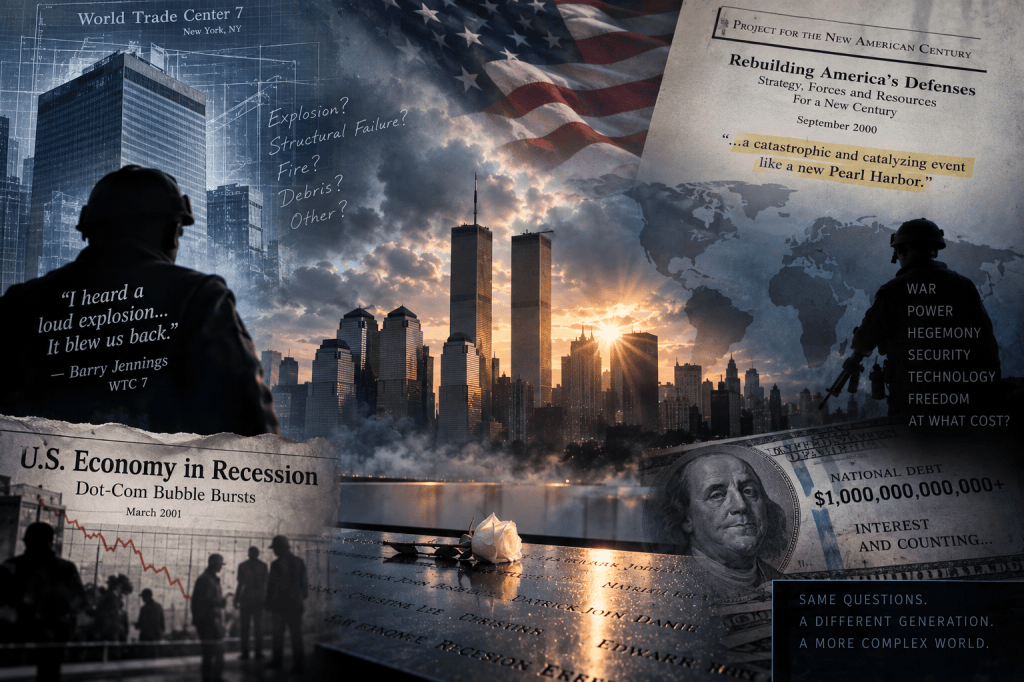
Science records what happened before deciding what it means. Twenty-five years later, are we still willing to examine every piece of the record?
September 10, 2026
Tomorrow is September 11.
Before going any further, there is something that needs to be said.
Nearly three thousand people were killed on September 11, 2001. Families lost parents, children, husbands, wives, brothers, sisters and friends. Firefighters, police officers and other first responders entered buildings while thousands of other people were trying desperately to escape them.
Nothing about questioning the history of that day should diminish those lives.
In fact, perhaps the opposite should be true.
If an event is important enough to send a nation to war, reorganize its security apparatus, transform surveillance, alter foreign policy and influence generations of Americans, then surely it is important enough to examine carefully.
And that brings us to science.
Science Doesn’t Begin With the Answer
What does a scientist actually do?
Observe.
Measure.
Record.
Repeat when possible.
Preserve evidence.
Document unexpected results.
Develop competing hypotheses.
Compare those hypotheses against the evidence.
And perhaps most importantly, scientists are supposed to pay attention when something happens that they did not expect.
Imagine conducting an experiment one hundred times.
Ninety-nine trials produce the expected result.
One does something completely different.
A poor investigator throws out the strange result because it interferes with the conclusion.
A scientist asks:
What happened in trial number one hundred?
Maybe the instrument malfunctioned.
Maybe the sample was contaminated.
Maybe somebody made a mistake.
Maybe an environmental variable changed.
Or maybe the anomaly is trying to tell us that our original understanding was incomplete.
Until it is investigated, we don’t know.
That principle shouldn’t disappear simply because the subject is September 11.
The Man Inside WTC 7
One name worth remembering is Barry Jennings.
Jennings was a New York City Housing Authority emergency-management official. On September 11, he and New York City Corporation Counsel Michael Hess entered World Trade Center Building 7.
WTC 7 was not one of the Twin Towers.
It was the 47-story building north of the main complex that collapsed later that afternoon.
Jennings described attempting to descend the building after reaching the emergency operations center. During that descent, he reported a violent event around the sixth-floor area.
He described it as an explosion.
Jennings said the event damaged the stairway and threw the men back, forcing them upward, where they became trapped.
That statement does not scientifically establish that explosives were planted in the building.
But neither does science require us to pretend the testimony never existed.
The observation gets recorded first.
Then we ask what caused it.
Was Jennings experiencing the consequences of structural damage?
Falling debris?
A fuel-related event?
Electrical equipment?
A localized explosion unrelated to demolition?
Some combination of events occurring inside a severely damaged building?
Or something investigators failed to identify?
Those are hypotheses.
The witness account is the observation.
There is an important difference.
What the Official Investigation Concluded
The National Institute of Standards and Technology eventually concluded that uncontrolled fires in WTC 7 led to thermal expansion and a sequence of structural failures, beginning around a critical interior column and progressing into the building’s global collapse.
NIST also considered whether explosives could have caused the collapse.
Its conclusion was no.
NIST stated that it found no evidence of a blast event capable of causing the collapse and argued that an explosion powerful enough to fail the critical column would have produced an extraordinarily loud sound that should have been heard over a substantial distance.
That conclusion deserves to be represented accurately.
But Jennings’ experience remains part of the historical record too.
And that is precisely where science becomes interesting.
The proper question isn’t:
Which side am I supposed to believe?
The proper questions are:
What exactly did Jennings experience?
At what time did it occur?
What physical mechanisms could produce what he described?
What evidence survived?
What evidence did not survive?
Can those observations be reconciled with the eventual explanation?
And if they can, how?
That’s investigation.
An unexplained observation isn’t automatically evidence of conspiracy.
But neither should an inconvenient observation automatically become irrelevant because an investigation reached a broader conclusion.
Why Wouldn’t This Be Important?
That may be the most important question.
Why wouldn’t testimony from someone trapped inside one of the buildings be worth examining?
Scientists don’t normally decide that observations matter only when they support the expected result.
Aviation investigators collect witness accounts.
Accident investigators examine unusual sounds.
Doctors record unexpected symptoms.
Engineers study failures.
Chemists investigate contamination.
Physicists investigate anomalous measurements.
Sometimes the anomaly turns out to be nothing.
But we discover that by investigating it—not by being afraid to ask about it.
September 11 deserves at least that standard.
Perhaps it deserves a higher one.
Because the consequences extended far beyond Lower Manhattan.
America Before September 11
Another misconception is that America was economically cruising along perfectly until the attacks suddenly changed everything.
It wasn’t.
The United States was already in recession.
The National Bureau of Economic Research dates the beginning of the 2001 recession to March 2001, six months before September 11.
The enormous technology boom of the late 1990s had broken.
Internet companies that had attracted extraordinary valuations disappeared.
Investments collapsed.
Stock-market wealth evaporated.
Businesses reduced spending.
Employment weakened.
The technological revolution had promised a new economy.
Then reality arrived.
This was absolutely not another Great Depression. The 2001 recession lasted eight months and was actually somewhat shorter than the average postwar recession.
But something important was happening before the attacks.
America was already going through an economic and technological adjustment.
And perhaps that deserves more attention when we study what came afterward.
What Happens When Technology Advances Faster Than Society?
Technology doesn’t merely give us better machines.
It reorganizes power.
The industrial revolution changed labor.
Railroads changed geography.
Radio changed politics.
Television changed culture.
Nuclear weapons changed warfare.
Computers changed information.
The internet changed nearly everything.
By the beginning of the twenty-first century, humanity had acquired technological capabilities that previous generations could barely have imagined.
Global communications.
Satellites.
Precision weapons.
Digital finance.
Massive databases.
Advanced surveillance.
Networked computing.
Automation.
Rapidly developing unmanned systems.
Information itself was becoming a strategic resource.
But technological advancement creates another problem.
What happens when we invent capabilities faster than our political and economic systems know what to do with them?
Technology can create prosperity.
It can also eliminate jobs.
Technology can democratize information.
It can also centralize surveillance.
Technology can connect humanity.
It can also make warfare more remote.
Technology can make a country extraordinarily powerful.
And extraordinary power creates the temptation to use it.
Then There Was the “New Pearl Harbor”
One document inevitably enters this discussion.
In September 2000—approximately one year before the attacks—the Project for the New American Century published a report titled Rebuilding America’s Defenses.
PNAC represented a group of influential thinkers concerned with American defense policy and America’s position in the post-Cold War world.
The report advocated maintaining American military preeminence and transforming the armed forces for a new technological era.
But one passage became infamous after September 11.
Discussing the difficulty of rapidly transforming the military, the authors wrote that the process would likely be slow without a “catastrophic and catalyzing event – like a new Pearl Harbor.”
That sentence needs to be handled carefully.
It is real.
But its existence does not prove that PNAC planned September 11, knew September 11 was coming, or had anything to do with carrying out the attacks.
Those would require completely different evidence.
Still, historically, the sentence matters.
Because it shows that before September 11, influential national-security thinkers were already considering three things:
American military dominance.
Technological transformation of warfare.
And the political difficulty of accomplishing rapid transformation without a major catalytic event.
Then a catastrophic event occurred.
The scientifically responsible question isn’t:
Does that prove they caused it?
It doesn’t.
The better question is:
What policies that existed before September 11 became politically possible after September 11?
That is something historians can actually investigate.
The Question of Hegemony
And that leads to a word Americans don’t use very often:
Hegemony.
Hegemony is the ability of a dominant power to shape the larger international system.
After the Soviet Union collapsed, the United States found itself in an extraordinary position.
There was no comparable global military competitor.
America possessed enormous economic influence, technological power, military reach and cultural influence.
That raised a fundamental question for policymakers.
What should America do with that power?
Should it simply defend American territory?
Should it maintain enough military superiority that no rival could realistically challenge it?
Should it maintain bases and alliances around the world?
Should it attempt to shape events in strategically important regions?
Should it guarantee international trade routes?
Should it intervene when governments threaten American interests?
And perhaps most importantly:
Should the United States attempt to prevent another nation from ever becoming its equal?
That is the deeper meaning of hegemony.
And it is worth asking whether some post-9/11 policies were solely responses to terrorism—or whether terrorism also became incorporated into a much larger strategy of maintaining American global power.
Again, asking that question does not establish the answer.
Then Came the Wars
September 11 changed the political atmosphere almost instantly.
Afghanistan followed.
Then Iraq.
Then came years of military deployments, intelligence operations, drone warfare, counterterrorism programs, security expansion and surveillance.
Some of those policies were directly connected to September 11.
Others became part of the much broader geopolitical environment that followed it.
And the costs accumulated.
Lives.
Injuries.
Psychological trauma.
Displacement overseas.
Veterans requiring decades of care.
Equipment.
Reconstruction.
Interest on borrowed money.
And opportunities at home that may never be measurable because the money was spent elsewhere.
Which leads to another uncomfortable question.
What Were We Trying to Save?
If a country is economically weakening, should its first priority be expanding power abroad or repairing weakness at home?
Imagine America as a household.
The roof leaks.
The foundation needs work.
The electrical system is aging.
The family is borrowing money.
But the homeowner continues purchasing increasingly expensive security systems for properties all over the neighborhood.
Eventually someone has to ask:
At what point does protecting everything else weaken the thing we originally intended to protect?
This is where the question of hegemony becomes economic rather than philosophical.
Global power isn’t free.
And Eventually Interest Comes Due
Today the United States isn’t merely paying for current government.
It is paying enormous amounts simply to service accumulated debt.
The Congressional Budget Office projects approximately $1 trillion in net federal interest costs in 2026 alone.
Think about what that means.
A trillion dollars that doesn’t build a bridge.
Doesn’t educate a child.
Doesn’t discover a new medicine.
Doesn’t modernize an electrical grid.
Doesn’t construct a laboratory.
Doesn’t repair a subway.
Doesn’t manufacture anything.
It services debt already accumulated.
And CBO projects that under current law, annual net interest costs could rise to roughly $2.1 trillion by 2036.
That isn’t entirely because of war.
It would be dishonest to say it is.
America’s debt accumulated through many channels: tax policy, entitlement spending, recessions, financial crises, pandemic spending, defense spending, higher interest rates and decades of political decisions made by both parties.
But wars and military commitments cost money too.
And when those costs are financed through borrowing, tomorrow’s taxpayers continue paying long after the battlefield has disappeared from television.
So the question becomes larger.
Did We Protect America—or the American System?
Maybe that is one of the questions September 10 should leave us with.
What exactly were we defending after September 11?
The American people?
American territory?
American constitutional government?
The global economic system?
Access to strategic regions?
Military superiority?
The dollar-centered international financial system?
American hegemony?
Perhaps policymakers believed those things were inseparable.
Perhaps some still do.
But twenty-five years later, we are allowed to examine the results.
That isn’t disrespect.
That’s history.
Imagine the Experiment
Suppose America itself were the experiment.
The hypothesis:
A nation can maintain extraordinary global military, technological and financial dominance while simultaneously preserving broad prosperity and stability at home.
Then we collect the data.
Economic growth.
Debt.
Interest payments.
Infrastructure.
Industrial capacity.
Wages.
Housing.
Health.
Education.
Technology.
Military expenditures.
Wars.
Veterans.
Domestic surveillance.
Civil liberties.
Political stability.
International influence.
And then we ask what scientists are supposed to ask:
Did the experiment produce the expected result?
Maybe some measurements say yes.
Others may say no.
But we should be willing to look at all of them.
September 10
Tomorrow we remember September 11.
Today should perhaps be about the questions surrounding it.
Not accusations without evidence.
Not conclusions selected in advance.
Questions.
What did witnesses experience?
What did investigators find?
What couldn’t they explain?
What policies existed before the attacks?
Which policies became possible afterward?
Why were influential thinkers already discussing military transformation and American primacy?
What did a “new Pearl Harbor” mean in the document where that phrase appeared?
What role did America’s existing recession play in the world that followed?
How did the collapse of the technology bubble affect American priorities?
Did emerging technology create new possibilities for warfare and surveillance?
Did the response to terrorism become intertwined with the pursuit of global hegemony?
What did those decisions cost?
And what are we still paying for today?
None of those questions proves a conspiracy.
But refusing to ask questions isn’t science either.
Perhaps the greatest respect we can show the people who died is not to use them to defend one political narrative or another.
Perhaps it is to insist that their deaths remain important enough for us to continue studying what happened, what followed, and why.
Science does not promise that the answer will make us comfortable.
It promises something much more difficult.
Follow the evidence wherever it goes.
 The ChillX Zone
Leave a comment