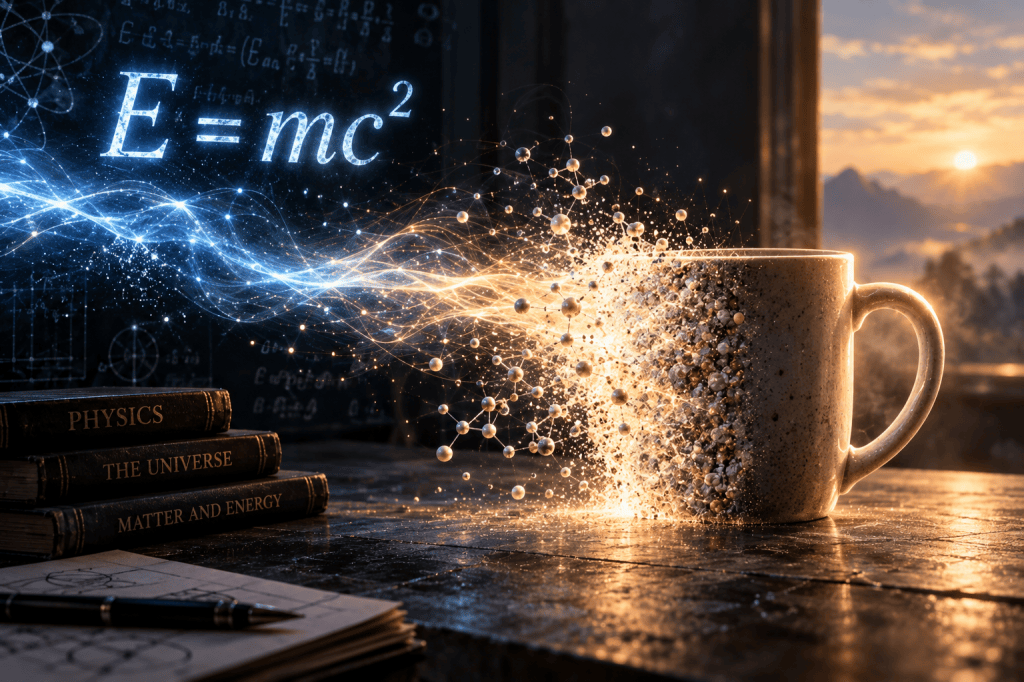
Einstein told us that matter and energy are interchangeable. So what would it actually take for something to appear where, moments before, there was nothing?
September 8, 2026
Most of us learned Einstein’s famous equation even if we never really stopped to think about what it says:
E = mc²
Energy equals mass multiplied by the speed of light squared.
Turn the equation around:
m = E/c²
Matter, in other words, has an energy equivalent.
And the number becomes astonishing very quickly.
The speed of light is approximately 300 million meters per second. Square it and you get roughly:
90,000,000,000,000,000
So the energy equivalent of just one gram of mass is approximately:
90 trillion joules.
That is an enormous amount of energy.
But here’s where things become interesting.
Physics doesn’t merely say that matter contains energy. Under appropriate conditions, energy can actually produce massive particles.
We know this happens.
So matter appearing from energy isn’t automatically science fiction.
The real question is considerably harder:
Could enough matter ever assemble itself into something recognizable?
From Energy to Matter
High-energy photons can participate in processes that produce particles, provided conservation laws are satisfied. One familiar example is the production of an electron and its antimatter counterpart, a positron.
Energy has become massive particles.
But notice what we haven’t created.
A chair.
A flower.
A human hand.
Producing particles is one thing. Producing an organized object requires something vastly more complicated.
An ordinary object contains an extraordinary number of atoms arranged in very particular ways.
To materialize even something as simple as a coin, you wouldn’t merely need matter.
You would need the right matter in the right arrangement.
That brings information into the problem.
The Materialization Problem
Suppose an object suddenly appeared on an empty table.
Where did its atoms come from?
There are several possibilities we could imagine.
Perhaps matter was transported from somewhere else.
Perhaps existing matter in the surrounding environment was reorganized.
Perhaps sufficient energy was somehow converted into particles and subsequently assembled.
Or perhaps the event only appeared instantaneous while the underlying process had been occurring for much longer.
Each possibility creates enormous scientific problems.
But they are different problems.
And that distinction may matter when considering reports of paranormal materialization.
Instantaneous Materialization
The most dramatic possibility is the one familiar from paranormal stories: something simply appears.
One moment the table is empty.
The next moment an object is sitting there.
If that represented genuine creation of ordinary matter from energy, the process would have to accomplish several extraordinary things nearly simultaneously.
Energy would have to be available.
The necessary particles would have to exist or be produced.
Those particles would have to form atoms.
Those atoms would have to be assembled into molecules.
And those molecules would have to assume the precise structure of the finished object.
All while obeying conservation of energy, momentum, electric charge and other physical constraints.
That isn’t merely a matter problem.
It is an organization problem.
Where did the instructions come from?
What If It Isn’t Instantaneous?
There is another possibility that receives less attention.
What if materialization were gradual?
Imagine that instead of creating an object in a fraction of a second, some unknown process accumulated or reorganized matter over hours, days, months or even years.
Suddenly the energy requirements become a different kind of question.
The final mass hasn’t changed, so its mass-energy equivalent hasn’t changed.
But the rate at which a process must operate could be drastically lower.
Nature does something vaguely analogous all around us.
A tree begins with a seed weighing almost nothing compared with the mature tree.
Years later, tons of wood may exist.
The tree hasn’t violated E = mc².
It didn’t manufacture that mass from nothing.
It gathered atoms from carbon dioxide, water and minerals and slowly organized them into something enormously complex.
The impressive part isn’t that matter appeared.
It is that matter was assembled.
Perhaps Materialization Is Really Assembly
That distinction opens an interesting paranormal possibility.
If something apparently materialized, perhaps asking “How was matter created?” is the wrong question.
Maybe no new matter was created at all.
Perhaps matter already present in the environment was gathered and reorganized.
That would still require a mechanism unknown to science if it happened in the extraordinary ways described in paranormal accounts.
But energetically, it is a very different proposition from manufacturing grams or kilograms of ordinary matter directly from radiation.
And it gives us two very different forms of hypothetical materialization.
Fast materialization: matter or energy is transferred, converted and organized almost instantaneously.
Slow materialization: existing material gradually accumulates and organizes until the final structure becomes noticeable.
One requires an extraordinary event.
The other requires an extraordinary process.
And Then Comes the Stranger Question
Paranormal literature contains stories of objects appearing, disappearing, moving between locations and—in some of the strangest accounts—forms supposedly becoming temporarily physical.
Science has not established these reports as examples of genuine matter creation or materialization.
But Einstein’s equation gives us a useful boundary for asking what such an event would require if one ever proved genuine.
Matter cannot simply appear without accounting.
If something materializes, something must provide the mass-energy.
And if the object is organized, something must account for the organization.
Which leaves us with two mysteries instead of one:
Where did the matter come from?
And perhaps the more important question:
How did it know what to become?
Maybe the great mystery of materialization isn’t making matter at all.
Nature already knows how to turn energy into particles.
The mystery would be turning those particles—or matter already surrounding us—into something specific.
And whether that happens in a billionth of a second or over a hundred years, the same question remains:
What is doing the assembling?
 The ChillX Zone
Leave a comment