September 5, 2026
The automobile industry is preparing for cars without drivers.
Perhaps it should first build cars ordinary drivers can afford.
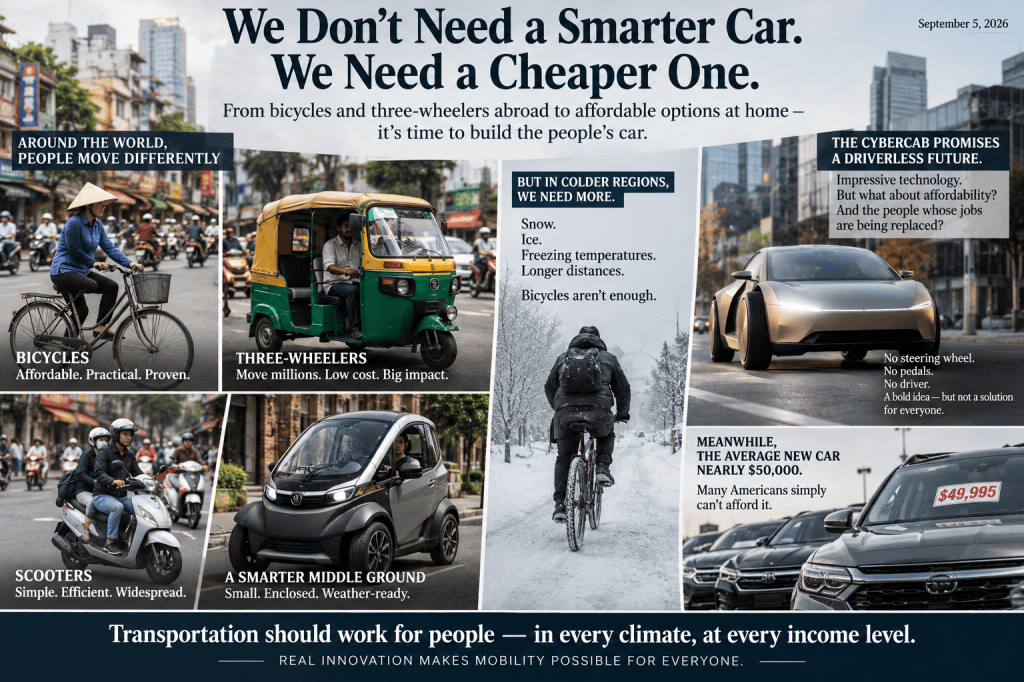
Tesla’s Cybercab, now the subject of a federal certification inquiry, represents an extraordinary engineering proposition: an automobile without a steering wheel, pedals or human operator.
But while engineers work to eliminate the driver, the average American new vehicle has been selling for nearly $50,000.
There is something backward about this picture.
Look at How the Rest of the World Moves
Travel through parts of Asia, Africa and Latin America and transportation often looks very different from the American model.
Bicycles carry workers short distances.
Motor scooters provide inexpensive personal transportation.
Three-wheeled motorized rickshaws and similar vehicles carry passengers through crowded cities without requiring a two-ton automobile for every journey.
They aren’t perfect.
But they recognize a simple truth:
Moving one or two people does not always require a large car.
America largely skipped the middle ground between bicycle and automobile.
Perhaps it is time to rediscover it.
The Problem Is January
Tell a worker in a warm climate to commute by bicycle and the proposition may be perfectly reasonable.
Tell somebody in Buffalo, Minneapolis or northern New England the same thing in February and you may receive a less enthusiastic response.
Cold changes the equation.
So does snow.
Freezing rain.
Wind.
Dark winter mornings.
A bicycle is wonderfully inexpensive transportation until the temperature drops below freezing and the road is covered in slush.
A motorcycle or three-wheeler has similar limitations.
That suggests an engineering problem worth solving.
Build the Missing Vehicle
Imagine something between a motorcycle and today’s automobile.
Four wheels—or a stable three-wheel configuration.
Two seats.
A roof.
Doors.
Heat and defrosting.
Basic air conditioning.
Excellent visibility.
Modern crash protection appropriate to its class.
Physical controls.
A modest engine or small battery.
Enough range for ordinary commuting.
Cheap tires.
Cheap replacement parts.
No enormous entertainment screen.
No 400-horsepower motor.
No powered door handles.
No requirement that the vehicle become obsolete when its computer does.
Call it a microcar.
Call it a commuter pod.
Call it the people’s car.
Just make it inexpensive.
Keep the Human
There is also something peculiar about spending enormous sums developing technology to remove a taxi driver.
The driver already comes equipped with eyes, hands, judgment and the ability to help a passenger.
If autonomous vehicles ultimately prove safer and cheaper, they will have an important place.
But replacing workers should not become our only definition of innovation.
Sometimes the better technological achievement is allowing the worker to afford the product.
An inexpensive enclosed commuter vehicle could provide mobility to young workers, retirees, students and families who cannot justify a $50,000 automobile.
It could also use less material, occupy less parking space and consume less energy than the enormous vehicles increasingly common on American roads.
Design for the Country We Actually Have
America cannot simply copy bicycle-heavy transportation systems elsewhere.
Our cities are farther apart.
Many communities were built around automobiles.
And much of the country experiences winters that make exposed transportation impractical for part of the year.
But that doesn’t mean every solution needs to be an expensive conventional car.
Take the affordability of the bicycle.
Take the compact dimensions of the three-wheeled taxi.
Add the weather protection demanded by a northern climate.
Then apply modern American safety engineering.
The result wouldn’t be glamorous.
That may be its greatest virtue.
The automobile industry has already demonstrated that it can build machines capable of driving themselves.
Now give its engineers a harder assignment:
Build one a working person can buy without needing seven years to pay for it.
 The ChillX Zone
Leave a comment