September 6, 2026
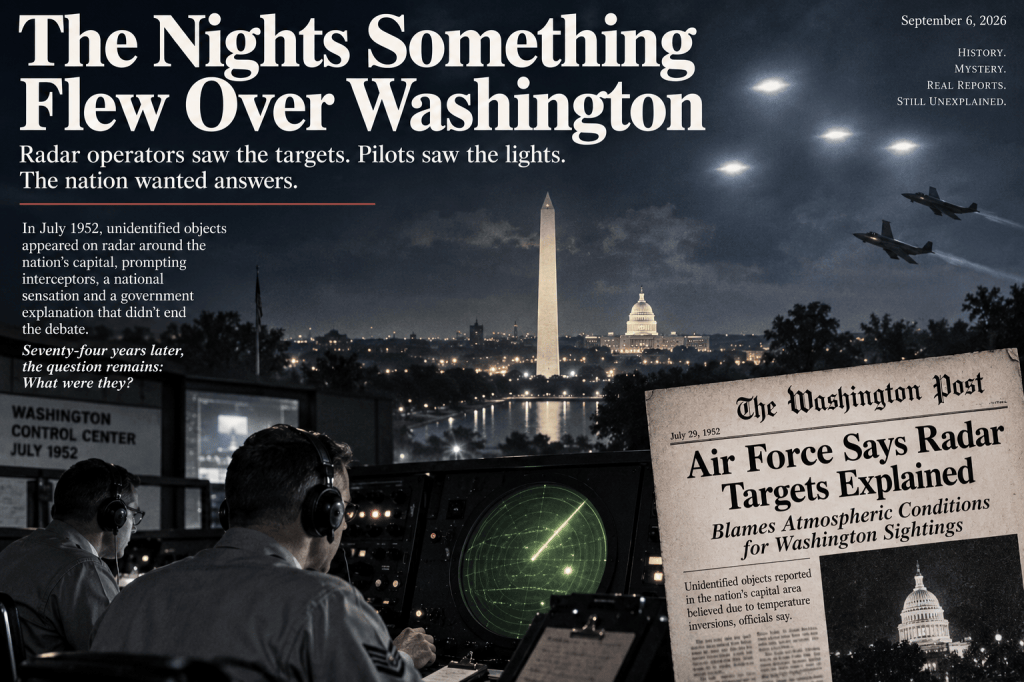
Shortly before midnight on July 19, 1952, an air-traffic controller at Washington National Airport noticed something peculiar on his radar screen.
Seven unidentified targets had appeared southwest of the nation’s capital.
They weren’t behaving like ordinary aircraft.
Other radar operators began reporting unusual returns. Pilots described strange lights. Additional sightings followed around Washington, including another dramatic series the following weekend.
For a country already fascinated—and frightened—by reports of “flying saucers,” the location couldn’t have been better.
Or worse.
Something apparently had entered the skies around Washington.
The question was what.
The Summer of the Saucer
America was already suffering from UFO fever.
The modern flying-saucer craze had begun only five years earlier, and newspapers were filling with reports of mysterious objects in the sky.
Then came Washington.
Radar operators detected unidentified targets around the capital during the nights of July 19–20 and July 26–27.
Some appeared and disappeared.
Some seemed to move unusually.
Pilots also reported lights they could not readily identify.
Interceptor aircraft were sent into the area.
Suddenly this wasn’t a farmer pointing at a light over his barn.
It involved radar operators, professional pilots, military aircraft and the airspace surrounding the seat of the United States government.
The story exploded.
The Air Force Had an Explanation
On July 29, the Air Force held a major press conference.
Officials argued that unusual atmospheric conditions—particularly temperature inversions—could distort radar and contribute to strange returns. Stars, meteors and other ordinary objects could account for some visual sightings.
This wasn’t an absurd explanation.
Radar is not a magical window through which reality appears perfectly.
Weather and atmospheric conditions can produce confusing returns. Human observers can also misjudge the distance, speed and size of lights at night.
Put unusual radar propagation together with a city full of lights, stars, aircraft and people already expecting flying saucers, and a remarkable story can develop quickly.
But that doesn’t necessarily mean every observation was neatly explained.
“Unexplained” Does Not Mean “Alien”
This is where UFO stories usually go wrong.
If investigators cannot identify an object, people immediately leap to:
SPACECRAFT.
But “unidentified” describes the observer’s information.
It does not identify the object.
A light can remain unidentified because the report contains too little information.
A radar return can remain unresolved because the conditions cannot be reconstructed.
A pilot can sincerely see something strange without seeing an extraterrestrial vehicle.
There is an enormous distance between:
We don’t know what that was.
and
Visitors from another planet flew over Washington.
Evidence has to cross that distance.
The 1952 incidents never produced publicly verified alien hardware, occupants or physical evidence demonstrating extraterrestrial origin.
But Don’t Throw Away the Mystery
Skepticism should work in both directions.
Saying “temperature inversion” shouldn’t become a magic phrase used to dismiss every inconvenient observation either.
The interesting part of Washington 1952 is that multiple kinds of observers and instruments became involved.
Radar operators saw unusual targets.
Pilots reported lights.
Military interceptors were dispatched.
Officials considered the incidents important enough to address publicly.
Those facts deserve examination without embellishment.
Perhaps different witnesses were observing different ordinary phenomena during an extraordinary couple of nights.
Perhaps atmospheric effects produced much of the radar mystery.
Perhaps some reports simply cannot be reconstructed confidently seven decades later.
That is less exciting than Martians.
It is also more intellectually honest.
The Government Really Did Investigate UFOs
Another fact frequently distorted by paranormal folklore is that the United States government genuinely investigated UFO reports.
The Air Force’s Project Blue Book collected and evaluated thousands of cases before ending in 1969.
That is real.
But government investigation does not prove the phenomenon being investigated has an extraordinary explanation.
Governments investigate mysteries because governments would very much like mysteries occurring near military installations and national capitals to stop being mysteries.
An unidentified aircraft could be an enemy aircraft.
An unusual radar return could reveal an equipment problem.
A wave of mistaken sightings could itself create military confusion.
During the Cold War, figuring out which was which mattered.
Seventy-Four Years Later
Washington’s 1952 UFO flap survives because it occupies that uncomfortable territory between explanation and uncertainty.
There is enough ordinary science to caution against extraterrestrial conclusions.
There is enough historical documentation to prevent us from dismissing the entire episode as somebody inventing a story at a bar.
That middle territory is where the best mysteries usually live.
Something appeared on radar.
People saw lights.
Fighter aircraft went looking.
The Air Force offered explanations.
And no publicly established evidence demonstrated visitors from another world.
Perhaps that should be enough.
Not every mystery needs to become a conspiracy.
Not every unexplained light needs an alien pilot.
But neither should history be rewritten to pretend nobody saw anything unusual at all.
On two weekends in the summer of 1952, experienced people watching the skies over Washington encountered something they struggled to identify.
Seventy-four years later, the argument is still over what.
 The ChillX Zone
Leave a comment