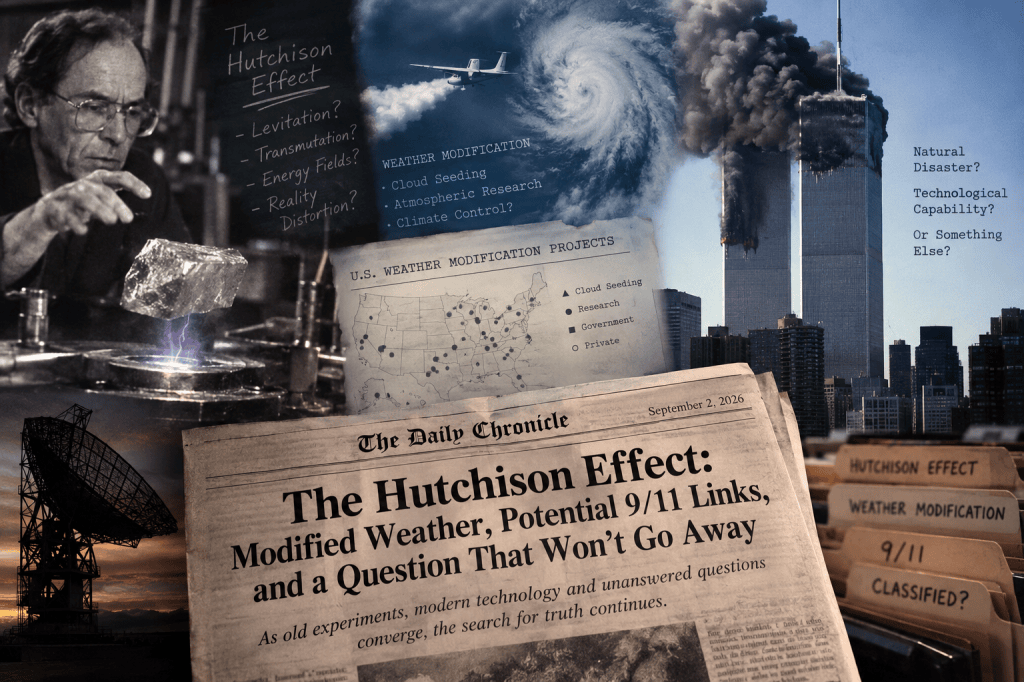
September 2, 2026
There are stories a reporter approaches with a notebook.
There are others where it is wise to bring a very large grain of salt.
The so-called Hutchison Effect belongs firmly in the second category.
For decades, extraordinary stories have circulated around experiments attributed to Canadian experimenter John Hutchison: metal supposedly bending or fracturing without ordinary mechanical force, objects appearing to levitate, materials behaving in ways their engineering textbooks insist they shouldn’t.
If reliably demonstrated under controlled laboratory conditions, such phenomena would be remarkable.
That “if” is doing considerable work.
The alleged effect has never acquired the sort of independently replicated experimental foundation necessary to establish a new physical phenomenon. Yet the story did not disappear. Instead, it migrated from experimental folklore into a much larger collection of claims involving electromagnetic energy, military technology, weather modification—and eventually September 11, 2001.
That is where an odd scientific tale becomes something considerably more serious.
First, What Exactly Is the Hutchison Effect?
The name refers not to one clearly defined phenomenon but to a collection of unusual effects attributed to Hutchison’s electrical experiments.
The basic story involves combinations of high-voltage and radio-frequency equipment operating around test objects.
Videos associated with the experiments have been presented as showing objects moving or levitating and pieces of metal undergoing peculiar deformation.
The problem is an old one in science.
A videotape can show that something happened in front of a camera.
It cannot necessarily tell us why it happened.
Science demands repeatable measurements, controlled conditions, independent replication and a mechanism capable of surviving attempts to prove it wrong.
Extraordinary footage may begin an investigation.
It cannot finish one.
Weather Modification Is Real—But That Doesn’t Make Every Weather Claim Real
This is where discussions of the Hutchison Effect often take a sharp turn.
Governments and private operators really have attempted to modify weather.
That is not secret history.
Cloud-seeding programs have existed for decades, and the federal government has maintained reporting requirements for weather-modification activities. NOAA’s historical records document American weather-modification projects, their locations, sponsors, equipment and seeding agents.
So the sentence “weather modification exists” is perfectly defensible.
The sentence “therefore any unusual storm or cloud formation was artificially created” is not.
Those are two very different propositions.
Cloud seeding generally attempts to influence precipitation under suitable atmospheric conditions. It does not establish the existence of a machine capable of casually manufacturing hurricanes, directing enormous storms at cities or manipulating matter through some exotic energy field.
This distinction matters because conspiracy theories often begin with one fact that is true and use it as a bridge to claims for which the evidence is much weaker.
The bridge may look sturdy from a distance.
A reporter ought to walk across it before telling readers it can carry traffic.
Then Came September 11
The most controversial extension of the story involves claims that unusual energy phenomena—sometimes linked by proponents to Hutchison-style effects or weather-control technology—might somehow explain aspects of the destruction at the World Trade Center.
These claims deserve an unusually high evidentiary standard.
Nearly 3,000 people were killed in the September 11 attacks. Any allegation that a radically different mechanism caused the destruction must therefore be supported by physical evidence capable of competing with the enormous quantity of engineering, photographic and eyewitness evidence already examined.
The National Institute of Standards and Technology reached a very different conclusion.
Its investigation found that the aircraft impacts severely damaged structural columns, floors and fireproofing in the Twin Towers. Jet fuel ignited widespread fires; those fires then weakened unprotected structural components until collapse initiated.
NIST says it found no corroborating evidence supporting alternative hypotheses involving planted explosives or missiles.
The towers, investigators concluded, did not require an unknown energy weapon to fall.
They required badly damaged structures, missing fire protection and sufficiently severe fires.
That explanation may sound less exotic.
Physics frequently does.
But What About the Strange Debris?
Advocates of alternative theories have pointed for years to photographs of damaged vehicles, twisted metal, dust, smoke and debris around Lower Manhattan.
Some images are unquestionably startling.
But “startling” is not a physical mechanism.
A catastrophe involving two enormous collapsing skyscrapers produced fires, enormous debris fields, shattered utilities, dust clouds and complicated patterns of mechanical damage.
To demonstrate an exotic energy effect, investigators would need more than an object that looks peculiar afterward.
They would need evidence showing that conventional mechanisms could not reasonably produce the observed damage—and then evidence positively identifying the proposed alternative.
Those are separate hurdles.
Neither can be skipped.
The Most Interesting Question May Be the Smaller One
There is nevertheless a legitimate story hiding underneath the extraordinary claims.
Human beings have spent decades trying to manipulate natural systems with technology.
Weather modification is real.
High-energy electromagnetic research is real.
Military research into unconventional technologies is real.
And governments have sometimes kept technological programs classified.
None of those statements proves the existence of a weather weapon or a Hutchison-derived system capable of destroying buildings.
But they explain why stories about such technologies remain attractive.
The ingredients are genuine.
The recipe is where evidence becomes essential.
A Lesson From the Tabloid Rack
Any reporter working in the 1990s learned something useful while standing in supermarket checkout lines.
A headline could begin with a fact and end somewhere on Mars.
“Scientists Study Meteorite” could become “SPACE ROCK MAY CARRY ALIEN MESSAGE” before the reader reached the chewing gum.
Modern conspiracy culture often works the same way.
Weather modification exists.
Therefore hurricanes can be controlled.
Electromagnetic experiments exist.
Therefore exotic energy weapons exist.
The Hutchison Effect has been claimed.
Therefore it explains unexplained damage.
And unexplained-looking damage exists at Ground Zero.
Therefore the Hutchison Effect explains September 11.
Each sentence appears to lean upon the previous one.
But somewhere along the chain, evidence has been replaced by assumption.
Questions Are Cheap. Evidence Is Expensive.
There is nothing improper about questioning an official explanation.
Science itself depends upon questioning explanations.
But skepticism has to work in both directions.
If government investigators say fire and structural damage caused a building collapse, skeptics should examine their evidence.
If somebody else says an unknown directed-energy phenomenon caused it, skeptics should examine that evidence even more carefully.
A theory does not become stronger merely because it challenges authority.
Nor does an official conclusion become correct merely because the government published it.
Both ultimately stand or fall on evidence.
For the World Trade Center towers, the publicly documented engineering evidence supports aircraft impact damage followed by severe fires and structural failure. NIST’s reconstruction incorporates aircraft damage, fire behavior and structural response and concludes that the impacts alone would not have brought the towers down; the subsequent fires were crucial to the collapse sequence.
There is presently no comparable body of reproducible physical evidence establishing that the Hutchison Effect—or a weather-modification or directed-energy system derived from it—caused the destruction.
That doesn’t make the history of these claims uninteresting.
Quite the contrary.
It makes them an excellent lesson in how we decide what we know.
Keep the File Open—But Label It Correctly
Perhaps that is the responsible place to leave this story.
Weather modification belongs in the file marked REAL TECHNOLOGY.
The Hutchison Effect belongs in the file marked EXTRAORDINARY CLAIMS REQUIRING INDEPENDENT VERIFICATION.
The proposed connection between exotic energy technology and September 11 belongs in another file entirely:
UNPROVEN.
Those labels aren’t nearly as exciting as a government weather machine or a mysterious beam from the sky.
But reporters have a troublesome obligation.
We are supposed to distinguish the story we can prove from the story that merely makes a terrific headline.
And sometimes the most important word in the newspaper is only eight letters long:
Evidence.
 The ChillX Zone
Leave a comment