September 4, 2026
Evolution makes an extraordinary amount of sense.
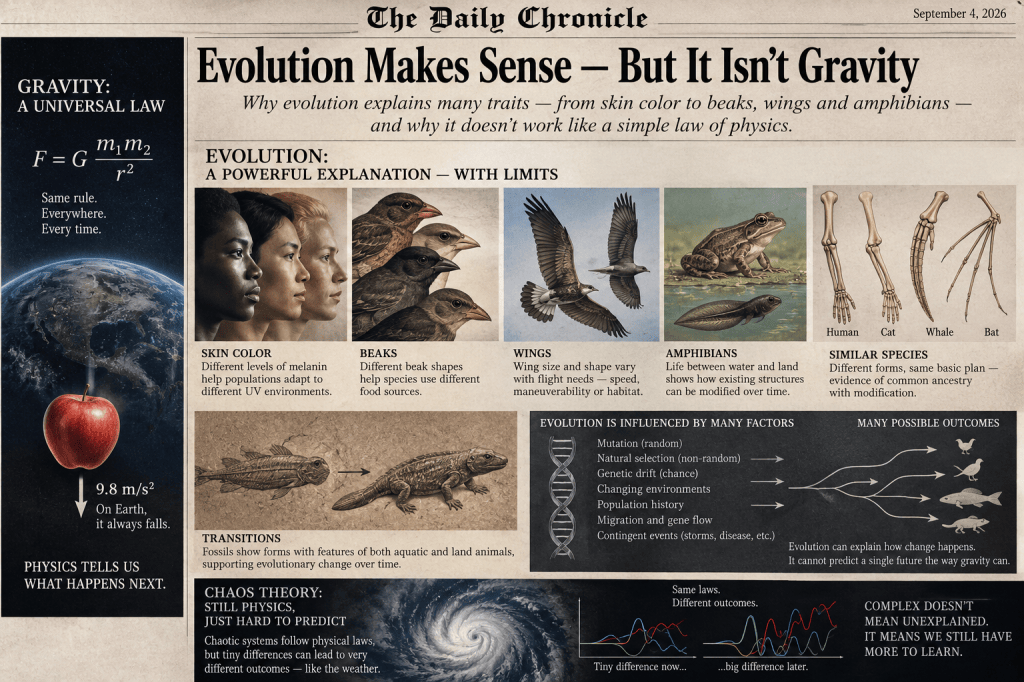
Birds living on different foods develop different beaks over generations. Wings vary with the demands of flight. Closely related species retain recognizable variations of the same anatomical machinery. Human populations developed differences in skin pigmentation partly in response to differing ultraviolet environments.
The fossil record records organisms changing through geological time.
DNA reveals relationships that nobody looking only at bones could have known.
So there is little reason to throw evolution out.
But there is another question worth asking:
What kind of scientific explanation is evolution?
Because evolution isn’t gravity.
And expecting the two to behave alike can produce considerable confusion.
Drop the Apple
Hold an apple above the floor and release it.
Physics gives us equations describing what happens next.
Near Earth’s surface, ignoring air resistance, the apple accelerates downward at approximately 9.8 meters per second squared.
Give a physicist the necessary starting conditions and the equations can predict the apple’s position moments later.
The same basic laws apply tomorrow.
They applied yesterday.
They don’t care whether the falling object is an apple, a baseball or a reporter’s coffee mug.
That is an extraordinarily powerful kind of explanation.
Now try something similar with evolution.
Take a population of birds.
Measure their genes, bodies, food supply, predators and climate.
Then ask:
What will their descendants look like 10 million years from now?
There is no evolutionary equation capable of giving us the equivalent of the physicist’s answer for the falling apple.
Not because evolution is necessarily wrong.
Because evolution describes a very different kind of system.
Evolution Explains Better Backward Than Forward
Consider a bird’s beak.
Suppose one population encounters an environment dominated by hard seeds.
Some birds possess slightly larger or stronger beaks.
If those differences are heritable and those birds obtain more food and leave more surviving offspring, beak characteristics can shift across generations.
That makes sense.
We can observe such selection.
But evolution cannot tell us with certainty what the descendants of those birds will look like millions of years from now.
Perhaps the climate changes.
Perhaps the seed plants disappear.
Perhaps a new predator arrives.
Perhaps some birds migrate to another island.
Perhaps a mutation changes digestion.
Perhaps a disease kills most of the population.
Perhaps a volcanic eruption wipes them out altogether.
Evolution can explain how populations respond to such events.
It cannot necessarily predict which events history will supply.
That makes evolutionary biology partly historical science.
And history has a troublesome habit of happening only once.
Skin Color Shows Both the Strength and the Limitation
Human pigmentation offers a useful example.
First, a terminology correction: the relevant pigment is melanin, not melatonin. Melatonin is primarily associated with regulation of the sleep-wake cycle.
Human skin pigmentation shows a broad geographical relationship with ultraviolet radiation.
Under intense UV conditions, greater pigmentation can provide important protection. Under lower-UV conditions, lighter pigmentation can help facilitate UV-dependent vitamin D production.
Evolutionary theory therefore gives us a convincing mechanism connecting inherited variation, environment and reproductive consequences.
But notice what the theory does not provide.
There isn’t a universal equation saying:
UV level X + population Y + 5,000 years = precisely this skin tone.
Migration matters.
Diet matters.
Population history matters.
Gene flow matters.
Culture matters.
Random genetic changes matter.
Natural selection matters.
The explanation can therefore be scientifically powerful without behaving like a simple law of mechanics.
Amphibians Tell a Similar Story
Consider the history of vertebrates moving from aquatic environments toward terrestrial life.
Evolution provides a coherent framework.
Existing anatomical structures were modified over generations. Limbs, lungs, skeletal structures, sensory systems and reproduction underwent enormous changes as different lineages adapted to different environments.
Fossils provide transitional combinations of characteristics.
Comparative anatomy reveals related structures.
Genetics provides another record of common ancestry.
Again, the explanation makes sense.
But imagine standing beside an ancestral aquatic population hundreds of millions of years ago.
Could a scientist have calculated:
In exactly 370 million years this lineage will produce this particular frog?
No.
Evolution doesn’t work like a celestial mechanics table predicting an eclipse.
Too many contingent events intervene.
Similarity Is Powerful Evidence
Closely related species provide some of evolution’s strongest evidence.
Their anatomy frequently looks less like separate inventions and more like variations on inherited plans.
The forelimbs of different vertebrates can perform radically different functions while retaining related underlying skeletal structures.
DNA makes the pattern still more striking.
Species thought to share relatively recent ancestry generally possess greater genetic similarity than organisms whose lineages separated much earlier.
Evolution explains these nested relationships elegantly through descent with modification.
That is a genuine scientific achievement.
But an explanation of relationships is different from a universal physical law.
A family tree explains why two cousins resemble one another.
It doesn’t allow you to calculate the exact face of somebody’s great-great-grandchild in the year 2140.
Randomness Enters the Picture
Evolution also contains stochastic—that is, probabilistic—processes.
Mutations arise without regard to whether the resulting change would be convenient for an organism.
Genetic drift can alter gene frequencies through chance.
Small populations can be especially affected by accidents of reproduction.
A storm might randomly kill individuals carrying one allele while sparing individuals carrying another.
Then natural selection operates upon the variation that exists.
So evolution combines necessity and chance.
Physics remains underneath all of it.
The storm obeys physics.
DNA molecules obey chemistry and quantum mechanics.
A bird’s wing obeys aerodynamics.
Muscles obey mechanics and thermodynamics.
Nothing supernatural has entered the system.
But the historical outcome isn’t necessarily predetermined in the useful everyday sense.
This Is Where Chaos Theory Gets Interesting
Chaos theory is often badly described as a theory of randomness.
It isn’t.
A chaotic system can obey deterministic physical equations while becoming extremely difficult to predict over long periods because tiny differences in its initial conditions grow into enormous differences later.
Weather provides the classic illustration.
The atmosphere doesn’t stop obeying physics because meteorologists cannot tell us whether it will rain in Manhattan at 3:17 p.m. on September 4, 2126.
The equations still operate.
The prediction fails because tiny uncertainties compound.
Biological evolution has an additional complication.
It contains not merely complex dynamics but stochastic events—mutation, genetic drift and historical accidents—alongside deterministic physical processes and nonrandom natural selection.
So asking evolution for the same predictive precision as a falling object is asking the wrong question.
There Is No Single “Evolution Equation”
Newtonian gravity can be expressed compactly:
F = Gm₁m₂/r²
That equation relates gravitational force to mass and distance.
There is no comparably universal equation:
E = organism + environment × time
that generates elephants, oak trees and hummingbirds.
Evolutionary biology instead contains many mathematical models.
Population genetics can model how allele frequencies change.
The Hardy-Weinberg framework establishes expectations under specified conditions.
Selection coefficients quantify differences in reproductive success.
Quantitative genetics can predict changes in traits statistically.
Phylogenetic methods reconstruct evolutionary relationships.
These are real mathematical sciences.
But they operate under assumptions and probabilities rather than providing one equation describing the entire future history of life.
Does That Make Evolution “Less Scientific”?
No.
It makes it a different kind of science.
Astronomy, geology, meteorology, epidemiology and evolutionary biology all contain historical or probabilistic components.
We shouldn’t demand that every scientific theory resemble introductory mechanics.
Consider plate tectonics.
It explains why matching geological formations appear on continents now separated by oceans.
It explains earthquakes, mountain building and seafloor spreading.
But plate tectonics cannot tell us precisely where every grain of sand will be located 80 million years from today.
That inability doesn’t send Africa and South America sliding back together.
Scientific strength isn’t measured solely by whether a theory produces one elegant equation.
It is measured by whether the theory explains observations, makes testable predictions, survives attempts at falsification and agrees with independent evidence.
Evolution does remarkably well by those standards.
Where Skepticism Is Still Useful
There is nevertheless a mistake in treating the word evolution as though saying it automatically explains every biological feature.
It doesn’t.
If somebody asks why an animal possesses an unusual structure, answering “evolution” is only the beginning.
What selection pressure?
Which genes?
What ancestral structure?
What environmental conditions?
Could genetic drift explain it instead?
Is the trait actually adaptive at all?
Did it arise because it was genetically linked to something else?
Could sexual selection be responsible?
What does the fossil record show?
What do related species show?
A scientific explanation needs mechanism and evidence.
“Evolution did it” can become just as intellectually lazy as “nature did it” if nobody investigates further.
Perhaps We Have Been Asking the Wrong Question
Evolution therefore occupies an interesting position.
It is not a fundamental law of physics comparable to gravitation.
It doesn’t replace physics.
It cannot normally predict the distant future of life with mechanical precision.
And historical contingency means that rewinding Earth’s history might not produce precisely the same organisms a second time.
Yet none of those observations undermines the basic evolutionary mechanism.
Variation exists.
Inheritance exists.
Mutation occurs.
Populations change genetically.
Natural selection occurs.
Species share ancestry.
The fossil and genetic records preserve evidence of those changes.
The mistake is thinking science gives us only two choices:
Perfectly predictable physical law—or chaos.
Nature isn’t that tidy.
Gravity tells us why the apple falls.
Evolution can tell us why the hand holding the apple has five fingers, why those fingers contain a particular arrangement of bones, and why remarkably similar bones appear inside the wings, flippers and forelimbs of other vertebrates.
But evolution cannot tell us exactly what that hand’s descendants will look like 10 million years from now.
That isn’t necessarily a hole in the theory.
It is a reminder that explaining the rules of change is not the same thing as predicting the entire history that those rules will produce.
 The ChillX Zone
Leave a comment