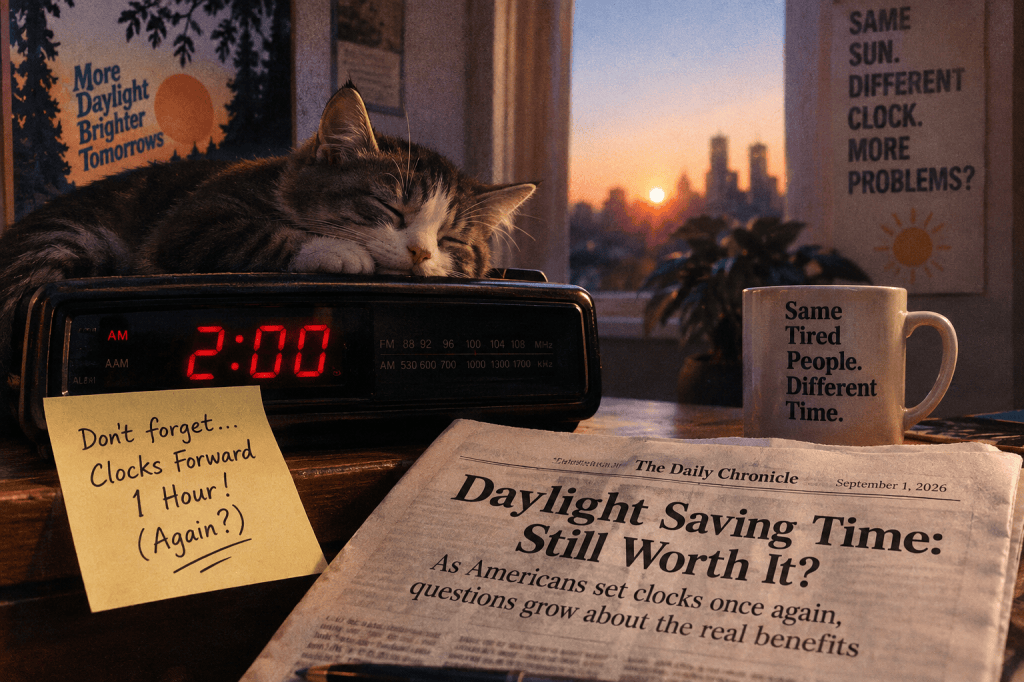
September 1, 2026
By Staff Reporter
Every spring, millions of Americans participate in one of the country’s strangest rituals.
Before going to bed, we move the clocks ahead an hour. We lose an hour of sleep, stumble into Monday morning in the dark, pour an extra cup of coffee and spend the next several days wondering why everybody seems tired and irritable.
Then, come autumn, we do the whole thing backward.
This is called progress.
Daylight saving time has survived wars, recessions, energy crises, eight-track tapes and the fax machine. It has endured not because it is particularly sensible, but because Americans have become remarkably good at accepting minor inconveniences once they have been around long enough to acquire the dignity of tradition.
The basic sales pitch has always sounded reasonable enough: move an hour of daylight from the morning to the evening, giving people more useful sunshine after work and, supposedly, conserving energy.
There is only one problem.
The sun has never read the law.
Congress can move the hands on every clock in America, but it cannot manufacture an additional minute of daylight. We are simply changing what number we assign to the hour.
And increasingly, researchers have been asking whether this little exercise in chronological bookkeeping costs more than it delivers.
An Hour Isn’t Always a Small Thing
Back in 1996, researchers reported in The New England Journal of Medicine that traffic accidents increased by roughly 8 percent on the Monday after the spring clock change. The apparent culprit was remarkably mundane: people had lost an hour of sleep.
That finding should have attracted more attention than it did.
An hour doesn’t sound like much. But take an hour of sleep away from millions of drivers at precisely the same time and then send them onto highways Monday morning, and a harmless-looking clock adjustment starts looking rather different.
Later research strengthened the case. An analysis of 732,835 fatal U.S. motor-vehicle accidents between 1996 and 2017 found that the spring transition was associated with about a 6 percent increase in fatal crash risk. The researchers estimated that eliminating the transition could prevent roughly 28 fatal accidents each year.
The increase was especially pronounced in the morning—the very hours when millions of workers and schoolchildren are trying to function after their clocks have suddenly been pushed forward.
There is something almost comical about deliberately making mornings darker, depriving people of sleep and then acting surprised when sleepy people have trouble driving automobiles.
Almost comical.
Your Body Doesn’t Own a Wristwatch
Human beings did not evolve according to a congressional timetable.
Our internal clocks respond heavily to light. Morning light helps tell the body that the day has begun. Darkness helps prepare it for sleep.
Moving the clock does not instantly move that biology.
Federal health researchers have noted that the spring change produces darker mornings and more evening light. That combination can make waking harder while encouraging the body to remain awake later—the opposite of what somebody who just lost an hour of sleep needs.
The effects aren’t confined to feeling groggy over breakfast.
Research has associated the spring transition with increases in cardiovascular problems and traffic accidents. A major systematic review published this year, examining 157 studies from 36 countries, concluded that the onset of daylight saving time is associated with short-term increases in acute myocardial infarction and fatal traffic accidents.
That doesn’t mean every frightening claim ever made about daylight saving time is correct. Science rarely cooperates with slogans that neatly.
The same review found some benefits associated with daylight saving time and emphasized that the evidence remains mixed for several outcomes.
But that qualification actually makes the sensible policy question easier.
We don’t need to prove that every minute spent on daylight saving time is dangerous.
We merely need to ask why we keep forcing nearly everybody to change clocks twice a year when the transitions themselves create measurable risks.
The Great Energy Argument
For decades, daylight saving time has also been defended as an energy-saving measure.
That argument made intuitive sense in an era when household electricity consumption meant, to a much greater degree, turning lights on and off.
America even experimented with extended daylight saving time during the 1970s energy crisis.
But the modern American home isn’t the American home of 1974.
We have air conditioners, computers, televisions, chargers, appliances and an impressive collection of machines quietly consuming electricity regardless of whether sunset arrives according to the number six or seven on the kitchen clock.
The world changed.
The clocks didn’t.
We Have Tried Uniformity Before
The modern federal framework traces back to the Uniform Time Act of 1966, which was intended in large part to bring order to what had become a confusing patchwork of local time practices.
There was logic in that.
Transportation companies, broadcasters and businesses had legitimate reasons to want predictable clocks from one jurisdiction to another.
But uniformity and clock-changing are two different questions.
We can agree about what time it is without agreeing to alter that time twice every year.
Indeed, parts of the United States already demonstrate that civilization does not collapse without the ritual. Hawaii and most of Arizona do not make the seasonal switch.
The grocery stores still open.
Airplanes still land.
People still arrive late for meetings, although they have had to find other excuses.
Pick a Time and Leave It Alone
There is a vigorous argument over what should replace the current system.
Some people want permanent daylight saving time because they enjoy long summer evenings.
Sleep and circadian-health specialists frequently favor permanent standard time because morning sunlight aligns more closely with human biological rhythms.
That debate is worth having.
But there is a simpler point on which Americans ought to be able to find considerable agreement:
Changing the clocks twice a year is an unnecessarily disruptive way to run a country.
We would never propose deliberately giving much of the population mild jet lag on the same weekend and then sending everybody back to work Monday morning.
Yet put the same policy on a calendar, give it a century of history and call it daylight saving time, and somehow it becomes normal.
Perhaps the strangest thing about daylight saving time is that we continue talking about it as though daylight were something the government had discovered how to save.
It hasn’t.
There are 24 hours in the day before the clocks change and 24 afterward.
No sunlight has been deposited in a federal vault.
No extra hour has been manufactured.
We have merely changed the labels.
After decades of tinkering, extending, shortening, advancing and retreating, perhaps the most modern solution is also the simplest one.
Choose a clock.
Then leave the poor thing alone.
 The ChillX Zone
Leave a comment