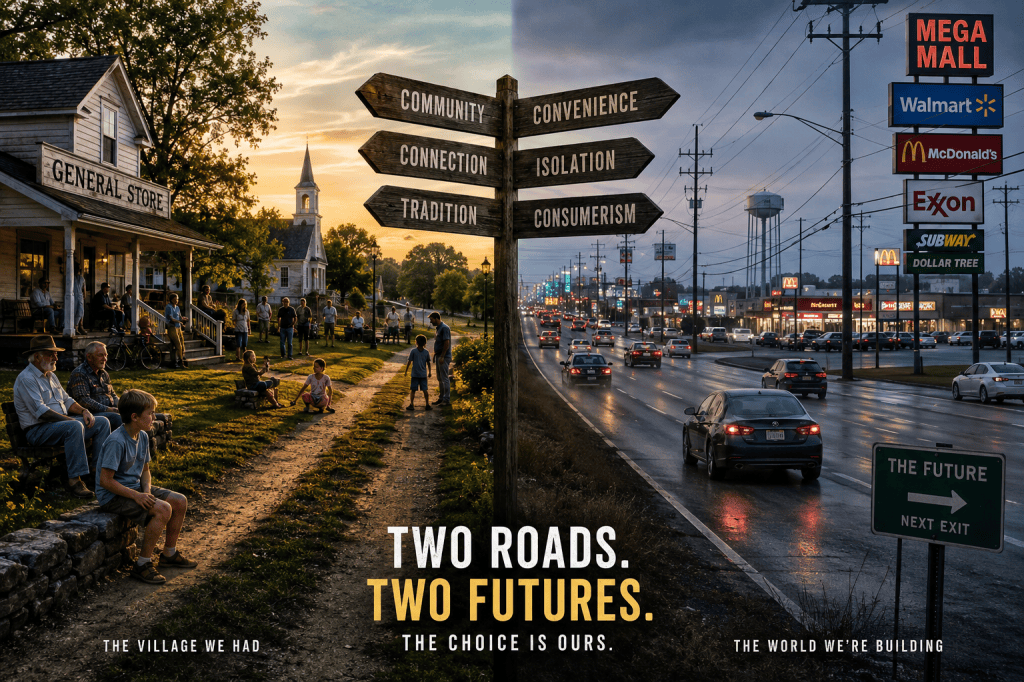
Electricity and the modern era promised freedom. They also helped dismantle the communities that once made civil society possible.
There was a time when the village was not merely a collection of houses.
It was a society.
The grocer knew the family buying the food. The mechanic knew the car and probably its owner’s father. Children walked to school, neighbors met on porches, and the town square wasn’t an architectural decoration invented by a developer.
It was where people actually met.
Then came the modern age.
Electricity illuminated the darkness. Paved roads connected isolated communities. Automobiles offered unprecedented mobility. Refrigeration preserved food. Telephones crossed distances. Modern medicine saved lives.
These were enormous achievements.
But progress sent us a bill nobody bothered to read.
Electricity Changed More Than the Light
Electricity liberated people from many brutal limitations of the old world.
It also changed where life happened.
Before electrification and electronic entertainment, much of life had to occur among other people. Work, entertainment, worship, commerce, news and politics were deeply connected to physical communities.
Then the center of gravity gradually moved indoors.
Radio entered the house. Then television. Then computers. Then the internet. Then smartphones.
The village didn’t disappear overnight.
It became less necessary.
Entertainment no longer required the dance hall. Information no longer required conversation at the store. Shopping no longer required knowing the shopkeeper. Work increasingly didn’t require living near the people you worked with.
Eventually, a person could inhabit a town without meaningfully belonging to it.
We became connected to everything and acquainted with almost nobody.
Then We Paved the Road
The paved road may have changed the village even more profoundly.
At first, the road was liberation.
A farmer could reach a larger market. A sick child could reach a hospital. Workers could find employment farther from home. Families weren’t trapped by geography.
But once transportation became faster, distance stopped protecting local institutions.
The village merchant wasn’t merely competing with the merchant down the street anymore.
He was competing with the city.
Then the shopping center.
Then the big-box store.
Then the entire planet.
The road that allowed villagers to travel outward also allowed economic power to travel inward.
Local stores disappeared.
Small farms consolidated.
Main Streets emptied.
Businesses moved toward highways.
Homes moved into subdivisions.
Work moved somewhere else.
And suddenly the village wasn’t a place where people lived, worked, shopped and governed themselves.
It became a place where people slept before driving somewhere else in the morning.
The Automobile Rebuilt Society Around Distance
Once the automobile became essential, America began constructing communities for machines rather than human beings.
Homes here.
Stores three miles over there.
School five miles in another direction.
Employment twenty miles down the highway.
A supermarket surrounded by acres of asphalt replaced several neighborhood stores.
The front porch lost ground to the garage.
The town square lost ground to the parking lot.
Walking became impractical, then unusual, then suspicious.
Children who once traveled independently increasingly required an adult with an automobile.
Older people who stopped driving could find themselves effectively stranded.
We called this mobility.
Yet we constructed a society in which millions of people cannot participate without owning a machine weighing several thousand pounds.
That’s a peculiar definition of freedom.
Efficiency Destroyed Redundancy
The old village was inefficient.
That’s partly why it worked.
There might be three little stores when one supermarket could sell everything more cheaply.
There might be several farmers producing locally when an industrial operation hundreds of miles away could produce more for less.
People repaired objects that could economically be replaced.
Neighbors borrowed things that could simply be purchased.
From the standpoint of pure economic efficiency, much of this made little sense.
From the standpoint of civil society, however, those inefficiencies created relationships.
The hardware store wasn’t merely distributing hammers.
The diner wasn’t merely distributing calories.
The barber wasn’t merely removing hair.
These places created repeated human contact.
Repeated contact created familiarity.
Familiarity created trust.
Trust created community.
And community made civil society possible.
We measured what modernization produced.
We rarely measured what it destroyed.
From Citizens to Consumers
Perhaps the largest transformation was psychological.
The village required participation.
Modern society increasingly requires consumption.
Instead of making entertainment, we purchase it.
Instead of repairing, we replace.
Instead of producing food locally, we depend upon enormous supply chains invisible to us.
Instead of asking a neighbor, we ask a platform.
Instead of gathering around a table, we stare individually into screens connected to corporations thousands of miles away.
We have more choices than our grandparents could have imagined.
Yet many people feel they possess remarkably little control over the systems governing their lives.
Food comes from somewhere else.
Energy comes from somewhere else.
Employment decisions are made somewhere else.
Banking happens somewhere else.
News comes from somewhere else.
And increasingly even friendship exists somewhere else.
The village was poor in choices but rich in dependencies between people.
Modern society is rich in choices but increasingly dependent upon systems.
That trade deserves more examination than we’ve given it.
Progress Was Real. So Was the Damage.
None of this means we should tear up the highways and switch off the electrical grid.
Nostalgia can lie just as easily as advertising.
The old village could be suffocating. Poverty was real. Isolation was real. Disease was more dangerous. Opportunities were limited. Communities could exclude people who didn’t conform. Rural life often involved exhausting physical labor that modern technology mercifully eliminated.
There is no golden past waiting for us.
But that doesn’t mean every consequence of modernization was progress.
Electricity was progress.
Clean water was progress.
Modern medicine was progress.
Being able to reach a hospital quickly was progress.
But bulldozing a walkable neighborhood for a highway wasn’t necessarily progress.
Destroying a local commercial district for a parking lot wasn’t necessarily progress.
Replacing independently owned businesses with distant monopolies wasn’t necessarily progress.
Making children dependent upon automobiles to see their friends wasn’t necessarily progress.
Allowing technology to replace nearly every ordinary occasion for human interaction wasn’t necessarily progress.
Those were choices.
And choices can be reconsidered.
We Don’t Need the Old Village. We Need Its Wisdom.
The answer isn’t returning to 1890.
It’s remembering something 1890 understood.
Human beings need one another.
A healthy civilization needs places where people encounter neighbors without scheduling an appointment or purchasing admission.
It needs sidewalks.
Parks.
Libraries.
Local businesses.
Schools connected to neighborhoods.
Public squares.
Porches.
Markets.
Churches, synagogues, mosques and civic organizations for those who choose them.
Volunteer groups.
Clubs.
Playing fields.
Places where generations mix instead of being separated into different commercial demographics.
And communities where a person can obtain some necessities without getting into an automobile.
Technology should strengthen those institutions rather than replace them.
Roads should connect communities without cutting them apart.
Electricity should improve human life without turning every waking hour into an opportunity for a corporation to capture our attention.
The internet should connect distant people without making the person living next door irrelevant.
Modernization’s greatest mistake wasn’t electricity or pavement.
It was believing that because technology could replace an old institution, the institution no longer had value.
We paved the road because we wanted to reach the wider world.
We electrified the house because we wanted a better life.
Both succeeded beyond anything our ancestors could have imagined.
But somewhere along that road, we started dismantling the places we were supposed to be coming home to.
The task now isn’t to retreat from modern civilization.
It’s to make modern civilization worth living in together.
 The ChillX Zone
Leave a comment