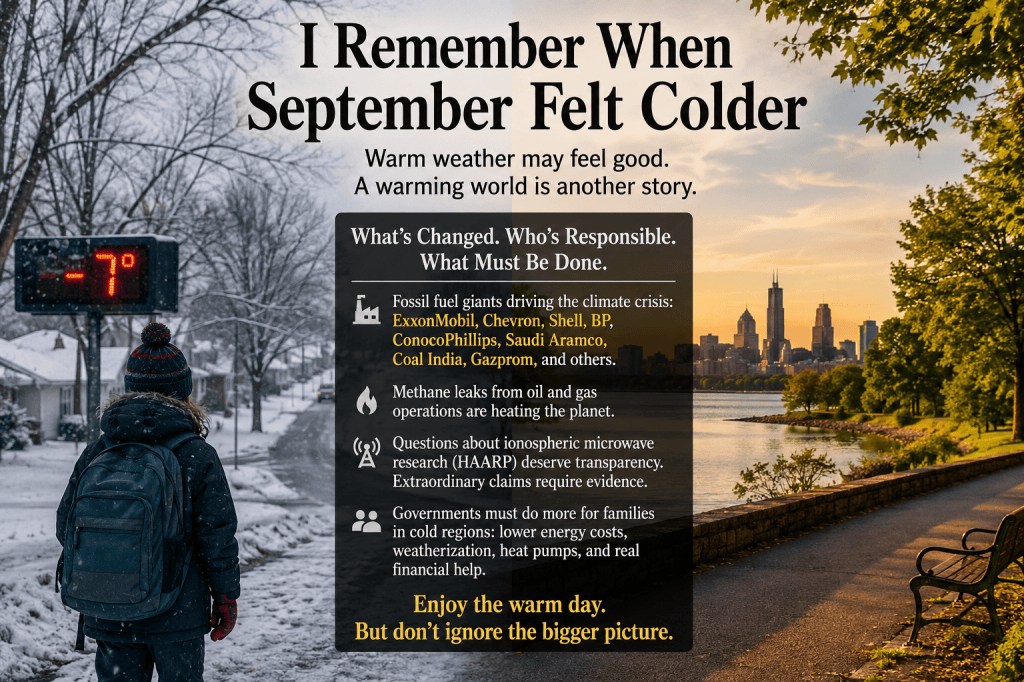
A warm Northeast may feel good. A warming world is another story.
August 30, 2026
NORTHEAST — I remember when the last week of August carried a warning: summer was ending, and the cold was coming.
It was around 1992. I was in second grade, and I remember the first week of September feeling brutally cold — readings around zero, even seven below, as I remember them. Whether those numbers were actual temperatures, wind chills, or simply a childhood memory blurred by 34 years, I remember one thing clearly:
It was cold.
Zero and below wasn’t normal for September across the Northeast. But cooler weather as August gave way to September was reasonable. Nights grew colder, Canadian air pushed south, windows started closing and mornings reminded you that fall wasn’t far away.
Today, warmth extending deeper into September doesn’t seem nearly as remarkable.
And that’s a strange thing.
Warmer Feels Better — Until You Look at the Planet
Nobody wants to freeze at a school bus stop.
Nobody in Maine, Vermont, New Hampshire, New York or Pennsylvania is going to complain because the furnace gets another week off.
Warmer weather can be desirable for people living in cold climates.
But there is an enormous difference between enjoying a warm September afternoon and continually warming the planet.
One hot day doesn’t prove climate change. One cold day doesn’t disprove it. Climate is measured across decades, and that record shows a warming Earth driven primarily by human-produced greenhouse gases.
That’s where this story becomes bigger than nostalgia about colder Septembers.
Follow the Carbon
If this were a newsroom in 1992, an editor would eventually ask:
Who’s responsible?
Start with the fossil-fuel economy.
Coal, oil and natural gas powered modern civilization, but burning them also released enormous quantities of carbon dioxide. Oil and gas operations additionally release methane, a potent greenhouse gas.
Among the world’s major fossil-fuel producers are Saudi Aramco, Coal India, CHN Energy, the National Iranian Oil Company and Gazprom.
Major investor-owned producers include ExxonMobil, Chevron, Shell, BP and ConocoPhillips.
They aren’t solely responsible. Governments permitted extraction. Banks financed it. Utilities burned the fuel. Industries demanded it, and ordinary people depended upon it.
But corporations that made enormous profits from fossil fuels cannot be absent when the bill for transitioning away from them arrives.
The same goes for methane leaks from wells, pipelines and processing facilities.
Find them. Measure them. Publish the results. Fix them.
A leaking pipe doesn’t require a climate summit.
It requires a wrench.
What About Ionospheric Microwaving?
People also raise questions about powerful radio-frequency transmissions into the ionosphere and facilities such as HAARP.
Those facilities and transmissions are real. Questions about government atmospheric research and demands for transparency are legitimate.
But there is no credible evidence establishing ionospheric radio research as the cause of global warming or demonstrating that it controls ordinary surface weather.
That’s an important distinction.
Governments should disclose what they’re doing, what frequencies and power levels are being used, and what environmental effects are being monitored.
But suspicion isn’t evidence.
When it comes to global heating, we already know where enormous quantities of greenhouse gases originate.
Don’t become so fascinated with the antenna that you stop looking at the smokestack.
Government Needs to Offer Northern Families More
Here’s where climate policy often loses people.
Come to the Northeast in January before telling families simply to stop using fossil fuels.
People heat their homes because they’re cold.
If governments expect households to change how they heat, drive and consume energy, governments must make the alternatives affordable.
That means greater assistance for insulation and weatherization, affordable heat pumps where appropriate, modern electrical grids, heating assistance, better transportation and help modernizing old homes.
And major fossil-fuel producers should shoulder a meaningful share of that transition.
Don’t hand a family a climate mandate and a $20,000 bill.
If society wants cleaner energy, society must help pay for it.
I Still Remember That September
I still remember second grade.
September 1992.
Cold air and the unmistakable feeling that summer was finished.
Maybe an old weather record would correct my memory of zero or seven below. That’s fine.
Memory remembers.
Instruments measure.
And those measurements tell us something more important than whether one morning 34 years ago was zero, seven below or considerably warmer.
The planet is warming.
That doesn’t mean we should wish for bitter cold again.
I’ll take 70 degrees over seven below.
Most people would.
But personal comfort and planetary health aren’t the same thing.
Late August cooling toward September is reasonable in the Northeast. Cold weather isn’t the enemy.
The danger is allowing a steadily warming climate to become so familiar that we stop noticing the baseline has changed.
So enjoy the warm September afternoon.
Just don’t mistake comfortable weather for evidence that everything is fine.
Governments need to demand more from major polluters, provide transparency about atmospheric research, and give people in cold-weather regions far more help transitioning to cleaner energy.
Because the goal isn’t to make Northeasterners cold again.
It’s to keep the planet from getting dangerously warmer while making sure ordinary people aren’t left paying the bill.
— August 30, 2026
 The ChillX Zone
Leave a comment