August 27, 2026
Across the United States, drivers are routinely told that crashes in highway construction zones are the result of speeding, distraction, or failure to obey signs.
Those factors are real. But they are not the entire story.
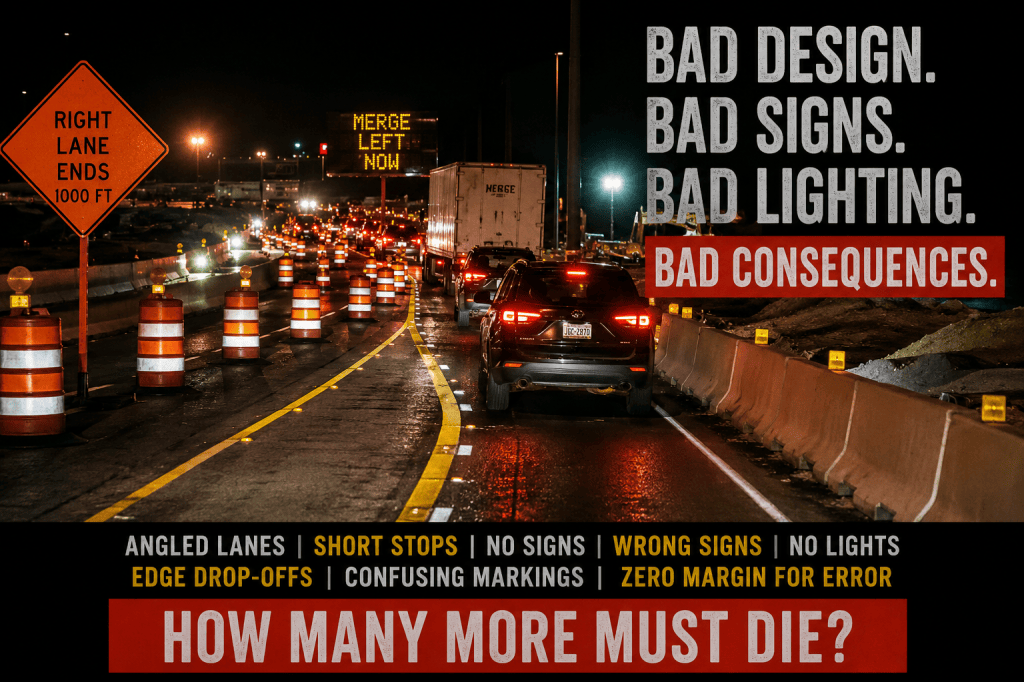
Behind every major roadwork zone is another system that receives far less public scrutiny: traffic-control plans, temporary lane geometry, concrete barriers, barrels, warning signs, pavement markings, construction equipment, lane closures and abrupt shifts that determine where motorists are expected to drive while a highway is being rebuilt.
When that temporary system fails—or when motorists cannot clearly understand it—the construction zone itself can become part of the danger.
Federal data show the scale of the problem. The Federal Highway Administration reported 763 fatal work-zone crashes and 850 work-zone deaths in 2024. Twenty-two percent of fatal crashes involved rear-end collisions, 31 percent involved large trucks or buses, and speeding was a factor in 34 percent.
A 2026 survey by the Associated General Contractors of America and HCSS found that 60 percent of highway contractors surveyed had experienced at least one vehicle crash in their work zones during the previous year. Nearly one-third reported five or more.
Those numbers demand a broader question:
When motorists are being routed through a roadway that has been temporarily redesigned for construction, who is responsible for making that temporary road understandable and safe?
THE TEMPORARY ROAD IS STILL A ROAD DESIGN
A construction zone is not merely a normal highway with orange barrels sitting beside it.
During major roadwork, contractors and transportation agencies may temporarily move lanes, eliminate shoulders, narrow travel paths, close exits, alter ramps, separate opposing traffic differently, change pavement markings and force several lanes to merge into fewer lanes.
The Federal Highway Administration says traffic management during construction is necessary both to manage delays and to maintain motorist and worker safety. Federal-aid highway projects are subject to transportation-management-plan requirements, and agencies are expected to monitor whether those strategies are actually working. Potential performance measures include queue length, crashes and other incidents, complaints and cumulative impacts from construction.
OSHA likewise points highway contractors and employers to federal temporary traffic-control standards governing signs, barricades, flagging and other work-zone protections.
The question, therefore, cannot always end with what a driver did seconds before a collision.
Investigators should also ask what the agency, engineering team, general contractor and traffic-control subcontractor did in the weeks and months before it.
WILLIAMS BROTHERS CONSTRUCTION: BARRIERS REPLACED BY PAINT AND BUTTONS
One of the clearest examples comes from Texas.
A TxDOT traffic-control plan for construction on Bay Area Boulevard called for concrete barriers separating opposing lanes of traffic.
According to the Texas Supreme Court’s description of the case, contractor Williams Brothers Construction Company determined there was insufficient space for those barriers and revised the configuration, substituting painted yellow stripes and pavement buttons.
Daniel Christ and Nicole Salinas were later traveling through the construction zone on a motorcycle when another vehicle crossed into their lane and struck them head-on.
They sued Williams Brothers, alleging among other things that the contractor’s failure to install the barrier and its deviations from the traffic-control layout contributed to the collision.
That allegation should not be confused with a judicial finding that Williams Brothers intentionally created a dangerous road. Indeed, litigation over the project produced rulings favorable to defendants on important issues.
But the case exposes precisely the kind of question that deserves national attention:
When a construction plan calls for a physical separation between opposing traffic, what happens when that separation is replaced with pavement markings motorists can cross?
Williams Brothers has surfaced in another recent work-zone dispute. Following an April 2026 fatal I-10 collision near Winnie, Texas, the family of reserve deputy constable Heather Avery sued Williams Brothers Construction and a trucking company. The lawsuit alleges, among other things, that necessary work-zone safety protections such as crash cushions were not installed. Those remain allegations rather than established findings of liability.
WEBBER LLC: A $245 MILLION PROJECT AND A SURGE OF CRASHES
Another Texas project illustrates what happens when an entire community begins questioning a construction corridor.
Webber LLC is the contractor on TxDOT’s approximately $245 million I-10 expansion between FM 464 and State Highway 130 near Seguin.
Between October 1 and December 30, 2025, Seguin police recorded 74 crashes, with 69 occurring inside the I-10 construction zone.
Police Chief Jason Brady called the number extraordinary and said the crashes were straining local emergency resources. Officials subsequently met with TxDOT and Webber to discuss the problem.
Reporting from the corridor has described lane merges, changing access points, reduced speed limits and construction-related navigation challenges. A May 2026 report observed choke points where six lanes merge into four and described limited advance warning at some locations.
But there is important counterevidence.
TxDOT reported that approximately 75 percent of the crashes were attributed to driver behaviors including speeding, unsafe lane changes and inattention. TxDOT and Webber have also inspected traffic-control arrangements and added or used measures including warning signs, message boards, reflective markers and additional lighting.
That makes Seguin particularly important.
It demonstrates that construction-zone safety does not have to be an either/or question.
Drivers can behave negligently and a road configuration can make the consequences of that negligence worse.
AUSTIN MATERIALS: WHERE WAS THE WARNING SIGN?
Another Texas case involved Austin Materials LLC, an asphalt paving contractor performing road construction under contract with TxDOT.
In 2019, Sonia Troche encountered an unexpected slowdown on I-10 in a construction zone. A tractor-trailer approaching from behind was unable to stop and struck her vehicle.
Troche suffered catastrophic injuries, and the truck driver died.
Her guardian sued Austin Materials, alleging that an electronic warning sign notifying motorists about the lane closure had not been placed where the company’s TxDOT contract required it.
The contract required the contractor to provide motorists with safe passage through the project while minimizing inconvenience.
Again, an allegation in litigation is not proof of negligence.
But the case demonstrates why something as mundane as the location of a message board can become a life-or-death engineering decision.
At highway speed, several hundred additional feet of warning can mean several additional seconds to perceive a stopped queue and brake.
HAYDON BUILDING CORPORATION AND TRAFFIC CONTROL SPECIALIST
A separate Texas wrongful-death case identified another layer of the road-construction system: subcontracting.
Haydon Building Corporation was the general contractor on a TxDOT bridge project over Interstate 10 in El Paso and had responsibility under its contract for implementing and maintaining the project’s traffic-control plan.
Haydon subcontracted traffic-control work to Leedsman Construction Inc., doing business as Traffic Control Specialist.
The traffic-control plan included freeway closures as well as requirements concerning signs, barricades, traffic-control devices and truck-mounted attenuators.
After a construction worker was killed, his daughter brought claims alleging negligent implementation of the traffic-control plan. An appellate court in 2024 concluded that factual disputes remained and affirmed the denial of Haydon’s motion for summary judgment.
This case highlights an accountability problem the driving public rarely sees.
The agency may design a plan.
A general contractor may be responsible for carrying it out.
A subcontractor may actually install and move the traffic-control devices.
Inspectors may monitor compliance.
When something goes wrong, responsibility can become divided among multiple organizations.
SHIRLEY CONTRACTING AND RICHMOND TRAFFIC CONTROL
The issue is not confined to Texas.
In Virginia, motorist Stephanie Blanchard brought litigation involving Richmond Traffic Control Inc. and Shirley Contracting Company LLC after a collision associated with an I-95 construction work zone.
The case involved lane closures on an I-95 South entrance ramp. Blanchard alleged that the work-zone design and signage were unsafe and failed to satisfy applicable safety standards.
A jury ultimately ruled for the contractors.
That outcome matters. Naming a contractor in a lawsuit does not establish that the contractor caused the crash.
But the litigation demonstrates that temporary traffic-control design itself can become a central factual issue after a serious roadwork collision.
THE DEADLY END OF THE QUEUE
One of the most dangerous places in a highway construction project may not be beside the workers.
It may be hundreds or thousands of feet upstream, where traffic unexpectedly stops.
The National Transportation Safety Board is investigating a March 13, 2025 multivehicle crash on Interstate 35 in Austin, Texas.
According to the NTSB’s preliminary information, a tractor-trailer entered a long-term work zone and encountered a traffic queue caused by lane closures approximately 0.4 miles farther south.
The truck did not stop before reaching the slowing traffic. It struck vehicles at the back of the queue and continued through the line of traffic, ultimately involving numerous vehicles.
The immediate conduct of the truck driver is obviously part of that investigation.
But the crash also illustrates why work-zone engineering has to account for predictable human behavior.
If construction predictably produces sudden queues on a high-speed interstate, transportation agencies and contractors know—or should know—that motorists will periodically approach those queues too quickly.
The safety question then becomes not merely whether drivers should pay attention.
It becomes whether the system gives them the best possible chance to survive when somebody does not.
THIS IS A NATIONAL PROBLEM
No evidence uncovered for this article establishes that America’s road contractors are deliberately designing highways to cause crashes.
That would be an extraordinary allegation requiring extraordinary evidence.
The documented problem is more concrete—and more useful to investigate.
America routinely converts high-speed public highways into temporary transportation systems using contractors, subcontractors, engineering plans, barrels, temporary stripes, barriers, attenuator trucks, message boards and warning signs.
Crashes continue to occur inside those systems.
Sometimes lawsuits accuse contractors of improper signs or traffic-control configurations.
Sometimes courts reject those allegations.
Sometimes investigators identify driver behavior as the dominant factor.
And sometimes the final allocation of responsibility remains contested for years.
That complexity should not become an excuse for avoiding scrutiny.
FOLLOW THE CONTRACT
Every serious work-zone crash should trigger questions that go beyond the police report:
Who designed the traffic-control plan?
Who approved it?
Which company was contracted to implement it?
Was traffic control subcontracted?
Were barriers installed where the plans required them?
Were temporary pavement markings visible at night and in rain?
How much advance warning did motorists receive before a lane ended?
Could an unfamiliar driver distinguish the temporary lane from the old roadway?
Were signs obscured, contradictory or placed too late?
Did queues routinely extend beyond the project’s advance-warning system?
Were previous crashes reported at the same location?
Did the contractor or transportation department alter the configuration after those crashes?
And most importantly:
If officials changed the work zone after repeated collisions, why wasn’t that protection there before them?
Those are not anti-construction questions.
They are public-safety questions.
America needs roads repaired, bridges replaced and highways expanded. Construction inevitably disrupts traffic, and motorists unquestionably have a responsibility to slow down and pay attention.
But road contractors and government transportation agencies also have a responsibility.
A driver entering a work zone should not have to decipher an engineering experiment at 60 miles per hour.
Orange barrels do not suspend the obligation to provide a roadway that ordinary people can understand.
And when a roadwork corridor repeatedly produces crashes, the public deserves more than another electronic sign telling drivers to be careful.
It deserves the contracts.
It deserves the traffic-control plans.
It deserves the inspection records.
It deserves the crash history.
And it deserves to know exactly which government agencies, engineering firms, general contractors and traffic-control subcontractors made the decisions that put that temporary road in front of the American driver.
 The ChillX Zone
Leave a comment