August 29, 2026
A new kitchen looks beautiful.
Fresh cabinets.
New countertops.
New flooring.
Fresh paint.
Everything sealed, polished and ready for the homeowner.
But what is happening where nobody can see?
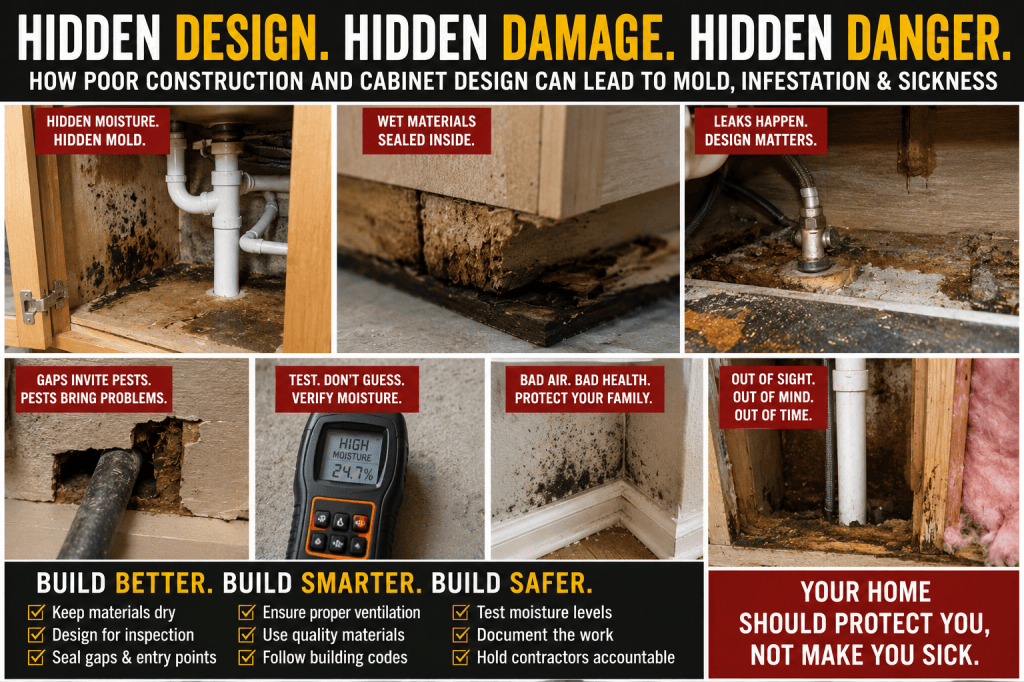
Behind the cabinets.
Under the sink.
Against the exterior wall.
Under the flooring.
Inside the wall cavity.
Behind the dishwasher.
Around plumbing penetrations.
Under particleboard cabinet bases.
Inside damp wood that was enclosed before it completely dried.
Those hidden spaces deserve far more attention because a house can look finished on the outside while moisture is accumulating where homeowners cannot see it.
And moisture changes everything.
It can support mold.
It can contribute to wood deterioration.
It can damage cabinetry and building materials.
And damp indoor environments can create legitimate health concerns.
The Environmental Protection Agency is explicit: the key to controlling mold is controlling moisture. Mold can grow on wood, paper and other materials when sufficient moisture is present.
So America needs to start asking a different question about housing construction:
Are we designing and building homes that adequately prevent moisture—or are some construction practices creating hidden spaces where moisture, mold and deterioration can flourish?
WOOD AND WATER ARE A SERIOUS COMBINATION
Wood is everywhere in American residential construction.
Framing.
Subfloors.
Roof decking.
Cabinets.
Trim.
Doors.
Furniture.
Engineered wood products.
Wood itself is not the enemy.
The problem is moisture.
EPA guidance says mold can grow on wood and other organic materials when moisture and oxygen are present. The agency also warns that mold gradually destroys the material on which it grows.
Yet houses are sometimes constructed through rain, snow and high humidity.
Wood can become wet during transportation.
Building materials can sit outside.
Framing can get soaked before the building is enclosed.
EPA construction guidance specifically warns that moisture-absorbing building materials—including wood—should be kept dry to prevent mold and bacterial growth. It also acknowledges that wood can arrive at a construction site with high moisture content or become wet during transportation or construction.
That creates an obvious accountability question:
Who verifies that wet building materials are sufficiently dry before contractors seal them inside the house?
DON’T BUILD A WALL AROUND THE PROBLEM
Construction schedules move quickly.
One trade follows another.
Framing.
Plumbing.
Electrical.
Insulation.
Drywall.
Cabinets.
Flooring.
Paint.
Finish work.
But water does not care about the construction schedule.
If wet material is enclosed before it adequately dries, the moisture does not disappear simply because somebody installed drywall over it.
EPA guidance says water-damaged materials generally should be dried within 24 to 48 hours to help prevent mold growth.
That should raise a fundamental question for builders:
Where are the moisture measurements?
Before enclosing walls containing wet framing, why shouldn’t builders document moisture conditions?
Before installing cabinets against a wall affected by a plumbing leak, why shouldn’t the area be verified as dry?
Before installing flooring over a damp subfloor, why shouldn’t somebody measure it?
Homeowners cannot inspect what contractors permanently conceal.
That gives the people doing the construction an enormous responsibility.
CABINETS CAN HIDE WATER FOR MONTHS
Kitchen and bathroom cabinets deserve special attention.
They contain plumbing.
They sit beside sinks.
They may surround dishwashers.
Bathroom vanities are exposed to water and humidity.
Cabinet bases may sit directly against walls and floors.
Now consider a slow plumbing leak beneath a sink.
Water enters the cabinet.
It penetrates seams.
It reaches the wall.
It travels beneath the cabinet.
But the cabinet itself can prevent the homeowner from easily seeing what is happening behind it.
By the time someone smells something unusual or notices swelling, staining or deterioration, the hidden area may have been wet for an extended period.
EPA identifies leaking pipes, including pipes hidden inside walls and utility cavities, as common sources of building moisture problems.
That is why cabinet design should not be judged exclusively by appearance.
It should also be judged by what happens when something leaks.
Can the homeowner see the leak?
Can water escape?
Can the area dry?
Can plumbing connections be inspected?
Can the cabinet base be removed without destroying the entire installation?
Can the wall behind the plumbing be accessed?
Or has everything been boxed into a dark cavity where a small leak can remain hidden?
DESIGN FOR INSPECTION
America needs a simple building principle:
If something can leak, somebody should be able to inspect it.
Water supply connections can leak.
Drain connections can leak.
Dishwashers can leak.
Refrigerator water lines can leak.
Ice makers can leak.
Garbage disposal connections can leak.
Bathroom plumbing can leak.
HVAC condensate systems can leak.
Roofs can leak.
Windows can leak.
The solution is not pretending these failures will never occur.
The solution is designing homes so failures can be discovered quickly.
A beautiful cabinet that conceals a leak for six months is not necessarily a better design than a cabinet incorporating accessible inspection areas.
HOMES ALSO NEED TO DRY
Stopping water intrusion is only part of moisture control.
Buildings must also be able to dry appropriately.
EPA warns that buildings have to be designed for their climate, site and use, and that the design must be correctly followed during construction to prevent moisture-control problems.
The agency also warns that improperly located or installed vapor barriers can contribute to moisture problems by preventing wet materials from drying quickly enough.
That is critical.
A contractor can install every layer specified on a drawing and still create a problem if the assembly is wrong for the climate or installed incorrectly.
The question cannot merely be:
Was something installed?
It should be:
Does the completed building actually manage water and moisture correctly?
TIGHTER HOMES REQUIRE BETTER MOISTURE MANAGEMENT
Modern houses are frequently designed to reduce uncontrolled air leakage.
That can improve energy efficiency.
But tighter construction makes ventilation and moisture management even more important.
EPA notes that changes in construction practices have produced tightly sealed buildings that, in some cases, lack adequate ventilation. Without adequate ventilation, indoor moisture can accumulate and mold can grow.
That does not mean energy-efficient construction causes sickness.
It means energy efficiency cannot be designed independently of indoor air and moisture management.
Seal the house tighter?
Then design ventilation correctly.
Insulate heavily?
Then understand where condensation can occur.
Install vapor-control materials?
Then make sure they belong where they are being installed for that climate.
Build cabinets tightly against walls?
Then consider how hidden moisture will be detected.
Good construction requires the entire system to work together.
WHAT ABOUT INFESTATION?
Moisture problems can also accompany conditions attractive to some household pests, while construction gaps can provide pathways into buildings.
But claims about infestation need to be specific.
Not every cabinet attracts insects.
Not every piece of engineered wood creates pests.
Not every moisture problem produces an infestation.
The legitimate construction question is whether builders are leaving gaps, penetrations, inaccessible cavities, persistent moisture or deteriorating materials that make pest prevention and detection more difficult.
Plumbing penetrations are an obvious example.
A pipe enters a cabinet through an oversized opening.
Nobody seals the remaining space.
That opening may lead into a wall cavity.
The homeowner sees a pipe.
A pest sees a pathway.
Again, the issue is not that the cabinet was intentionally designed to make people sick.
The issue is whether construction practices unnecessarily create hidden, inaccessible environments that homeowners cannot reasonably inspect or maintain.
SICKNESS CLAIMS REQUIRE EVIDENCE
Health claims must also be handled responsibly.
Not every headache is caused by a house.
Not every respiratory symptom is caused by mold.
And finding mold does not automatically establish the cause of a particular person’s illness.
But that does not mean damp buildings are harmless.
EPA says mold exposure can cause allergic reactions, irritate the eyes, skin, nose, throat and lungs, and trigger asthma attacks in people with asthma who are allergic to mold.
CDC-published research has likewise discussed associations between damp indoor environments and respiratory symptoms and diseases.
So the responsible position is neither panic nor dismissal.
It is prevention.
Keep buildings dry.
FOLLOW THE CONTRACTOR
When a newly constructed or renovated house develops extensive hidden moisture or mold, homeowners should be able to determine who performed the relevant work.
Who framed the house?
Who installed the roof?
Who installed the windows?
Who performed the plumbing?
Who installed the cabinets?
Who installed the dishwasher?
Who installed the HVAC system?
Who waterproofed the foundation?
Who installed the siding?
Who performed insulation and air sealing?
Who inspected the work?
Who was the general contractor?
And, critically:
Who was responsible for verifying moisture conditions before wet materials disappeared behind finished surfaces?
The answer should not become an endless circle of subcontractors pointing at one another.
BUILDERS SHOULD DOCUMENT WHAT THEY COVER
Modern construction already generates enormous amounts of documentation.
Plans.
Permits.
Invoices.
Inspection reports.
Change orders.
Product specifications.
Warranty documents.
Why not create a moisture record?
For critical areas, builders could photograph conditions before walls, cabinets and flooring permanently conceal them.
Document major plumbing connections.
Document waterproofing.
Document window flashing.
Document under-sink plumbing before cabinetry prevents easy access.
Document moisture readings where significant wetting occurred during construction.
Document repairs after leaks.
Give those records to the homeowner.
The technology required is hardly revolutionary.
A smartphone can photograph an entire house before drywall installation in minutes.
BUILDING CODES SHOULD ADDRESS ACCESS, NOT JUST INSTALLATION
Legislators, building-code organizations and local governments should examine whether existing requirements adequately address long-term inspection and maintenance.
Building something correctly on day one is not enough if nobody can inspect it on day 500.
Critical plumbing connections should remain reasonably accessible.
Known leak-prone areas should be designed for early detection.
Cabinetry surrounding plumbing should permit practical inspection.
Building assemblies should be appropriate for the climate.
Ventilation should actually move moisture where it is supposed to go.
And builders should not permanently enclose known wet materials simply to keep a project moving.
DON’T BLAME THE HOMEOWNER FOR WHAT THE HOMEOWNER CANNOT SEE
Homeowners have responsibilities.
They should repair leaks.
Use bathroom exhaust fans.
Control excessive humidity.
Maintain roofs and gutters.
Respond to visible water damage.
EPA recommends keeping indoor humidity below 60 percent where possible, ideally around 30 to 50 percent.
But homeowners cannot maintain what contractors have made inaccessible.
A homeowner cannot repair a leak he cannot see.
She cannot dry wet framing she does not know was enclosed.
A family cannot inspect a plumbing connection permanently hidden behind finished construction.
That is why accountability must begin before the house is sold.
THIS IS NOT “SICKNESS BY DESIGN” WITHOUT PROOF
There is no evidence presented here that American builders, cabinet manufacturers or contractors collectively and intentionally design homes to make occupants sick.
That accusation requires evidence of intent.
But there is a legitimate and much more important question:
Can poor design, improper material handling, inadequate moisture control, inaccessible plumbing, defective installation or rushed construction create a home that is unnecessarily vulnerable to moisture, mold, deterioration and unhealthy indoor conditions?
The answer is yes.
Federal building guidance exists precisely because moisture must be considered during design, construction and maintenance.
The problem therefore deserves investigation without exaggeration.
BUILD HOMES THAT CAN BE INSPECTED
America should demand homes designed not only for the day they are sold but for the decades people will live inside them.
Design for leaks.
Design for inspection.
Design for drainage.
Design for ventilation.
Design for drying.
Design for maintenance.
Keep wood dry.
Keep construction materials dry.
Seal unnecessary pest pathways.
Make plumbing accessible.
Document concealed work.
Test moisture before enclosing wet construction.
And stop treating everything behind the finished wall or cabinet as somebody else’s problem.
Because when a family discovers mold behind a cabinet, rotted material beneath a floor or years of hidden moisture inside a wall, the most important question may not be:
Why didn’t the homeowner notice sooner?
It may be:
Who designed and built the condition that made the problem so difficult to notice in the first place?
Follow the moisture.
Follow the materials.
Follow the design.
Follow the inspections.
And follow the contractor.
 The ChillX Zone
Leave a comment