August 28, 2026
America must be able to defend itself.
If the United States is attacked, the President cannot wait days or weeks for Congress to debate while Americans are under fire. The military must be capable of responding immediately to an actual attack, protecting American territory, defending American forces and stopping an imminent threat.
But defending America is not the same thing as giving any president an open-ended power to take the country into another prolonged conflict.
Those two ideas have been blurred for far too long.
Washington has built a political system in which presidents of both parties have accumulated enormous freedom to use military force while Congress repeatedly avoids the responsibility the Constitution assigns to it.
The result is predictable.
Another operation.
Another deployment.
Another bombing campaign.
Another emergency.
Another supplemental appropriation.
Another explanation for why this particular military action supposedly does not require a declaration of war.
Then taxpayers receive the bill.
Service members and their families carry the risk.
And Congress argues about its constitutional authority after military operations have already begun.
That system needs to change.
THE CONSTITUTION DID NOT MAKE CONGRESS A SPECTATOR
The Constitution gives Congress the power to declare war.
The President is Commander in Chief.
Those responsibilities were divided for a reason.
America needs an executive capable of responding rapidly when the nation is attacked. But decisions about sustained warfare were never supposed to become the exclusive judgment of one individual.
The War Powers Resolution of 1973 was itself an attempt to restore that balance after Vietnam.
The law says its purpose is to ensure the collective judgment of Congress and the President applies when American forces are introduced into hostilities.
Under the existing law, a president generally must report to Congress within 48 hours after introducing forces into hostilities without prior authorization.
The law then establishes a 60-day termination requirement unless Congress declares war, specifically authorizes the operation or extends the period. An additional period of up to 30 days can apply when necessary to safely remove American forces.
That sounds like a limitation.
In practice, it has repeatedly produced arguments over what constitutes “hostilities,” when the clock starts, whether it stopped, whether an operation amounts to a constitutional “war,” and how much unilateral authority the President possesses.
The Congressional Research Service has described the War Powers Resolution’s record as mixed and noted the longstanding controversy over whether it has actually ensured Congress an adequate role in committing American forces abroad.
After more than half a century, that should tell us something.
The law needs an overhaul.
THIS SHOULD NOT BE A REPUBLICAN OR DEMOCRATIC QUESTION
This problem is bigger than Donald Trump.
It is bigger than Joe Biden.
It is bigger than Barack Obama, George W. Bush or any individual president.
Presidents from both parties have asserted substantial authority to use military force without traditional declarations of war.
That is exactly why reform should be written without knowing who will occupy the White House next.
A good constitutional restriction is one you are willing to impose on your own candidate.
If Republicans believe a Democratic president should not be able to initiate an extended war without Congress, they should accept the same restriction under a Republican president.
If Democrats believe a Republican president requires congressional authorization, they should accept precisely the same rule when a Democrat controls the military.
War powers should not expand and contract depending upon which political party occupies the Oval Office.
THE IRAN CONFLICT SHOWS WHY THE QUESTION IS URGENT
Congress has spent much of 2026 fighting over precisely this issue.
In July, the House voted 214-208 for a measure directing the President to remove U.S. forces from unauthorized hostilities involving Iran. Four Republicans joined Democrats.
A separate Senate effort failed to advance 47-49.
Earlier congressional efforts produced additional votes and bipartisan defections over presidential war authority.
Supporters of tighter restrictions argue that Congress is reclaiming a constitutional responsibility it surrendered.
Opponents argue that presidents require flexibility to confront threats and that excessive congressional interference can weaken the Commander in Chief during dangerous international confrontations.
Both concerns deserve to be taken seriously.
Which is precisely why Congress should write a better law.
PROTECT THE COUNTRY — ABSOLUTELY
Any new War Powers Act should begin with an unequivocal principle:
If America is attacked, America fights back.
The President should retain immediate authority to repel an actual or imminent attack against the United States, its territories and American armed forces.
No enemy should believe congressional procedure prevents America from defending itself.
No American service member under attack should have to wait for a roll-call vote.
No terrorist organization should receive a procedural advantage because Congress is out of session.
Emergency defensive authority is necessary.
But emergency authority should be exactly that:
Emergency authority.
It should not quietly transform into months or years of offensive warfare without an affirmative vote from the people’s elected representatives.
CONGRESS SHOULD HAVE TO PUT ITS NAME ON THE WAR
A new law should reverse Washington’s political incentives.
If sustained military action is necessary, Congress should vote.
Not issue statements.
Not appear on television.
Not complain afterward.
Vote.
Every member should have to answer a straightforward question:
Do you authorize this war or don’t you?
If lawmakers believe the conflict is necessary to protect America, they should have the courage to put their names behind it.
If they are unwilling to vote for it, they should not expect American service members to fight it indefinitely.
NO MORE PERMANENT BLANK CHECKS
Congress should also stop writing military authorizations that can effectively survive forever.
Every future Authorization for Use of Military Force should contain a mandatory expiration date.
No automatic indefinite authority.
If a military operation remains necessary after the authorization expires, Congress can renew it.
That forces lawmakers to examine what changed.
What was accomplished?
What failed?
How many Americans were killed or wounded?
How much has the operation cost?
What is the objective now?
What constitutes victory?
What is the exit strategy?
And does the original threat still exist?
If Congress cannot answer those questions, perhaps it should not authorize another year of war.
REQUIRE A PUBLIC PRICE TAG
Americans should know what military intervention is costing them.
Emergency operations obviously cannot always be predicted in advance.
But once sustained hostilities begin, Congress should receive regular public accounting.
How much has been spent?
How much ammunition has been consumed?
What equipment has been lost?
What additional appropriations will be required?
What costs are expected over the next six months?
What are the projected long-term costs of caring for wounded veterans?
War is sometimes necessary.
Necessary war is still expensive.
Government should never disguise that fact.
STOP MAKING WAR POLITICALLY EASIER THAN DOMESTIC SPENDING
Congress can spend months arguing over comparatively small domestic programs.
Yet once military operations begin, enormous expenditures can suddenly be described as unavoidable necessities.
That imbalance deserves scrutiny.
National defense is one of the federal government’s fundamental responsibilities.
But calling something “defense” should not exempt it from questions about effectiveness, necessity or waste.
A billion dollars wasted remains a billion dollars wasted whether it disappears into a failed domestic program or an unnecessary military operation.
Fiscal responsibility cannot stop at the Pentagon’s front door.
CONGRESS NEEDS RESPONSIBILITY, NOT JUST POWER
There is another side to this debate that lawmakers may not like.
Congress cannot demand war powers while continually avoiding war votes.
The Constitution does not merely give legislators authority.
It gives them responsibility.
Lawmakers benefit politically when presidents make the difficult decision.
If the operation succeeds, members can praise it.
If it fails, they can condemn the President.
If they never voted, they can claim it was never their war.
That arrangement may be politically convenient.
It is constitutionally unhealthy.
A stronger War Powers law should therefore force Congress to act.
After the emergency period expires, Congress should have to conduct an up-or-down vote.
No hiding the authorization in committee.
No indefinite postponement.
No pretending silence constitutes consent.
Yes or no.
DEFINE THE MISSION BEFORE APPROVING THE WAR
Future military authorizations should also answer basic questions.
Who is the enemy?
Where may force be used?
What is the objective?
How long does authorization last?
What geographical boundaries apply?
What circumstances permit expansion?
Does the authorization permit ground troops?
What reporting does Congress receive?
What conditions terminate the authority?
Those questions sound obvious.
They should be.
The more vaguely Congress writes military authority, the easier it becomes for future administrations to stretch yesterday’s authorization into tomorrow’s completely different conflict.
THE PEOPLE WHO VOTE FOR WAR SHOULD OWN THE CONSEQUENCES
War should never become just another Washington policy instrument.
People die.
American service members die.
Civilians die.
Families lose sons and daughters.
Veterans return with injuries that can last for the rest of their lives.
Taxpayers can spend hundreds of billions of dollars long after television cameras move on to another story.
That does not mean America should never fight.
It means the threshold for sustained war should be appropriately high.
DEFENSE IS NOT WARMONGERING
There is an important distinction.
Maintaining a powerful military is not warmongering.
Deterrence can prevent wars.
Destroying an imminent threat can save lives.
Defending American troops under attack is not optional.
And there are circumstances in which refusing to fight can ultimately cost more lives than fighting.
But constantly expanding the definition of what requires American military intervention creates its own danger.
Washington should not need another enemy simply because its political institutions have become accustomed to operating in a permanent state of conflict.
Foreign policy needs more than military options.
Diplomacy is not weakness.
Negotiation is not surrender.
Economic pressure is not appeasement.
And asking whether a military operation actually makes Americans safer is not anti-military.
It is exactly the question civilian leaders should be asking before sending the military into danger.
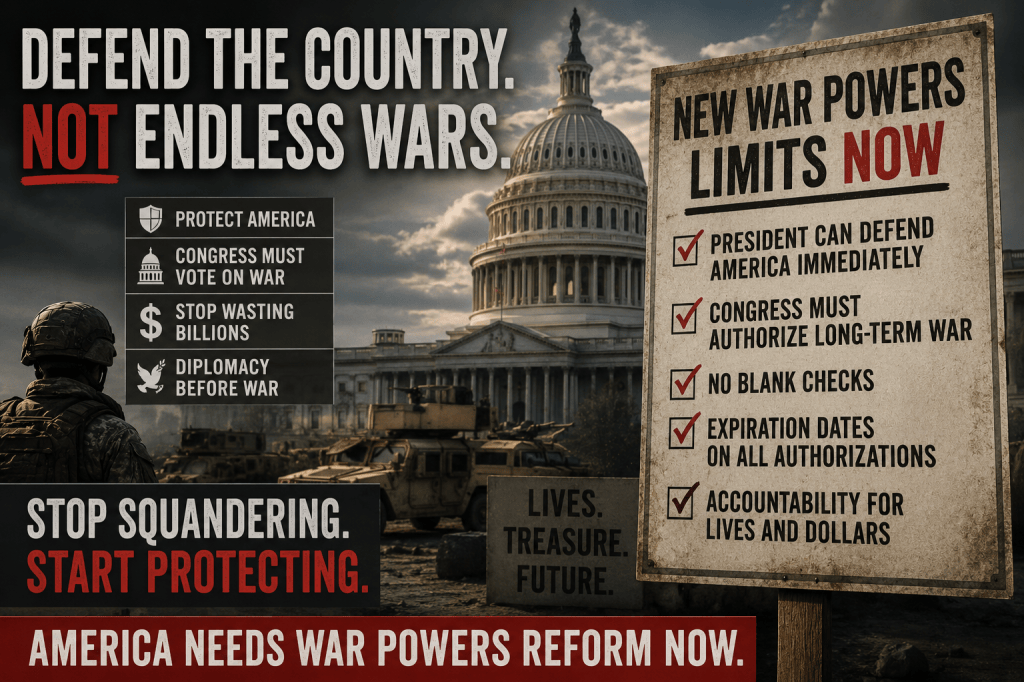
A NEW WAR POWERS ACT
Congress should replace or substantially strengthen the 1973 framework.
A serious reform should establish:
Immediate presidential authority to repel attacks and address genuine imminent threats.
A much shorter deadline for affirmative congressional authorization of sustained offensive hostilities.
A mandatory recorded vote by Congress.
Automatic expiration of every future Authorization for Use of Military Force.
Clearly defined enemies, objectives and geographic limits.
Automatic termination when authorization expires unless Congress renews it.
Regular public cost reporting.
Regular casualty and readiness reporting consistent with operational security.
Restrictions on using unrelated decades-old authorizations to justify new wars.
Mandatory congressional reconsideration before substantially expanding a conflict into another country or against another enemy.
Expedited voting procedures so congressional leadership cannot bury war-powers legislation indefinitely.
And Congress should use its constitutional appropriations authority to reinforce those limits while ensuring that American personnel are never abruptly deprived of resources necessary for their immediate protection and safe withdrawal.
NO PRESIDENT SHOULD OBJECT TO THAT STANDARD
This should be the test:
Imagine the president you trust least.
Now imagine that person possessing the war powers you are willing to give the president you trust most.
Still comfortable?
If not, the law is too broad.
The presidency changes hands.
War powers remain.
America does not need a weak Commander in Chief.
It needs a constitutionally accountable Commander in Chief backed by a Congress willing to perform its own constitutional duty.
Protect America?
Yes.
Destroy an imminent threat?
Yes.
Defend American troops?
Absolutely.
But launch an open-ended conflict, expand it, spend billions of dollars and keep Americans fighting without a clear congressional mandate?
No.
National defense is necessary.
Permanent war is not a national strategy.
And American blood and American treasure should never become Washington’s blank check.
Defend the country.
Make Congress vote.
Put an expiration date on war.
And stop squandering lives and billions on conflicts that the nation’s elected representatives are unwilling to openly authorize.
 The ChillX Zone
Leave a comment