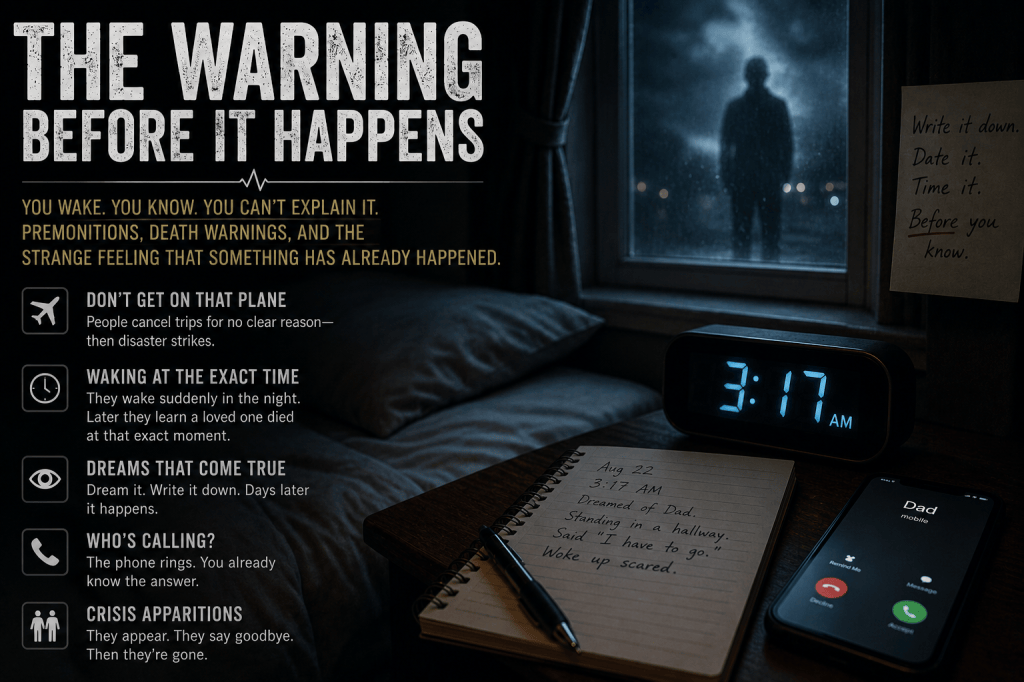
People Wake Moments Before a Loved One Dies. They Avoid Flights, Change Routes and Know Who’s Calling Before the Phone Rings. Coincidence—or Does Something Reach Us Early?
August 22, 2026
PARANORMAL DESK
You wake suddenly.
No nightmare.
No noise.
No reason.
You look at the clock.
3:17 a.m.
Something feels wrong.
Not frightening exactly.
Just wrong.
You think about your father.
Maybe your sister.
Maybe someone you haven’t thought about in months.
Eventually you fall asleep.
The telephone rings in the morning.
There’s been an accident.
They died during the night.
You ask when.
Around 3:17.
And suddenly that meaningless moment in the darkness isn’t meaningless anymore.
Stories like this have circulated for generations.
A mother knows her child is in danger.
Someone dreams of a death shortly before it occurs.
A traveler develops an overwhelming feeling that they shouldn’t board a plane.
A driver inexplicably takes another road and later discovers there was a terrible accident on the usual route.
A telephone rings and somehow you already know who’s calling.
We call them premonitions.
But what exactly are they?
Coincidence?
Subconscious prediction?
Memory playing tricks?
Or information arriving before it should?
“DON’T GET ON THAT PLANE”
It’s practically become a paranormal cliché.
Someone has a terrible feeling about a trip.
They cancel.
The plane crashes.
The train derails.
Something terrible happens.
Those stories are powerful because we hear about the person who stayed home.
We don’t hear about the thousands of people who woke with a terrible feeling, canceled perfectly safe plans and spent the afternoon watching television.
That’s the statistical problem with premonitions.
Human beings have enormous numbers of thoughts every day.
Most predict nothing.
When one accidentally corresponds with a later event, we remember it.
Suddenly:
I knew it.
Maybe you did.
Or maybe probability eventually produced one extraordinary coincidence.
THE BRAIN IS ALWAYS PREDICTING
There’s another possibility that doesn’t require anything supernatural.
Your brain is an astonishing prediction machine.
It notices things you don’t consciously notice.
A strange sound from the engine.
A person’s unusual tone of voice.
Weather changing.
Someone behaving differently.
A subtle physical sensation.
You may not consciously assemble those clues.
Instead, you get:
A feeling.
Don’t go.
Call Mom.
Check the door.
Something’s wrong.
We call it intuition.
Sometimes intuition may simply be unconscious information reaching consciousness without bringing the calculations along with it.
Your brain gives you the answer without showing its work.
That’s remarkable enough.
But it doesn’t explain every story.
THE 3:17 PROBLEM
The most interesting cases involve timing.
You wake suddenly at 3:17.
Later you discover someone close to you died at approximately 3:17.
There was no telephone call.
No message.
Nobody in the house knew.
So what woke you?
Maybe nothing.
People wake during the night constantly.
Normally we forget.
But attach tragedy to that moment and memory preserves it.
There’s another complication.
Death times aren’t always exact.
Memories aren’t always exact either.
“It was around three.”
Over the years, around three becomes 3:17.
The story improves.
Human memory isn’t a video recording.
It’s reconstruction.
That’s why paranormal evidence becomes much stronger when somebody writes the experience down before learning what happened.
WRITE IT DOWN
This is one of the simplest paranormal experiments anyone can perform.
If you have a disturbing dream tonight, document it immediately.
Date.
Time.
Names.
Places.
Numbers.
Colors.
Exact events.
Don’t post a vague prediction saying:
Something terrible will happen soon.
Something terrible is always happening somewhere.
Write:
I dreamed my brother was standing beside a red truck near a flooded road.
Now you’ve created something testable.
If nothing happens, keep that record too.
That’s crucial.
You cannot count the hits and throw away the misses.
Otherwise we’re not investigating premonition.
We’re manufacturing it.
THE DREAM BEFORE THE NEWS
Dreams create some of the strangest claims.
Someone dreams of a relative saying goodbye.
The next morning they learn the relative died.
Someone dreams about an accident.
Days later something resembling it occurs.
Someone sees a location they’ve supposedly never visited—then recognizes it later.
The skeptical explanation is powerful.
We dream constantly.
Most dreams disappear within minutes of waking.
Occasionally reality resembles one.
Then the matching dream becomes unforgettable while thousands of meaningless dreams vanish.
But some cases contain unusually specific details.
Those are the ones worth preserving.
Not because specificity proves psychic ability.
Because specificity makes coincidence harder to hide behind.
CRISIS APPARITIONS
There is an older and stranger variation.
Someone doesn’t merely feel that a loved one is in danger.
They see them.
A person appears briefly in a bedroom.
A familiar voice calls their name.
Someone seems to stand at the foot of the bed.
Then disappears.
Later comes the news:
The person died around that time.
Parapsychological literature has traditionally called experiences of this kind crisis apparitions, particularly when they appear connected with death or extreme danger.
Are they ghosts?
Telepathy?
Hallucinations?
Coincidence?
Nobody has established an answer.
But these reports are old enough that smartphones can’t be blamed for inventing them.
WHO’S CALLING?
Then there’s the tiny version almost everyone recognizes.
The phone rings.
Before looking, you think:
That’s Sarah.
It is Sarah.
Psychic?
Maybe.
But let’s investigate the boring possibilities first.
Sarah usually calls around this time.
You recently texted her.
You were already thinking about her.
Your brain knows patterns even when you don’t consciously articulate them.
And most importantly, you forget the times you confidently thought:
That’s Sarah.
And it was the dentist.
Again, the misses disappear.
The hits become stories.
BUT WHAT IF INFORMATION DOESN’T BEHAVE THE WAY WE THINK?
Now we can open the paranormal door.
Suppose consciousness isn’t completely confined to the ordinary sequence of sensory information.
Suppose—purely hypothetically—that under unusual conditions information can reach a person without traveling through familiar channels.
Then what we call premonition might not be “seeing the future” at all.
It could be something stranger.
A connection between people.
A disturbance produced by extreme emotion.
Some unknown property of consciousness.
Perhaps death itself creates the signal.
There is currently no established scientific evidence demonstrating that human beings can reliably receive information from the future.
That’s important.
But the reports remain interesting precisely because humans across different periods and cultures have described similar experiences.
I knew before they told me.
That’s the recurring sentence.
WHY DEATH?
Notice what premonition stories usually aren’t about.
People rarely wake screaming because tomorrow’s supermarket has discounted laundry detergent.
The stories cluster around emotionally significant events.
Death.
Accidents.
Danger.
Children.
Parents.
Partners.
Disaster.
Maybe that’s simply because emotionally powerful coincidences are the ones we remember.
That makes perfect psychological sense.
But paranormal interpretations suggest another possibility.
Perhaps whatever mechanism is supposedly involved requires intensity.
A dying person.
A terrified child.
A catastrophic event.
Something powerful enough to somehow cross whatever normally separates one consciousness from another.
If such a mechanism existed, emotion might be the amplifier.
That’s speculation.
But it’s an old speculation.
THE WARNING YOU IGNORE
Then comes the most unsettling version.
You get the feeling.
And ignore it.
Don’t take that road.
You take it.
Call your brother.
You don’t.
Don’t go inside.
You go.
Nothing supernatural needs to happen for intuition to save lives. Humans evolved precisely because our nervous systems became extremely good at detecting danger.
Sometimes the smartest thing you can do is respect an unexplained feeling long enough to look around.
Not because a ghost whispered it.
Because your brain may have noticed something your conscious mind missed.
Premonition and intuition aren’t necessarily the same thing.
But from inside the experience, they can feel identical.
THE ONLY FAIR TEST
If we’re serious about this subject, we have to play fair.
Record predictions before the event.
Make them specific.
Record failures.
Don’t rewrite details afterward.
Don’t count vague similarities as exact matches.
And don’t turn every anxious feeling into prophecy.
If premonitions are real, careful documentation shouldn’t destroy them.
It should reveal them.
And if they disappear under controlled observation?
That’s important too.
A mystery doesn’t become more valuable by protecting it from examination.
3:17 A.M.
Tonight you’ll probably dream.
You’ll probably forget most of it.
Your brain will make predictions tomorrow.
Most will be wrong.
Your phone will ring and occasionally you’ll know who’s calling.
Statistics can explain an enormous amount of apparent psychic experience.
Memory can explain more.
Subconscious pattern recognition can explain still more.
Maybe that’s everything.
But someday you might wake suddenly.
No sound.
No nightmare.
Just a name in your head.
You look at the clock.
3:17 a.m.
Before going back to sleep, do one thing.
Write it down.
Because if the telephone rings tomorrow morning and somebody asks you to sit down before they tell you what happened—
you’re going to want to know exactly what you knew.
And exactly when you knew it.
 The ChillX Zone
Leave a comment