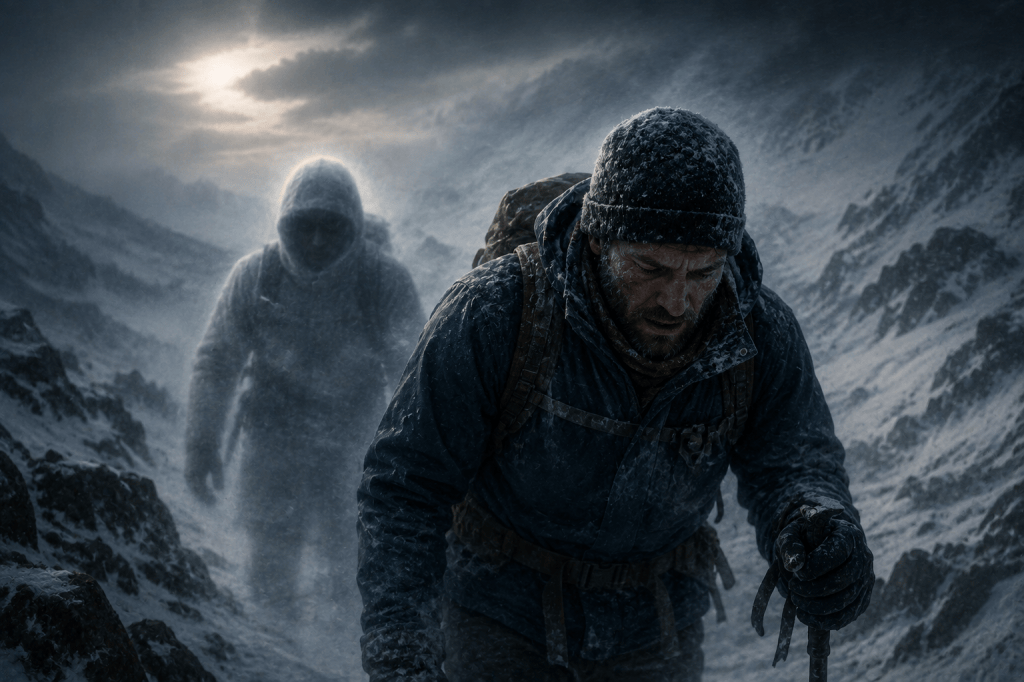
When People Are Lost, Freezing, Dying or Completely Alone, Why Do Some of Them Suddenly Realize Someone Is Walking Beside Them?
August 17, 2026
PARANORMAL DESK
You’re going to die.
Maybe you’re lost on a mountain.
Maybe the temperature has fallen below zero.
Maybe your aircraft has gone down.
Maybe you’ve been walking for hours and no longer know which direction leads home.
Nobody knows where you are.
Your body is exhausted. Your judgment is failing. You sit down.
Then somebody says:
Get up.
You look around.
Nobody.
But somehow you’re no longer alone.
There’s someone beside you.
You can’t always see him.
Sometimes you hear a voice. Sometimes it’s simply an overwhelming awareness that another person is walking a few feet away.
He encourages you.
Tells you where to go.
Keeps you moving.
And occasionally seems to know something you don’t.
Hours later you’re rescued.
There’s only one problem.
The person who saved you never existed.
At least nobody else can find him.
Welcome to one of the strangest recurring experiences in survival history.
Psychologists have explanations for it.
Explorers have experienced it.
Mountaineers have written about it.
Religious people have another name for it.
Guardian angel.
Paranormal researchers call it something else.
And once you’ve heard enough of these stories, one question becomes difficult to avoid:
Who is the Third Man?
SHACKLETON WASN’T ALONE
One of the most famous accounts came from Antarctic explorer Ernest Shackleton.
In 1916, after the destruction of the Endurance and an extraordinary struggle for survival, Shackleton and companions made a brutal crossing of South Georgia’s mountainous interior in an attempt to reach help.
They were exhausted.
Cold.
Operating at the limits of human endurance.
Later, Shackleton wrote of a strange sensation during that journey.
He felt that there had been another person accompanying them.
They were three men.
Yet somehow it seemed there were four.
Even stranger, his companions reportedly experienced something similar.
Nobody had planned it.
Nobody was supposed to be there.
But something was.
Or seemed to be.
That experience would eventually become one of the classic examples of what is now commonly called the Third Man Factor or Third Man phenomenon.
The name is slightly misleading.
Sometimes it’s the fourth man.
Sometimes it’s a woman.
Sometimes it’s a voice.
Sometimes it doesn’t seem human at all.
But the pattern is remarkably consistent.
A person reaches the edge.
Then somebody arrives.
HE DOESN’T ALWAYS HAVE A FACE
This isn’t usually the classic ghost story.
There isn’t necessarily a transparent Victorian woman floating through a hallway.
The presence can be surprisingly subtle.
Someone simply knows another person is there.
A climber senses a companion walking behind him.
A stranded traveler hears instructions.
A survivor feels somebody sitting beside her.
Sometimes the presence provides comfort.
Sometimes direction.
Sometimes it becomes forceful.
Move.
Don’t sleep.
Go this way.
Then, when the danger passes, the companion disappears.
No footprints.
No rescuer.
No mysterious stranger walking toward the horizon.
Nothing.
And that makes the phenomenon particularly interesting.
Because the Third Man doesn’t behave like most hauntings.
He doesn’t seem interested in frightening anyone.
He seems interested in keeping them alive.
THE BRAIN’S EMERGENCY COMPANION
There is a perfectly reasonable scientific possibility.
The brain creates him.
Extreme isolation, sleep deprivation, hypoxia, hunger, cold, dehydration and severe physical exhaustion can profoundly alter perception.
Under those conditions, the brain can produce hallucinations.
People can hear voices.
See figures.
Lose their sense of time.
Misidentify objects.
Feel detached from their own bodies.
A sensed presence may therefore be a neurological survival response.
Think about what the brain is attempting to accomplish.
You’re alone.
You’re terrified.
You’re exhausted.
You’re considering giving up.
Then another person appears.
Suddenly you’re socially accountable again.
Someone tells you to continue.
Someone accompanies you.
Someone prevents you from surrendering.
If the brain manufactured a companion under extreme circumstances, it might actually improve survival.
Evolution doesn’t care whether the rescuer is real.
It cares whether you get off the mountain.
That’s an extraordinarily compelling explanation.
Except for one thing.
Sometimes the Third Man appears to know where to go.
“TURN LEFT.”
This is where these accounts become harder to dismiss emotionally, even if they remain explainable scientifically.
Survivors sometimes report being directed.
Take this route.
Avoid that direction.
Wake up.
Leave now.
Move away from here.
The instruction later appears to have been correct.
Now, coincidence can explain some cases.
Memory can improve the story afterward.
And subconscious perception is enormously powerful.
A person may notice environmental clues without consciously recognizing them.
Perhaps the brain already knows the safest direction.
The hallucinated companion simply gives that unconscious information a voice.
That’s possible.
In fact, it’s fascinating.
But the paranormal interpretation asks:
What if the information didn’t originate inside the survivor?
GUARDIAN ANGEL?
Every culture has some version of the helper.
Guardian angels.
Spirit guides.
Ancestors.
Protective spirits.
Divine messengers.
The names change.
The function doesn’t.
Something unseen intervenes when a human being is in danger.
Modern people tend to separate these concepts into boxes.
Religion goes here.
Psychology goes there.
Ghosts go somewhere embarrassing in the basement.
But human experience doesn’t always respect our filing system.
If a dying mountaineer reports an invisible person guiding him toward safety, the psychologist may call it a sensed presence.
A Christian might call it an angel.
A spiritualist might call it a guide.
A paranormal investigator might call it an entity.
Four names.
One experience.
The interesting question isn’t what we call it.
It’s whether anything exists independently of the experiencer.
WHY DOES IT ARRIVE WHEN YOU’RE NEAR DEATH?
Timing may be everything.
Third Man experiences frequently appear under extreme conditions.
That’s exactly what we’d expect if they’re neurological.
Push the brain hard enough and perception begins behaving strangely.
Case closed?
Maybe.
But paranormal traditions have argued for centuries that extreme conditions also change consciousness.
Fasting.
Isolation.
Sleep deprivation.
Meditation.
Pain.
Illness.
Near-death states.
Many spiritual traditions deliberately use physical hardship to alter ordinary awareness.
That creates an intriguing overlap.
Science says extreme conditions can cause the brain to generate unusual perceptions.
Mysticism says extreme conditions can make normally invisible realities perceptible.
Same doorway.
Two explanations for what’s on the other side.
MAYBE WE FILTER MORE THAN WE SEE
Think back to our August 14 investigation.
Human senses don’t perceive everything physically present around us.
Radio waves pass through the room.
Infrared exists beyond normal human vision.
Ultraviolet exists.
Magnetic fields exist.
We experience a biologically useful slice of reality.
So paranormal researchers occasionally ask whether the brain might also filter forms of information we don’t normally perceive.
Under ordinary conditions, the filter stays closed.
Under extreme conditions?
Maybe something slips through.
There is no established scientific evidence demonstrating that spirits occupy some hidden perceptual frequency.
But as a hypothesis, it gives the Third Man an interesting role.
Maybe he doesn’t appear.
Maybe we become capable of noticing him.
WHAT IF IT’S YOU?
Here’s another possibility.
And this one might be stranger than the ghost.
What if the Third Man is another part of yourself?
Human consciousness isn’t as unified as it feels.
The brain performs enormous amounts of processing outside conscious awareness.
It evaluates danger.
Reads facial expressions.
Tracks sounds.
Maintains balance.
Recognizes patterns.
Predicts outcomes.
Most of that never arrives in consciousness as a detailed report.
You simply get a feeling.
Something’s wrong.
Now imagine the brain under extreme stress.
What if that normally silent intelligence becomes personified?
The subconscious doesn’t merely suggest:
Keep moving.
It creates somebody who says:
Keep moving.
The stranger walking beside you might therefore be you.
A deeper survival system wearing a human face because that’s the easiest language consciousness understands.
No spirit required.
And frankly, that’s nearly as paranormal as the paranormal explanation.
BUT WHY SOMEONE ELSE?
This is the detail I keep coming back to.
Why does the survival mechanism become a person?
Why not simply produce energy?
Determination?
A sudden burst of confidence?
Instead, people describe company.
Presence.
Another intelligence.
Perhaps the answer is social.
Humans survived because humans survived together.
We aren’t particularly impressive animals individually.
No claws.
No armor.
Not especially fast.
Terrible night vision.
Leave most of us naked in the wilderness and nature will eventually issue a correction.
But groups?
Groups are formidable.
We cooperate.
Teach.
Warn.
Carry.
Protect.
Maybe when isolation becomes deadly, the brain reaches for humanity’s oldest survival tool.
Another human being.
Even if it has to invent one.
OR MAYBE SOMEBODY ACTUALLY COMES
Now we’ll leave the laboratory lights behind.
Suppose consciousness survives death.
Suppose deceased people can occasionally perceive the living.
Suppose some form of intelligence can intervene without becoming fully physical.
Then the Third Man phenomenon makes a peculiar amount of sense.
Most ghost stories involve trivial behavior.
Footsteps.
Doors.
Cold spots.
Knocking.
A picture falls.
If the dead can actually interact with us, you’d hope eventually somebody would do something useful.
The Third Man does.
He arrives when needed.
He doesn’t waste time proving he’s dead.
He doesn’t spell his name through a Ouija board.
He says:
Get up.
Maybe that’s exactly what genuine paranormal intervention would look like.
Not theatrics.
Information.
HOW WOULD WE PROVE IT?
That’s the problem.
A Third Man experience usually occurs when somebody is alone.
There are no controlled conditions.
No cameras.
No baseline neurological measurements.
No investigator standing nearby with an EMF meter.
The survivor returns and tells the story afterward.
That’s powerful testimony.
But testimony isn’t proof.
A truly extraordinary case would require verifiable information the survivor couldn’t reasonably have known.
Suppose the presence tells someone:
“There’s an abandoned shelter 600 yards east.”
The survivor goes east.
The shelter exists.
Nobody knew it was there.
Now we’re interested.
Or the presence identifies itself as a deceased person unknown to the survivor, providing information later verified independently.
That’s the kind of case paranormal investigation needs.
Specific.
Recorded.
Testable.
Not merely strange.
THE PERSON BESIDE YOU
Most of us will hopefully never experience the Third Man under survival conditions.
But lesser versions of the phenomenon are surprisingly familiar.
You’ve been alone and suddenly felt watched.
You’ve entered a room and sensed somebody else there.
You’ve awakened convinced someone was beside the bed.
You’ve turned around because you were certain somebody stood behind you.
Usually nobody does.
The brain continuously predicts the presence and movement of other people.
Sometimes it gets things wrong.
But occasionally the sensation is so powerful that explanation doesn’t remove the chill.
Because seeing nothing isn’t the same as feeling alone.
WHEN THE THIRD MAN LEAVES
Perhaps the strangest part comes afterward.
The survivor reaches safety.
Warmth returns.
Food.
Sleep.
Other people.
The presence disappears.
No goodbye.
No explanation.
Its job appears finished.
If it’s neurological, that makes perfect sense.
The emergency is over.
If it’s paranormal?
Oddly enough, that makes sense too.
The emergency is over.
Either way, the Third Man behaves like a rescue mechanism.
The only disagreement is where the rescuer lives.
Inside the brain?
Or somewhere outside it?
DON’T SIT DOWN
So imagine it.
Night.
Snow.
You’ve lost the trail.
Your hands barely work.
You’re exhausted enough that lying down suddenly sounds reasonable.
Then somebody starts walking beside you.
You don’t see a face.
Maybe you don’t hear footsteps.
But you know he’s there.
And he says:
Don’t sit down.
You argue.
He insists.
Keep walking.
So you walk.
An hour later you see lights.
People.
Rescue.
You turn around.
Nobody.
Maybe your brain saved your life.
If so, thank it.
Maybe some unconscious part of you recognized the route.
If so, that’s extraordinary enough.
But if neither explanation quite fits what happened?
Well.
Maybe somebody came looking for you.
And perhaps that’s the comforting part of the Third Man mystery.
Ghost stories usually ask us to imagine that we’re never truly alone.
The Third Man asks something slightly different.
What if, when it matters most, we’re never abandoned?
 The ChillX Zone
Leave a comment