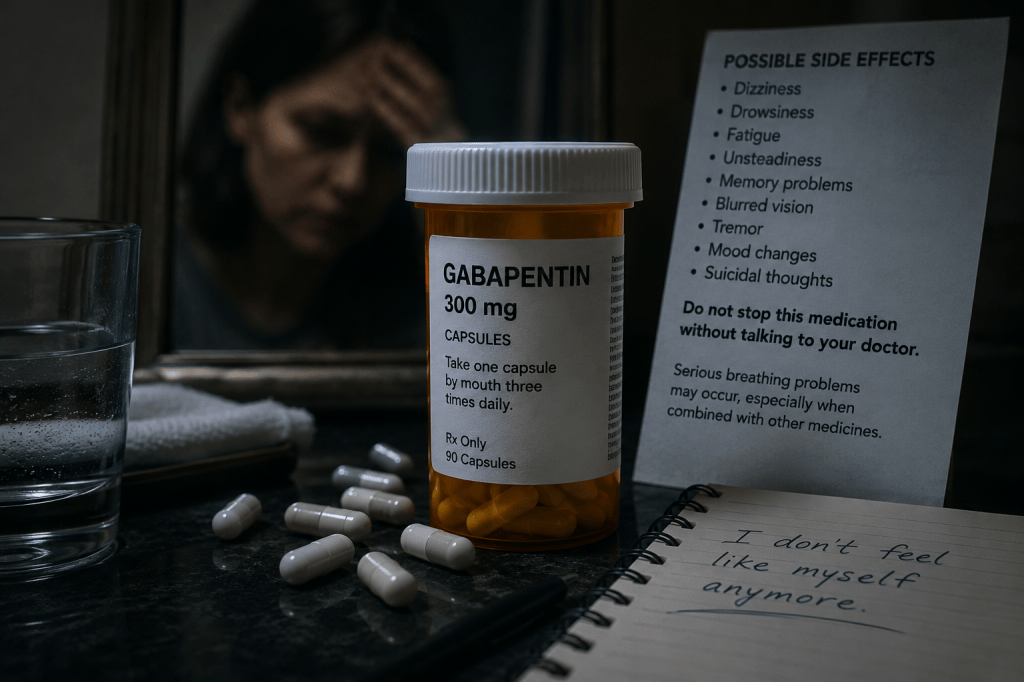
Prescription Medicine Can Save Your Life. But What Happens When the Medicine Starts Changing the Person Taking It?
August 19, 2026
PARANORMAL DESK
You take the pill because you’re supposed to.
Your doctor prescribed it.
The pharmacy filled it.
The label tells you when to swallow it.
Everything about that little orange bottle says medicine.
Then something changes.
You’re exhausted.
Your balance feels wrong.
Your thoughts aren’t as sharp.
You forget conversations.
Your vision seems strange.
You wake from bizarre dreams.
Maybe your anxiety increases. Maybe your mood changes. Maybe you simply look in the mirror one morning and realize:
I don’t feel like myself anymore.
That’s when a frightening question appears.
Is something happening to me?
Or is it something I’m taking?
THE OTHER SIDE OF THE BOTTLE
Modern pharmaceuticals are capable of remarkable things.
They control seizures, reduce pain, treat psychiatric disorders, fight infections and keep people alive.
But somewhere along the way, many of us began confusing prescribed with harmless.
They aren’t the same thing.
A drug powerful enough to change the body in a useful way can sometimes change it in unwanted ways too.
Consider gabapentin.
Gabapentin is an anticonvulsant used for certain seizure disorders and nerve pain; particular formulations are also used for restless legs syndrome. Doctors may prescribe it for other conditions as well.
For many patients, it helps.
For others, the experience can be considerably more complicated.
WHEN THE BRAIN FEELS DIFFERENT
Recognized gabapentin side effects include dizziness, drowsiness, fatigue, problems with coordination, tremor, blurred or double vision and memory difficulties.
Those sound almost harmless when reduced to words on a medication sheet.
Try living them.
“Memory problems” might mean repeatedly forgetting why you entered a room.
“Dizziness” might mean grabbing the wall.
“Drowsiness” might mean struggling to stay awake during normal life.
And when several symptoms arrive together, a person may begin wondering whether they’re becoming seriously ill.
There are also more serious warnings. Gabapentin belongs to a class of antiepileptic drugs associated with a small increased risk of suicidal thoughts or behavior, so major changes in mood, depression, agitation or thoughts of self-harm need to be taken seriously.
Gabapentin can also contribute to dangerous breathing problems in some circumstances, particularly when combined with other central-nervous-system depressants such as opioids or in people with certain respiratory risk factors.
This isn’t internet folklore.
These are recognized medication risks.
THEN YOU TRY TO STOP
Here’s where another surprise can appear.
Someone feels terrible and thinks:
Fine. I’m not taking it anymore.
Then they abruptly stop.
Now they feel worse.
Withdrawal symptoms have been reported after gabapentin discontinuation, including anxiety, insomnia, nausea, sweating, pain, agitation, confusion and tremor. Abrupt discontinuation can be particularly concerning for people taking it to control seizures.
That’s why suddenly throwing away the bottle isn’t the answer.
If a medication appears to be causing problems, the conversation should be:
How do I safely change or discontinue this?
Not:
I’m stopping tonight.
And withdrawal doesn’t automatically mean someone is an addict.
The body can become physically dependent on medications taken exactly as prescribed. When the substance disappears suddenly, the nervous system has to readjust.
That’s biology.
Not a moral failure.
IT ISN’T JUST GABAPENTIN
Gabapentin isn’t uniquely dangerous.
That’s the larger point.
Many medications can produce significant adverse effects in some patients.
Antidepressants.
Benzodiazepines.
Opioids.
Sleep medications.
Steroids.
Antipsychotics.
Anticonvulsants.
Even medications people have taken for years can become problematic when dosages change, health conditions change or another drug enters the mixture.
The lesson isn’t fear medicine.
It’s:
Know what you’re taking.
Know why you’re taking it.
Know the major side effects.
Know what shouldn’t be stopped abruptly.
And tell your doctor and pharmacist about everything else you’re using.
THE MEDICATION CASCADE
There’s another phenomenon worth knowing about.
Suppose Drug A causes a new symptom.
Nobody realizes the medication caused it.
So Drug B is prescribed for the symptom.
Drug B creates another problem.
Now Drug C appears.
This is known as a prescribing cascade.
It doesn’t mean every person taking multiple medications has been treated incorrectly. Plenty of patients legitimately need several drugs.
But when a new problem appears, there’s a remarkably useful question:
Did this begin after I started or changed something?
Sometimes that question solves the mystery.
WHY IS THIS ON THE PARANORMAL DESK?
Because we investigate strange experiences.
And before blaming the dead, demons, shadow people or whatever may be standing beside your bedroom door at 3:00 a.m., somebody needs to check the medicine cabinet.
A person begins seeing shadows.
They hear something.
They experience extraordinarily vivid dreams.
They wake confused.
They feel detached from themselves.
Their memory develops gaps.
They feel a presence nearby.
That’s excellent material for a ghost story.
It’s also a reason to ask:
Did you recently start, stop or change a medication?
Drugs can alter sleep.
Sleep deprivation can alter perception.
Medications can alter cognition.
Withdrawal can alter mood and sensation.
Drug interactions can produce unexpected effects.
And because everything you experience is filtered through the brain, an altered brain doesn’t necessarily announce:
“Attention: your perception is currently unreliable.”
The experience simply feels real.
THE HAUNTING INSIDE THE HEAD
This is where medicine becomes almost paranormal by itself.
Change a tiny amount of chemistry and the world can become different.
Time feels strange.
Dreams become intense.
Thoughts slow down.
Emotions change.
A familiar room feels unfamiliar.
A shadow suddenly looks like somebody standing there.
Does that mean every paranormal encounter is medication-related?
Of course not.
But it means a responsible investigator should ask medical questions before reaching supernatural conclusions.
What changed?
When?
What medication was started?
Was the dosage increased?
Was something suddenly discontinued?
Is the person sleeping normally?
Could two substances be interacting?
Those questions may not make good television.
They make good investigations.
LISTEN TO THE PATIENT
There’s something a medical chart cannot completely capture.
The experience of being inside the patient.
Blood pressure can look normal.
Bloodwork can look normal.
The examination can look normal.
Meanwhile the person sitting there says:
“My brain hasn’t felt right since I started this.”
That isn’t proof the medication caused the problem.
But it is evidence worth investigating.
Patients know their normal selves.
They know how they usually think.
Sleep.
Walk.
Remember.
Feel.
When that baseline suddenly changes, clinicians should want to know.
DON’T MAKE THE OPPOSITE MISTAKE
There’s danger at both extremes.
One side says:
A doctor prescribed it, so it can’t be hurting you.
Wrong.
The other says:
Prescription drugs are poison. Stop taking them.
Also wrong—and potentially dangerous.
Medicine is about risk versus benefit.
The same medication can dramatically improve one person’s life and cause intolerable side effects in another.
That’s why individual monitoring matters.
“Safe” doesn’t mean nothing bad can happen.
It means the known benefits and risks have been evaluated for particular uses and patients.
DON’T THROW AWAY THE BOTTLE TONIGHT
If you’re taking gabapentin or another prescription drug and recognize something in this article, don’t abruptly stop because of something you read online.
Talk to your prescriber or pharmacist.
Describe exactly what’s happening.
Ask whether the medication could be contributing.
Ask about interactions.
Ask whether the dose should be reconsidered.
And if discontinuation is appropriate, ask how it should be done safely.
Severe breathing difficulty, extreme sedation, serious allergic reactions, suicidal thoughts or other potentially life-threatening symptoms require urgent medical attention.
That’s the part where the paranormal investigation ends.
Medicine takes over.
THE PILL THAT CHANGED YOU
Every prescription is essentially a request:
Change something inside me.
Stop the pain.
Stop the seizure.
Help me sleep.
Calm the nerves.
Lift the depression.
Usually we’re grateful when chemistry changes exactly what we wanted.
The trouble begins when something else changes too.
Maybe your medication is doing exactly what it should.
Maybe the benefits overwhelmingly outweigh the side effects.
But if you start a drug and suddenly feel like a different person, don’t automatically dismiss it.
Write down what changed.
Note when it started.
Talk to the person prescribing it.
Because sometimes the mystery isn’t in the haunted house.
It isn’t an entity.
It isn’t something following you.
Sometimes the answer is sitting quietly beside the bathroom sink in an orange plastic bottle.
And sometimes the most important clue in the entire investigation is only six words:
“I wasn’t like this before.”
References: FDA prescribing information and medication guides; DailyMed; MedlinePlus.
 The ChillX Zone
Leave a comment