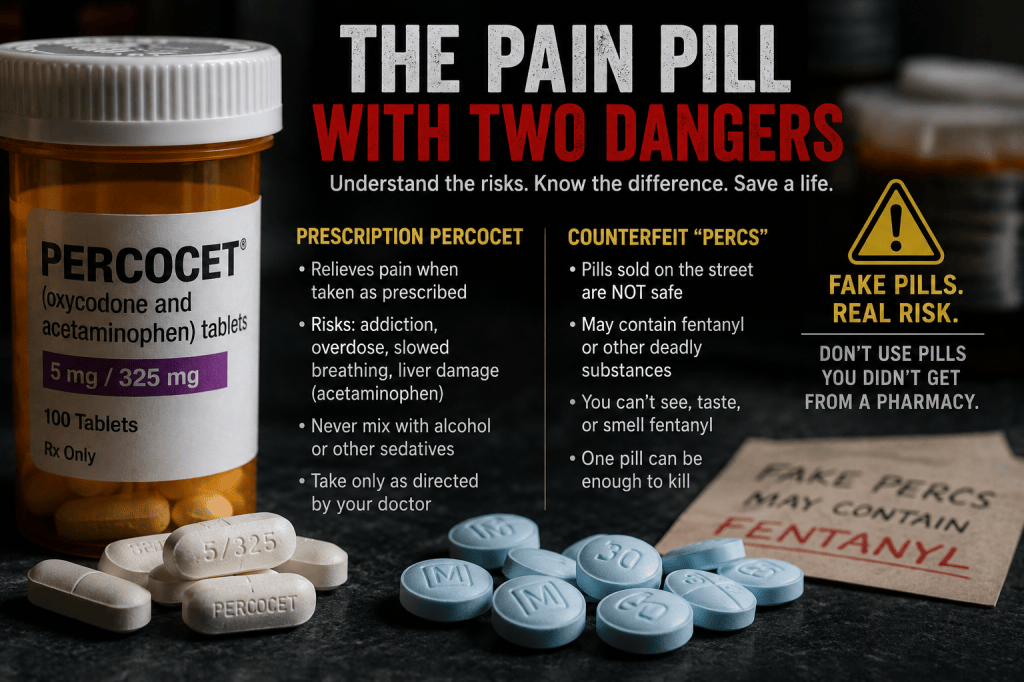
Percocet Can Relieve Serious Pain. It Can Also Slow Breathing, Create Dependence—and on the Street, the “Perc” in Someone’s Hand May Not Be Percocet at All.
August 20, 2026
PARANORMAL DESK
Somebody hands you a pill.
“It’s a Perc.”
Small.
Ordinary.
Pharmaceutical-looking.
Maybe you’ve taken one after surgery.
Maybe somebody you know has a prescription.
And that’s part of what makes prescription opioids psychologically different from a bag of mystery powder.
They look legitimate.
But there are really two separate stories hiding behind the word Percocet.
One involves the genuine prescription medication.
The other involves counterfeit pills sold illegally as “Percs.”
Confusing the two can be deadly.
FIRST: WHAT IS PERCOCET?
Percocet is a prescription medication containing oxycodone and acetaminophen.
Oxycodone is an opioid pain reliever.
Acetaminophen is the same active pain-relieving ingredient found in products such as Tylenol.
That combination can effectively treat pain when appropriately prescribed.
But it also means one tablet carries two different categories of risk.
Too much oxycodone can dangerously suppress breathing.
Too much acetaminophen can seriously damage the liver.
Current Percocet labeling carries prominent warnings about addiction, abuse, misuse, life-threatening respiratory depression and acetaminophen-related liver injury.
The danger isn’t imaginary.
Neither is the medical benefit.
Both things are true.
THE PART THAT KILLS: BREATHING
Opioids don’t merely make pain feel different.
They affect the central nervous system.
At excessive doses—or in particularly dangerous combinations—they can suppress the brain’s drive to breathe.
Breathing becomes slow.
Shallow.
Irregular.
Then it can stop.
A person experiencing an opioid overdose may be impossible to wake, have very slow or absent breathing, or develop blue or discolored lips or fingertips.
This isn’t somebody who should be allowed to “sleep it off.”
It’s an emergency.
And the danger can increase when opioids are combined with other substances that cause sedation, particularly alcohol, benzodiazepines or other central-nervous-system depressants.
THE SECOND DRUG HIDING INSIDE
Then there’s acetaminophen.
Because Percocet contains it, someone taking Percocet may also unknowingly consume acetaminophen from other products.
Cold medicine.
Headache medicine.
Another prescription.
Suddenly the totals add up.
Excessive acetaminophen exposure can cause severe liver injury and, in extreme cases, liver failure and death. The current Percocet label specifically warns about this risk and notes that many serious cases have involved people using more than one acetaminophen-containing product.
So the danger isn’t only:
How many Percocets did I take?
It’s also:
What else did I take?
WHEN RELIEF BECOMES THE PROBLEM
Then there’s dependence.
Opioids can produce tolerance, meaning the same amount may have less effect over time.
They can produce physical dependence, meaning withdrawal symptoms may occur when use is stopped after the body has adapted.
And some people develop opioid use disorder—a medical condition involving problematic opioid use despite harmful consequences.
None of this means everyone prescribed Percocet becomes addicted.
But anyone taking prescription opioids is exposed to real risks, including overdose and addiction.
That’s why these aren’t medications to casually share with somebody because their back hurts.
THEN THE STREET CHANGED EVERYTHING
Here’s where the story becomes considerably darker.
Someone says they’re buying Percocet.
But they’re not buying it from a pharmacy.
They’re buying a pill from somebody.
Maybe it has markings.
Maybe it looks professionally pressed.
Maybe it’s the same color as a pill they’ve seen online.
None of that proves it’s Percocet.
Counterfeit pills have become a major part of the illicit drug supply, and fake pills made to resemble prescription oxycodone products may contain illegally manufactured fentanyl instead.
That distinction is enormous.
A pharmacy-dispensed Percocet contains a known medication manufactured under regulated conditions.
A pill bought illegally that somebody calls a Perc may contain something entirely different.
You cannot reliably identify the chemistry with your eyes.
THE COUNTERFEIT PHARMACY
This may be one of the most disturbing developments in modern drug culture.
The street drug doesn’t have to look like a street drug anymore.
It can look medical.
That’s powerful psychologically.
People understand that an unidentified powder might be dangerous.
A tablet feels different.
A tablet has edges.
Numbers.
A familiar shape.
It looks like something that came from behind a pharmacy counter.
Except counterfeit pills can be deliberately manufactured to create exactly that impression.
The pill is essentially wearing a costume.
And sometimes fentanyl is underneath it.
CDC data have documented the increasing role of counterfeit pills in overdose deaths, with illegally manufactured fentanyl frequently involved.
“I’VE TAKEN THESE BEFORE”
That’s another dangerous sentence.
Even if the last illicit pill someone took contained oxycodone, that doesn’t establish what’s inside the next one.
The appearance may be similar.
The seller may be the same.
The bag may be the same.
The chemistry doesn’t have to be.
That’s the fundamental difference between regulated medication and an illicit counterfeit supply.
Consistency cannot be assumed.
And with potent opioids, guessing wrong can mean somebody stops breathing before anyone realizes what’s happening.
WHY PEOPLE KEEP GOING BACK
This is where moral judgment becomes useless.
Opioids can produce powerful reinforcement.
Dependence can make stopping physically and psychologically difficult.
Withdrawal can involve intense discomfort, and fear of withdrawal itself can help perpetuate continued use.
From the outside, somebody asks:
Why don’t they just stop?
From inside dependence, the question can feel completely different.
That’s why opioid use disorder is treated as a medical condition rather than a failure of character.
The person needs help.
Not a lecture.
THE PARANORMAL VERSION OF POSSESSION
And here’s where this subject crosses our desk.
For centuries, humans described people who appeared controlled by something they couldn’t resist as possessed.
Today we have neuroscience, pharmacology and addiction medicine.
We know chemicals can alter reward, motivation, judgment and behavior.
No demon is required.
But listen to the language people use when describing severe addiction:
It took him over.
She wasn’t herself.
It controlled everything.
He would do anything for it.
We couldn’t get her back.
That’s almost the ancient vocabulary of possession.
Perhaps some old “demons” were attempts to describe human conditions nobody yet understood.
Or perhaps demon was always partly a metaphor for the terrifying experience of losing control over yourself.
Either way, addiction demonstrates something unsettling:
A human being can feel inhabited by a need stronger than reason.
NALOXONE CHANGES THE ENDING
There is one piece of this story everyone should know.
Naloxone can reverse an opioid overdose.
It can restore breathing when opioids are responsible for respiratory depression, buying critical time for emergency treatment.
If opioid overdose is suspected, emergency medical help is still necessary even when naloxone is given.
Because sometimes the difference between a tragedy and a survivor isn’t somebody recognizing exactly which opioid was involved.
It’s somebody recognizing:
This person isn’t breathing normally.
And acting.
THE PILL ISN’T WHAT IT LOOKS LIKE
That’s ultimately the August 20 story.
There are two dangers.
The genuine prescription opioid has real risks.
Addiction.
Dependence.
Sedation.
Respiratory depression.
Dangerous interactions.
And, because Percocet also contains acetaminophen, potential liver toxicity when acetaminophen exposure becomes excessive.
Then there is the second danger:
The pill that isn’t Percocet at all.
A counterfeit.
Something manufactured to resemble medicine while containing an entirely different chemical reality.
That’s why “my friend said it’s a Perc” isn’t pharmacology.
And a pill bought on the street isn’t made safer by looking professionally manufactured.
If it’s prescribed to you and dispensed by a legitimate pharmacy, follow the prescription and ask your clinician or pharmacist about interactions and risks.
If it came from somewhere else?
Don’t confuse appearance with identity.
Because one of the most dangerous things about the modern drug supply isn’t that it looks frightening.
It’s that sometimes it looks exactly like medicine.
 The ChillX Zone
Leave a comment