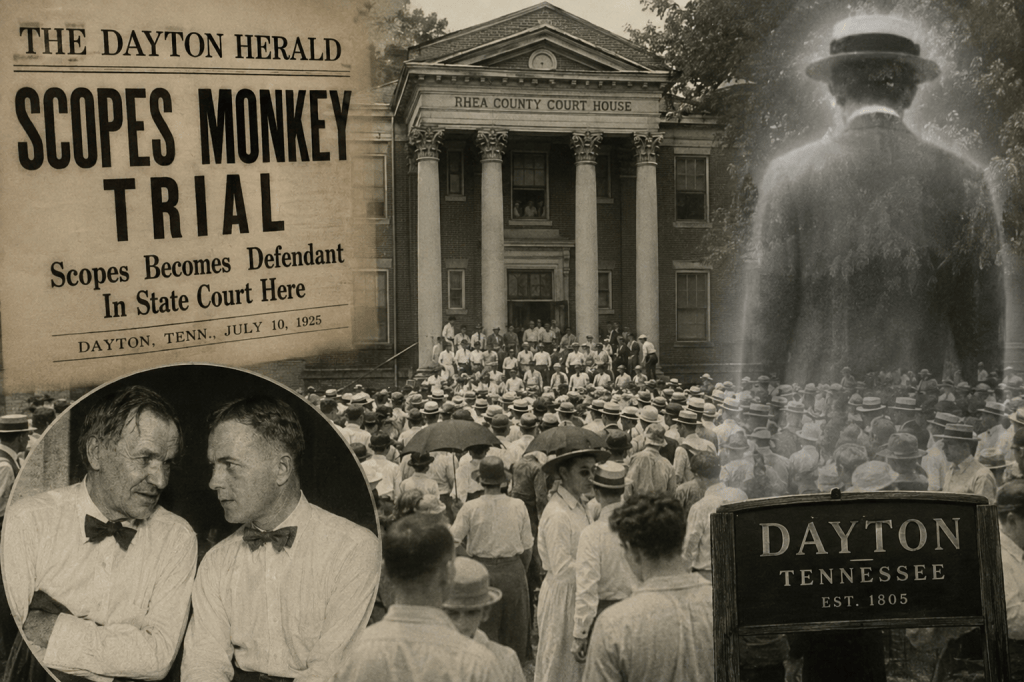
101 Years After the Scopes Trial, Evolution Explains Where Our Bodies Came From. But What About the Thing Inside Them?
August 10, 2026
DAYTON, TENNESSEE — PARANORMAL DESK
A hundred and one years ago, America came to Dayton, Tennessee, looking for a fight.
It found one.
In July 1925, a young teacher named John T. Scopes went on trial for violating Tennessee law by teaching human evolution in a public school. The case had been deliberately arranged as a test of the state’s anti-evolution law, with local boosters also recognizing that the controversy could put their little town on the map.
It worked.
Clarence Darrow came for the defense. William Jennings Bryan came for the prosecution. Reporters descended on Dayton. Tourists followed. Cameras clicked. Microphones appeared. The courthouse became a national stage for an argument much bigger than John Scopes.
Science versus Scripture.
Evolution versus creation.
Modernity versus tradition.
Except, sitting here in 2026, I think they missed a question.
A rather large one.
Because evolution has become one of the foundations of modern biology. The evidence that human beings share ancestry with other forms of life is overwhelming.
Fine.
But that answers what happened to the body.
What about the thing reading this sentence?
What about consciousness?
And, for those willing to wander farther down the hallway:
What about the soul?
THE QUESTION BEHIND THE MONKEY
The popular memory of the Scopes Trial is simple.
One side had Darwin.
The other had the Bible.
The real history was considerably messier. Scopes admitted teaching evolution as part of a deliberately constructed test case. He was convicted, and Tennessee’s Supreme Court later overturned that conviction on a technicality while leaving the underlying law intact.
But the cultural argument escaped the courtroom.
It is still with us.
And beneath it lies a question neither side could really settle:
What is a human being?
Evolution gives us an extraordinary account of how organisms change across generations.
It explains anatomy.
Inheritance.
Adaptation.
Common ancestry.
What it does not automatically give us is a complete explanation of subjective experience.
Why does electrical and chemical activity inside a biological organ produce the sensation of being somebody?
Why aren’t we merely biological machines operating in darkness?
Why is there apparently somebody home?
And then there’s the question that keeps paranormal investigators employed:
What happens to that somebody when the machine stops?
DARWIN MEETS THE GHOST HUNTER
This is where the Scopes Trial becomes unexpectedly interesting from a paranormal perspective.
Suppose consciousness is entirely produced by the brain.
Damage the brain and consciousness changes.
Drug the brain and perception changes.
Put the brain under anesthesia and ordinary awareness can apparently disappear.
The materialist case is formidable.
When the brain dies, therefore, consciousness should end.
Period.
And yet humans have spent practically our entire recorded history insisting that sometimes it doesn’t.
Ghosts.
Deathbed apparitions.
Near-death experiences.
Mediums.
Haunted houses.
Children claiming memories of lives they never lived.
Electronic voices supposedly appearing on recordings.
Most individual cases have possible conventional explanations. Some are frauds. Some are wishful thinking. Some are bad memories. Some are sleep paralysis. Some are coincidences that become remarkable only after the story has been polished through repeated telling.
Any paranormal reporter who doesn’t acknowledge that probably shouldn’t have a press card.
But dismissing weak evidence doesn’t eliminate the underlying question.
It sharpens it.
Because if even one credible case demonstrated that human consciousness can exist independently of a functioning brain, our understanding of ourselves would require a substantial rewrite.
Not necessarily a religious rewrite.
A scientific one.
SO WHEN DID THE SOUL EVOLVE?
Here’s the question nobody asked Clarence Darrow.
If human beings evolved gradually, and human consciousness can survive death, when did that ability appear?
There was no morning when one generation of hominids woke up without souls and their children suddenly had them.
Evolution doesn’t work that way.
So follow the idea backward.
Could a Neanderthal become a ghost?
Could Homo erectus?
What about an earlier hominin?
Keep traveling backward and eventually the distinction between “human” and “animal” becomes increasingly difficult to draw.
Which produces an uncomfortable paranormal question:
If humans have spirits, why wouldn’t animals?
Ask people who investigate hauntings and you’ll hear stories of phantom dogs jumping onto beds, cats glimpsed after death, hoofbeats with no horse attached and beloved pets apparently returning to familiar rooms.
Anecdotes aren’t proof.
But philosophically, evolution creates a fascinating problem for the traditional human-only soul.
If humans and other animals exist along branches of the same evolutionary tree, where exactly would nature—or God—draw the supernatural line?
Chimpanzees?
Dogs?
Dolphins?
Elephants?
Crows?
Or does consciousness itself exist on a spectrum, with whatever we call the “soul” developing alongside it?
Now we’re a long way from a Tennessee biology classroom.
But we’re following the same monkey.
WHAT IF GHOSTS ARE FOSSILS?
There’s another possibility.
And this one is considerably stranger.
Paranormal investigators have long used the term residual haunting for reports in which an apparition doesn’t seem conscious of witnesses.
The dead soldier walks the same hallway.
The woman appears on the same staircase.
Footsteps cross an empty room at approximately the same time.
Nobody communicates.
Nobody responds.
The event simply repeats.
The popular paranormal explanation is that something about an emotionally powerful moment somehow became “recorded” into the environment.
There is no established scientific mechanism showing that buildings record human experience and replay it later.
But entertain the idea for sixty seconds.
If matter can somehow preserve traces of consciousness, then perhaps archaeology isn’t the only place the past survives.
Maybe some hauntings wouldn’t be spirits at all.
They would be fossils of experience.
Not a dead person thinking.
A dead moment repeating.
And if such a phenomenon existed, there would be no obvious reason it should begin with modern humans.
Imagine the implication.
Somewhere on Earth, theoretically, there could be an environmental echo older than civilization.
Older than agriculture.
Older than Homo sapiens.
A paranormal fossil.
The ghost of evolution itself.
No, we don’t have convincing evidence of a spectral Neanderthal wandering around a cave.
But admit it.
You’d watch the documentary.
THE OTHER MAN IN THE COURTROOM
The most famous confrontation of the Scopes Trial came when Darrow questioned Bryan about his biblical beliefs.
The courtroom controversy has been replayed so often that Darrow and Bryan have practically become symbols rather than men.
Darrow: reason.
Bryan: faith.
Reality, naturally, was more complicated.
But imagine placing a third chair between them.
In that chair sits a modern neuroscientist.
Now place a fourth beside it.
A paranormal investigator.
Darrow asks how species evolve.
We have a pretty good answer.
Bryan asks whether mankind possesses something transcendent.
We don’t have an instrument capable of settling that question.
The neuroscientist asks how consciousness emerges from brain activity.
We have theories, experiments and increasingly sophisticated measurements—but consciousness remains one of the deepest problems in philosophy and neuroscience.
Then the paranormal investigator raises a hand.
“What if consciousness doesn’t emerge from the brain at all?”
The room gets quiet.
Because that’s the dangerous question.
BRAIN OR RECEIVER?
One of the oldest alternative ideas about consciousness treats the brain less like a generator and more like a receiver.
Think radio.
Destroy the radio and the music stops coming out.
But you haven’t necessarily destroyed the broadcast.
Under that hypothesis, brain damage altering personality wouldn’t prove the brain creates consciousness any more than smashing a speaker proves the singer lived inside it.
It’s an appealing analogy.
It’s also just that—an analogy.
We have enormous evidence connecting mental states to brain states and no established evidence of some external consciousness signal being picked up by human skulls.
Still, paranormal claims keep circling this possibility.
Near-death experiences are interesting precisely because some experiencers report vivid awareness during periods of extreme physiological crisis.
Mediumship claims are interesting because they propose information moving between living and deceased minds.
Apparitions are interesting because they imply personality can occasionally appear without its original body.
None of those phenomena currently overturn neuroscience.
But if any were conclusively demonstrated, they wouldn’t merely give ghost hunters something to celebrate.
They would change the meaning of the Scopes Trial.
MAYBE DARWIN DIDN’T KILL THE SOUL
There’s an assumption hiding inside America’s century-old argument about evolution.
If evolution is true, then humanity isn’t special.
But that conclusion doesn’t necessarily follow.
Evolution tells us how we got here.
It doesn’t tell us everything about what “here” is.
Perhaps consciousness is an emergent property of sufficiently complex brains.
Perhaps the sensation of a soul is something natural selection produced because organisms possessing a coherent sense of self survive more effectively.
Perhaps religious experiences are neurological events.
Perhaps ghosts exist only inside the minds of the living.
All perfectly possible.
But another possibility remains logically open:
Evolution produced a biological organism capable of interacting with something we don’t yet understand.
Call it consciousness.
Call it spirit.
Call it information.
Call it whatever keeps you out of trouble at faculty meetings.
The name isn’t important.
The evidence is.
101 YEARS LATER
The courthouse in Dayton survived.
So did the argument.
The National Park Service’s historical documentation describes the trial as a collision of major religious, scientific, legal and philosophical forces whose reverberations continued long afterward.
A century later, we know vastly more about human origins than the crowds sweating outside that courthouse could have imagined.
We can read DNA.
We can compare genomes.
We can reconstruct extinct populations.
We can watch the living brain operate with technologies that would have looked like science fiction to Scopes, Darrow and Bryan.
And still, tonight, somewhere in America, somebody will wake at 3:14 in the morning because they heard their dead father’s voice in the hallway.
Maybe it was a dream.
Probably was.
Somebody else will see a figure beside a road.
Probably a shadow.
Someone sitting beside a dying relative will swear that person suddenly began speaking to somebody who wasn’t in the room.
Maybe the brain was shutting down.
Science should investigate those possibilities first.
That’s what science is supposed to do.
But after the obvious explanations have been checked, the intellectually responsible response to what remains isn’t belief.
And it isn’t ridicule.
It’s investigation.
Because the strangest implication of the Scopes Monkey Trial may not be that human beings descended from earlier animals.
It’s that 101 years later, after mapping so much of our biological journey, we still don’t completely understand the traveler.
The monkey question has largely been answered.
The ghost question hasn’t.
And if Clarence Darrow and William Jennings Bryan could somehow walk back into that Tennessee courtroom tonight, I’d forget the evolution argument entirely.
I’d put a recorder between them.
Check the batteries.
Hit RECORD.
And ask just one question.
“Gentlemen, you’ve both been dead for nearly a century. What happened next?”
 The ChillX Zone
Leave a comment