I Dreamed of a Submerged Entrance Covered in Ancient Symbols. The Disturbing Part Is That Places Like It Really Exist.
August 13, 2026
PARANORMAL DESK
It began with a hole.
Not a grand temple entrance. Not towering columns rising from the sea. Nothing that would have looked particularly important from a distance.
Just a small shaft.
An opening barely large enough to enter.
Beyond it was water.
And beneath that water was something that shouldn’t have been there.
Architecture.
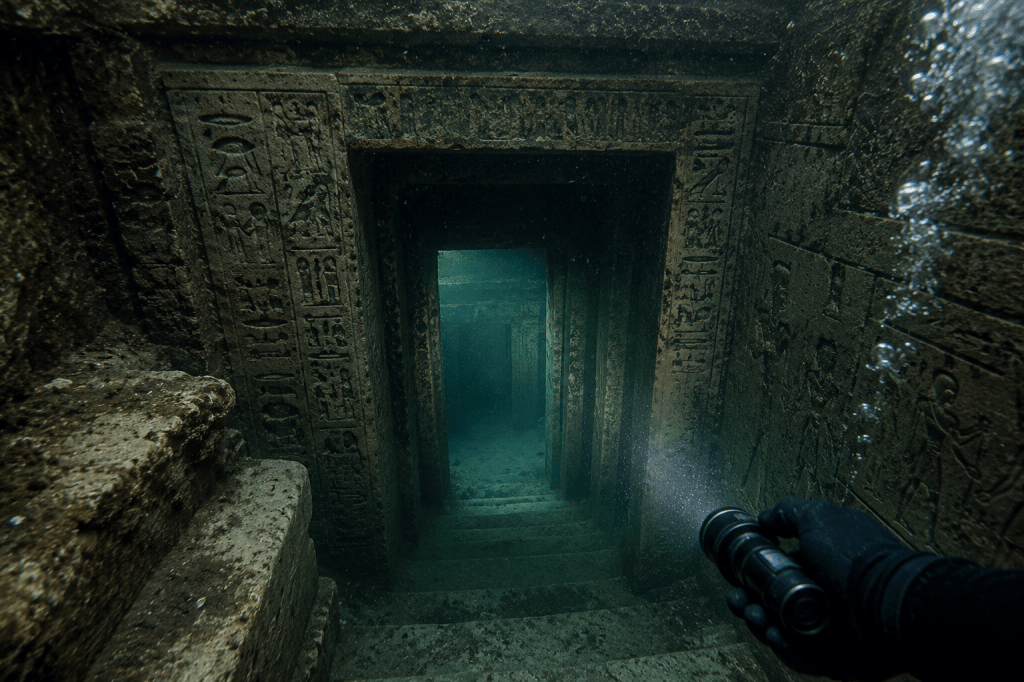
I could see what appeared to be an entrance descending into a submerged structure—a tomb, temple, underground complex, I couldn’t tell which. The passage disappeared into darkness. Along the stone were markings resembling ancient Egyptian hieroglyphics.
And there was an overwhelming sensation that the visible doorway wasn’t the discovery.
It was only the beginning.
Something was farther inside.
Then I woke up.
For several seconds, I didn’t know where I was.
It had been a dream.
Obviously.
But every once in a while you have a dream that doesn’t behave like one.
You remember the dimensions of the room.
The texture of the stone.
The color of the water.
The sensation of looking through an opening and realizing there is more architecture beyond it.
And once morning arrived, one question wouldn’t leave me alone.
Has anybody ever actually found something like this?
Unfortunately for a good night’s sleep, the answer is yes.
Not necessarily this place.
But close enough to make the dream considerably more interesting.
CITIES REALLY DO DISAPPEAR UNDERWATER
The idea of discovering ancient architecture beneath water belongs as much to archaeology as it does to adventure fiction.
Coastlines move.
Earthquakes lower land.
Tsunamis destroy settlements.
Rivers change course.
Reservoirs cover old communities.
Sea levels rise.
And occasionally archaeologists go underwater and discover that the stories were true.
Ancient Alexandria is one spectacular example. Archaeologists have investigated submerged ruins in the waters around the Egyptian city, including structures, statues and artifacts associated with the ancient landscape.
Then there is Thonis-Heracleion, an ancient Egyptian port city whose remains were located beneath the waters of Abu Qir Bay after centuries of disappearance.
Temples.
Statues.
Inscriptions.
Coins.
Anchors.
Ceremonial objects.
An entire piece of the ancient world sitting beneath the Mediterranean.
So the first part of the dream isn’t paranormal at all.
Ancient Egyptian structures can absolutely exist underwater.
They do.
BUT THIS WAS DIFFERENT
The place in the dream didn’t feel like a drowned city.
That’s the part that stayed with me.
It felt enclosed.
Hidden.
The opening was small, almost like an access shaft leading into something much larger.
And that creates a different archaeological possibility.
A tomb.
Ancient Egyptians constructed tombs and underground complexes containing corridors, shafts, chambers and passages.
And groundwater can invade them.
Archaeologists working in Egypt sometimes encounter flooded shafts and chambers, particularly where changing groundwater conditions have filled structures that were originally dry.
Now imagine being the first person through one.
Your flashlight hits water.
You descend.
Stonework appears beneath the surface.
Then writing.
A doorway.
Beyond it, darkness.
That’s not paranormal television.
That’s a scenario archaeology can produce.
The important question becomes:
What’s behind the door?
THE HIEROGLYPHICS
This was perhaps the strongest visual element in the dream.
Writing.
Not random scratches.
Not decorative lines.
Symbols arranged deliberately across ancient stone.
Hieroglyphics change everything because writing turns architecture into testimony.
A wall can tell you who built a place.
Who was buried there.
Which gods were invoked.
What rituals occurred.
What offerings were expected.
What dangers awaited.
Ancient Egyptian tomb inscriptions could contain prayers, spells, names, titles and instructions connected with the deceased person’s journey through the afterlife.
Which means entering an unknown Egyptian chamber isn’t merely entering a room.
You’re entering somebody’s plan for eternity.
And if the writing survived underwater?
Every symbol could matter.
WHAT COULD ACTUALLY BE INSIDE?
Suppose tomorrow archaeologists locate exactly what I saw.
A narrow shaft.
Flooded entrance.
Carved Egyptian symbols.
An unexplored passage continuing beyond the water.
What might realistically be inside?
The boring answer is:
Mud.
Lots and lots of mud.
Archaeology has a cruel sense of humor.
But after the mud?
Possibly chambers.
Burial goods.
Pottery.
Fragments of coffins.
Human remains.
Animal remains.
Religious objects.
Tools.
Statues.
Sealed containers.
Inscriptions.
Offerings.
Or another shaft leading farther down.
And then there’s the possibility archaeologists secretly dream about even if they’re sensible enough not to say it aloud:
an intact chamber.
A room nobody has entered since antiquity.
THE SEALED ROOM
There may be no more powerful phrase in archaeology.
Sealed chamber.
Because once a tomb has been robbed, disturbed or repeatedly entered, its archaeological context changes forever.
But a sealed chamber is a message delivered through time.
Everything remains approximately where ancient people left it.
Footprints can matter.
Dust can matter.
The position of an object can matter.
Organic material can matter.
Even the contents of containers can matter.
Now put that chamber behind a submerged corridor.
Suddenly the water that makes exploration difficult might also have discouraged intrusion.
Could something survive?
Possibly.
Stone certainly can.
Ceramics can.
Metals can, depending upon conditions.
Organic materials become more complicated, but waterlogged environments can sometimes preserve materials in surprising ways when oxygen and microbial conditions are favorable.
The treasure wouldn’t necessarily be gold.
The treasure might be information.
WHY DOES WATER MAKE IT FEEL FORBIDDEN?
There’s another layer to this.
Human beings react strangely to submerged architecture.
A ruined building on land feels old.
The same building underwater feels wrong.
Look at photographs of submerged staircases.
Statues beneath the sea.
Doorways disappearing into dark water.
There’s an immediate psychological response.
Part of it is simple biology.
We aren’t built to breathe down there.
Dark water conceals threats.
Visibility collapses.
Movement becomes difficult.
Every opening becomes dangerous because escape isn’t guaranteed.
But there’s something else.
Architecture is evidence of human presence.
When we see architecture in a place humans cannot comfortably survive, two contradictory signals hit the brain simultaneously.
People were here.
And:
People shouldn’t be here.
That’s practically the formula for a haunting.
DREAM OR MEMORY?
Now we arrive at the dangerous question.
Could somebody dream about a real place they’ve never seen?
There is no established scientific evidence that dreams routinely provide clairvoyant access to undiscovered archaeological sites.
That’s important to say plainly.
The brain is extraordinarily good at constructing environments.
I’ve seen documentaries.
You’ve seen photographs.
We’ve absorbed Egyptian imagery from movies, museums, books, television, video games and advertisements for our entire lives.
Put enough fragments into the subconscious and eventually it can build its own tomb.
That is by far the simplest explanation.
But paranormal history contains another idea:
the psychic dream.
People have long reported dreams they believe revealed distant locations, future events or information they couldn’t consciously have known.
Most such stories are impossible to verify properly.
Memory changes after an event.
Coincidences become meaningful retrospectively.
Details that didn’t match are forgotten while the successful ones are emphasized.
That’s why writing a dream down before anything happens is so important.
If you believe you’ve dreamed something potentially significant, don’t wait.
Document it.
Date it.
Draw the layout.
Write every detail you remember.
Then leave it alone.
If something resembling the place is discovered five years later, you’ve got a contemporaneous record rather than a reconstructed memory.
That’s still not proof of psychic perception.
But now you’ve got something testable.
SO LET’S DOCUMENT THIS ONE
Here’s what I remember.
A relatively small opening.
A shaft or narrow entrance.
Water occupying the passage.
Ancient stone construction.
What appeared to be Egyptian-style hieroglyphics visible near or beneath the waterline.
The impression that the entrance connected to a much larger underground structure.
Possibly a tomb.
Possibly a temple complex.
Possibly something else entirely.
And most importantly:
the feeling that the structure continued considerably farther than what could initially be seen.
That’s the fingerprint.
Not “underwater ruins.”
That’s too broad.
We’re looking for something more specific:
A small access point leading into a partially or substantially submerged ancient Egyptian structure containing visible inscriptions and unexplored interior spaces.
If such a discovery appears after August 13, 2026, then we come back to this page.
HAS ANYTHING SIMILAR ALREADY BEEN FOUND?
Pieces of the scenario certainly exist in real archaeology.
Egypt possesses underground tombs and shafts.
Some archaeological structures experience groundwater intrusion.
Ancient Egyptian remains exist beneath water.
Submerged cities have been discovered.
Divers have explored temples and ruins beneath the Mediterranean.
In other words, nothing about the physical environment of the dream requires supernatural architecture.
That’s almost what makes it stranger.
If I’d dreamed of a crystal pyramid floating above Saturn, we could safely file it under brain having fun.
But a flooded ancient structure with a narrow entrance and inscriptions?
That’s plausible.
Maybe not discovered.
Maybe not where I saw it.
Maybe not existing at all.
But plausible.
AND WHAT IF THE SHAFT GOES DEEPER?
Here’s where my reporter’s notebook gives way to the flashlight.
Imagine the discovery.
Divers enter.
The first chamber contains sediment almost to the ceiling.
They remove it carefully.
A doorway appears.
The inscription identifies somebody history barely remembers.
Behind the doorway is another descending passage.
Then another.
Suddenly the “tomb” isn’t a tomb.
It’s a complex.
And somewhere inside is evidence of a chapter of ancient history we didn’t know existed.
Maybe that’s the real attraction of these dreams.
Not prophecy.
Possibility.
We live in an age when satellites have mapped the planet and phones can tell us exactly where we’re standing.
It creates the illusion that there are no blank spaces left.
But archaeology keeps proving otherwise.
Structures remain beneath jungles.
Shipwrecks remain beneath oceans.
Chambers remain behind walls.
Cities remain beneath cities.
Entire landscapes occupied by prehistoric people are now beneath the sea.
There are doors nobody living has opened.
That’s not speculation.
That’s practically guaranteed.
THE THING BEHIND THE DOOR
Maybe the dream was assembled from a thousand forgotten images.
Probably.
Maybe I once saw a photograph of a flooded Egyptian shaft and forgot about it.
Entirely possible.
Maybe the subconscious took archaeology, water, darkness and hieroglyphics and constructed the perfect mystery.
That’s what brains do.
But there’s something wonderful about leaving one inch of the door open.
Not because we should believe every vivid dream predicts reality.
We shouldn’t.
But because somewhere tonight an archaeologist is looking at radar data showing an unexplained void.
Somewhere a diver is swimming over stone that doesn’t look natural.
Somewhere beneath sand, mud or seawater is a doorway.
And somewhere behind that doorway is a room no human being has entered for thousands of years.
Maybe my shaft doesn’t exist.
Maybe it never did.
But I’ve written it down now.
August 13, 2026.
Small entrance.
Submerged passage.
Ancient inscriptions.
Structure continuing beyond the visible chamber.
Something deeper inside.
If archaeology ever finds it, somebody call me.
I’ll bring the flashlight.
You bring the scuba tanks.
 The ChillX Zone
Leave a comment