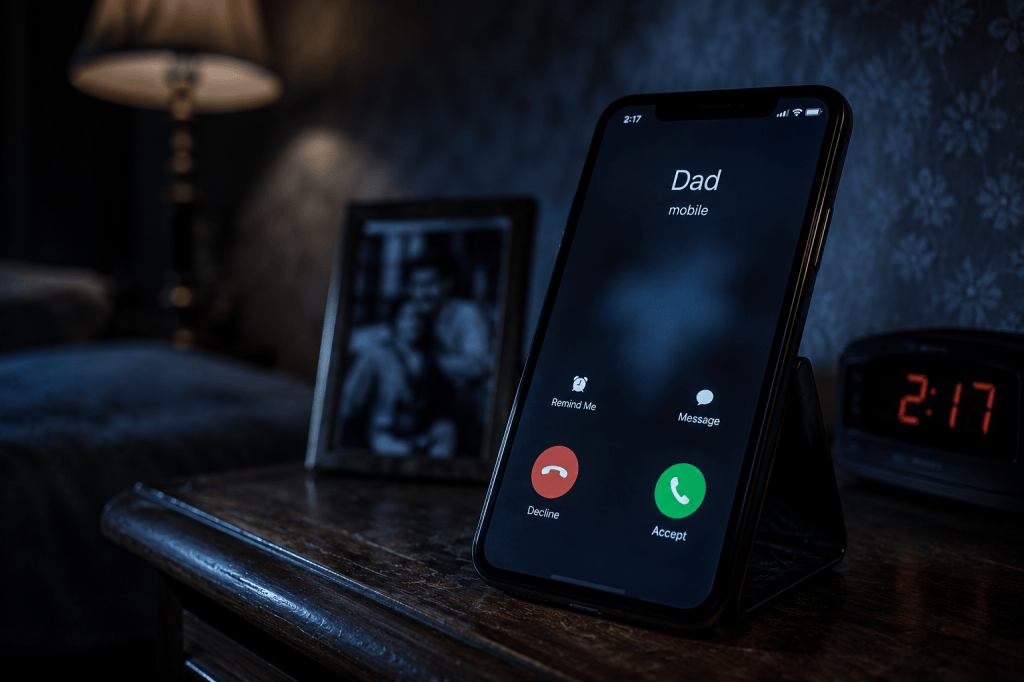
People Have Reported Phone Calls From the Dead for Decades. In 2026, There Are More Ways to Reach Us Than Ever.
August 18, 2026
PARANORMAL DESK
The phone rings at 2:13 in the morning.
You recognize the number.
That’s impossible.
You stare at the screen until it rings again.
Same name.
Same number.
The problem isn’t that you don’t want to answer.
The problem is that the person calling you has been dead for three days.
Eventually, you pick up.
Static.
Breathing.
Maybe a distant voice.
Maybe one sentence.
Then the connection disappears.
You call back.
Nothing.
Later you check the phone.
Sometimes there’s a record of the call.
Sometimes there isn’t.
Welcome to one of the strangest corners of paranormal folklore:
telephone calls from the dead.
And the phenomenon raises a question that has become considerably more interesting in the age of smartphones, Wi-Fi and permanently connected devices.
If consciousness survives death, why knock on walls?
Why not call?
THE GHOST GETS A TELEPHONE
Ghost stories are much older than telephones.
But once humans invented electronic communication, the dead apparently upgraded.
By the 20th century, stories began circulating about mysterious telephone calls associated with deceased relatives, friends and acquaintances.
Sometimes the caller supposedly died shortly before the call.
Sometimes the recipient didn’t yet know the person was dead.
That last category is particularly disturbing.
Imagine answering normally.
A familiar voice says something brief.
Maybe goodbye.
Maybe your name.
Hours later somebody tells you:
“There’s been an accident.”
You mention the call.
They look at you strangely.
The person was already dead.
That’s the kind of story paranormal researchers love.
It’s also exactly the kind requiring extremely careful documentation.
TELEPHONES DO STRANGE THINGS
Before we call the cemetery, call the phone company.
Modern telecommunications systems are complicated.
Caller ID can be wrong.
Numbers can be spoofed.
Voicemails can arrive late.
Networks experience delays.
Devices synchronize imperfectly.
Old notifications appear.
Phones malfunction.
Accounts remain active after their owners die.
And human memory becomes particularly unreliable during grief.
If somebody desperately misses a deceased parent and sees that parent’s name briefly appear on a screen, the emotional impact is enormous.
But emotion isn’t evidence.
The first rule remains:
Check the technology.
Yet occasionally a case contains details that aren’t so easily dismissed.
That’s when we keep the file open.
THE VOICE
The strongest cases wouldn’t merely involve caller ID.
They would involve information.
A recognizable voice.
A specific statement.
Something the recipient couldn’t reasonably have anticipated.
Because static proves nothing.
A mysterious click proves nothing.
Even a dead person’s phone number appearing isn’t necessarily paranormal.
But a conversation?
That’s different.
Especially if the caller provides independently verifiable information.
Paranormal investigation always becomes more interesting when the phenomenon stops merely producing weirdness and starts producing knowledge.
WHY ELECTRONICS?
We’ve been here before.
On August 14, we asked whether alleged entities might interact more easily with electronic signals than physical objects.
The phantom phone call takes that question to its logical conclusion.
A telephone already converts human communication into signals.
Your voice doesn’t physically travel intact from your mouth to another person’s ear.
It is transformed.
Encoded.
Transmitted.
Reconstructed.
Technology takes something invisible and turns it back into a human voice.
If you were inventing a machine specifically designed to make ghost stories possible, you could hardly do better.
A telephone is essentially a box whose entire purpose is:
Let an invisible person speak from somewhere else.
No wonder paranormal folklore adopted it.
THE DEAD HAVE ALWAYS USED THE AVAILABLE TECHNOLOGY
Think about how alleged spirit communication changes with technology.
In the 1800s:
Knocks.
Raps.
Table movements.
Automatic writing.
Then photography arrives.
Ghost photographs appear.
Audio recording arrives.
Electronic Voice Phenomena appear.
Radio becomes widespread.
Stories of mysterious voices emerge from radio static.
Television arrives.
Faces supposedly appear on screens.
Telephones become universal.
The dead start calling.
Computers arrive.
Now we have strange emails.
The internet arrives.
Accounts behave mysteriously after death.
Smartphones arrive.
Now the possibilities are endless.
Calls.
Texts.
Voicemails.
Notifications.
Photos.
Bluetooth.
Voice assistants.
Cloud accounts.
Every generation gives its ghosts new equipment.
Or perhaps every generation gives itself new ways to mistake technology for ghosts.
Both explanations deserve consideration.
THE TEXT FROM THE DEAD
The modern version may be even creepier than the phone call.
A text message.
No voice to mishear.
No static.
Words.
Imagine receiving:
I’m okay.
From somebody who died yesterday.
Your first assumption should still be technological.
Someone else may possess the phone.
An automated message may have been scheduled.
A delayed message may finally have been delivered.
An account may have been compromised.
But if all of those explanations are eliminated?
Now we’ve got a mystery.
And digital communication creates something earlier paranormal investigators rarely possessed.
A record.
Screenshot.
Timestamp.
Server information.
Device logs.
Potential evidence.
The ghost story has entered the forensic age.
THE DIGITAL AFTERLIFE
There’s another problem our ancestors never faced.
Dead people now leave enormous technological shadows.
Photos remain online.
Videos remain.
Voice recordings remain.
Emails remain.
Text conversations remain.
Social-media profiles remain.
Algorithms continue presenting memories of people who are gone.
A birthday notification appears.
“Wish Michael a happy birthday!”
Michael has been dead four years.
That’s not paranormal.
It’s software.
But emotionally?
Try explaining the distinction to your nervous system at midnight.
For the first time in human history, the dead remain electronically present around us on an enormous scale.
Their voices are stored.
Their faces move on screens.
Their writing appears instantly.
Their accounts remain searchable.
We have accidentally constructed something resembling a technological spirit world.
AND NOW AI CAN MAKE THEM TALK
2026 introduces an even stranger complication.
Artificial intelligence can imitate voices.
Generate faces.
Reconstruct speech patterns.
Create conversational systems based on someone’s writings or recordings.
That means one of the oldest paranormal tests—“I heard his voice”—is becoming less useful.
A voice is no longer necessarily proof that a living person produced it.
Soon enough, neither is video.
That’s going to make paranormal investigation considerably harder.
Imagine receiving a voicemail from your deceased grandfather in 2035.
Is it supernatural?
Delayed data?
A prank?
AI?
Malware?
An automated memorial service?
The ghost hunters of the future may need computer forensic specialists sitting beside the mediums.
BUT WHAT ABOUT THE CALL BEFORE YOU KNEW?
This remains the category worth watching.
The person dies.
Nobody has informed you.
Then something happens.
A call.
A message.
A voice.
You learn about the death afterward.
If the timing and records can be independently verified, the case becomes considerably more interesting because grief cannot easily explain an experience occurring before conscious knowledge of the death.
There are still conventional possibilities.
Coincidence.
Incorrect timelines.
Memory reconstruction.
Information reaching the person subconsciously.
Technical errors.
But the evidentiary bar is getting higher.
That’s exactly what we want.
The paranormal shouldn’t fear good records.
It should demand them.
THE FINAL CALL
There is another possibility.
Maybe these experiences aren’t attempts at conversation.
Maybe they’re goodbyes.
Stories of unusual experiences around the moment of another person’s death appear across cultures.
Someone wakes suddenly.
A clock stops.
A photograph falls.
A person sees the deceased standing in a doorway.
A dream occurs at approximately the time of death.
Then the telephone version:
The phone rings.
The dead person is there.
One final connection.
Then nothing.
Parapsychology has historically used terms such as crisis apparition for reports in which someone experiences an apparition or unusual perception around the time another person is dying or undergoing severe danger.
The telephone call could be the technological descendant of the same idea.
Maybe the phenomenon didn’t change.
Our interpretation did.
WHO DIALED?
Suppose consciousness survives.
We’ve still got a mechanical problem.
How does a dead person operate a telecommunications network?
Does the entity physically interact with the phone?
Manipulate electrical signals?
Influence the recipient’s perception?
Create the experience directly inside consciousness?
If the call appears in network records, that’s one mystery.
If it doesn’t, that’s another.
A logged call suggests something affected the technology.
An unlogged call might suggest the experience occurred entirely within the recipient’s perception.
Those are very different phenomena.
And that’s why investigators should stop lumping every strange phone experience into the same category.
The records matter.
DON’T DELETE THE VOICEMAIL
If this ever happens to you, resist the urge to immediately interpret it.
Document it.
Save the voicemail.
Screenshot the call log.
Record the time.
Write down exactly what you heard before discussing it repeatedly with other people.
Check whether the number was spoofed.
Check whether anyone else had access to the device.
Preserve the boring evidence.
Because the difference between a ghost story and an investigation is documentation.
And if the dead genuinely can reach us electronically, eventually somebody should capture something extraordinarily difficult to explain.
UNKNOWN CALLER
Tonight millions of phones will ring.
Most calls will be ordinary.
Some will be scams.
Some will be wrong numbers.
Some will arrive at terrible hours because apparently certain relatives don’t understand time zones.
And somewhere, somebody may look at a screen and freeze.
A name they haven’t seen in years.
A number they never deleted.
Someone impossible.
Maybe there’s a technical explanation.
Probably.
Check it.
But if you answer and hear a familiar voice—
don’t start asking whether Heaven has roaming charges.
Listen.
Remember the exact words.
Check the records.
And whatever you do:
don’t delete the voicemail.
 The ChillX Zone
Leave a comment