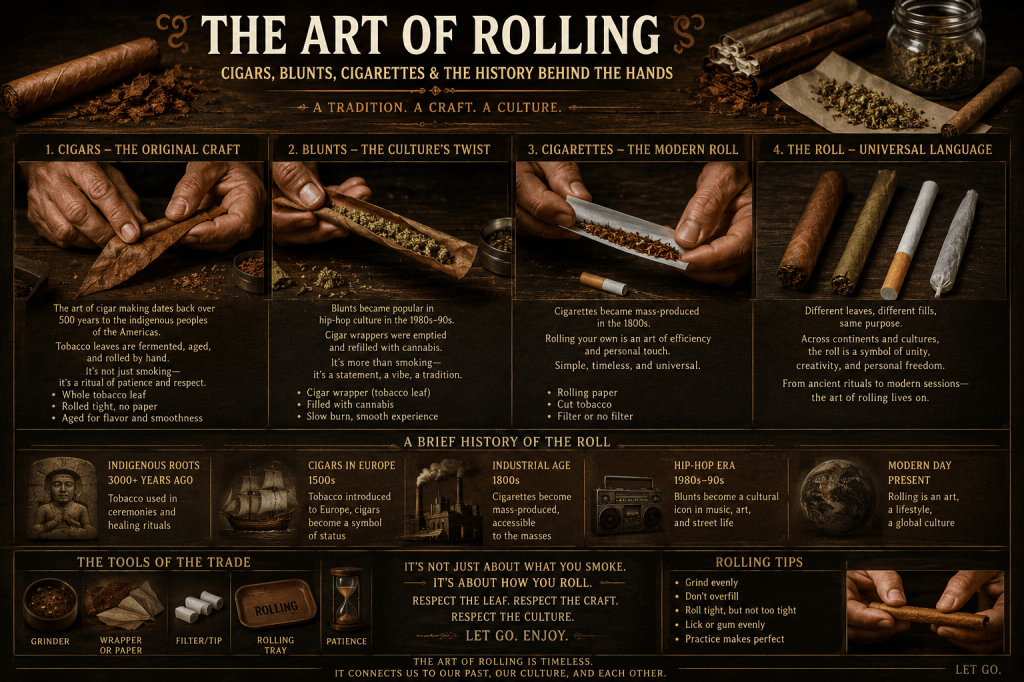
Cigars, Cigarettes, Blunts, and 500 Years of Hand-Rolled Culture
August 16, 2026
PARANORMAL DESK
Watch somebody who really knows how to roll a cigar and something becomes obvious.
The hands remember.
Leaf is inspected. Turned. Felt between the fingers. Pressure is controlled almost instinctively. The finished object may eventually disappear into smoke, but making it is a craft built from repetition.
The same basic human gesture appears in very different places.
A cigar maker working tobacco leaf.
A smoker rolling a cigarette.
A blunt being prepared in the musical and street cultures that popularized it.
Different materials. Different histories. Different meanings.
But the same ancient idea:
Take a leaf or paper, place something inside it, and roll.
It seems almost too simple to have a history.
It has one anyway.
And it begins long before cigarette factories, corner stores, humidors—or hip-hop.
BEFORE COLUMBUS, THERE WAS TOBACCO
Europe did not invent smoking tobacco.
Indigenous peoples of the Americas cultivated and used tobacco long before sustained European contact. Tobacco had ceremonial, medicinal, diplomatic and social significance in different Indigenous societies, and methods of consuming it varied widely.
It could be smoked in pipes.
Used ceremonially.
And in parts of the Americas, tobacco was wrapped in leaves and smoked in forms that Europeans would eventually recognize as predecessors of the cigar.
When Europeans encountered tobacco, they weren’t discovering an unused plant.
They were encountering traditions already possessing histories of their own.
Then the plant crossed the Atlantic.
And everything changed.
THE CIGAR
The cigar may be the purest expression of rolling as craft.
No machine-made white paper required.
Traditionally, tobacco itself provides the structure.
Different leaves perform different jobs. Tobacco is cultivated, harvested, cured, fermented, sorted and aged before skilled hands ever begin constructing the cigar.
The roller—or torcedor in the Cuban tradition—must produce something deceptively difficult.
A cigar needs structure without becoming impossibly tight.
Consistency without crushing the leaf.
A finished shape that looks almost effortless despite the labor behind it.
In places where cigar making became an industry, expert rollers developed speed and precision through years of repetition.
Watch an experienced roller and you understand why the word craft keeps appearing.
There is very little hesitation.
Hands move.
Leaf turns.
The object takes shape.
Hundreds of years of knowledge condensed into a few minutes of muscle memory.
TOBACCO CONQUERS EUROPE
By the 16th century, tobacco was moving through Europe.
Like many unfamiliar substances, it accumulated extravagant claims.
Some praised it.
Some condemned it.
Some treated it as medicine.
Others considered the habit filthy or morally dangerous.
Governments eventually discovered another feature.
It could be taxed.
That helped ensure tobacco wasn’t disappearing.
As European empires expanded, tobacco became part of an enormous international commercial system—one inseparable from colonial exploitation and, particularly in North America and the Caribbean, enslaved labor.
The elegant cigar sitting in a polished wooden box therefore has another history underneath it.
Agriculture.
Empire.
Labor.
Trade.
Money.
The smoke was never the whole story.
THEN CAME THE CIGARETTE
A cigar takes time.
A cigarette is built for speed.
Tobacco wrapped in paper existed before modern industrial production, but the 19th century transformed the cigarette into a mass commodity.
Mechanization changed the scale completely.
Once machines could manufacture cigarettes rapidly, what had been rolled individually could be produced by the millions.
Then came packaging.
Advertising.
Brands.
Matches.
Convenience.
And eventually one of the most successful consumer industries in modern history.
The roll had left the hands.
The factory could do it faster.
Much faster.
But people never entirely stopped rolling their own.
WHY ROLL YOUR OWN?
There is something strangely personal about a hand-rolled cigarette.
Factory cigarettes are uniform.
Same diameter.
Same paper.
Same general shape.
A hand roll isn’t.
One is crooked.
Another is thin.
Another looks like it survived a minor automobile accident.
Then somebody who’s been doing it for twenty years produces one almost perfectly without appearing to look at their hands.
That’s where rolling becomes interesting culturally.
The finished object carries evidence of the person who made it.
Skill.
Habit.
Preference.
Ritual.
The cigarette isn’t simply consumed.
It’s prepared.
And preparation changes the experience.
THE RITUAL BEFORE THE SMOKE
Humans love rituals surrounding consumption.
Coffee gets ground.
Tea gets steeped.
Wine gets uncorked.
Cocktails get mixed.
Pipes get packed.
Cigars get cut.
The preparation creates anticipation.
Rolling belongs to that family of behaviors.
The few minutes before smoking become part of the event.
That doesn’t erase tobacco’s health consequences. Cigarette and cigar smoke contain harmful chemicals, and tobacco use is associated with cancer, cardiovascular disease, respiratory disease and other serious harms.
Craft doesn’t make combustion healthy.
History doesn’t make nicotine harmless.
But if we’re discussing culture, the ritual matters.
Because people don’t maintain traditions for centuries solely because they’re efficient.
Sometimes inefficiency is the point.
THE BLUNT CHANGES THE LANGUAGE
Then American culture produced another branch of the rolling tradition.
The blunt.
The word originally belonged to cigars—particularly certain machine-made cigar products—but the meaning expanded as cigar wrappers became associated with cannabis use.
By the late 20th century, blunts had become especially visible within American hip-hop culture.
And this wasn’t merely another way of consuming cannabis.
It acquired a vocabulary.
A social ritual.
Music referenced it.
Album covers referenced it.
Movies referenced it.
People gathered around it.
Passing it could become communal.
The object became cultural shorthand.
By the 1990s, you didn’t need somebody to explain what a blunt represented in certain musical circles.
The culture had already done the explaining.
WHY THE 1990s MATTER
The 1990s were particularly important because hip-hop was becoming a dominant cultural force.
Rap wasn’t merely selling records.
It was transmitting language, clothing, attitudes, brands and rituals around the world.
Something mentioned in a New York studio could become familiar to a teenager thousands of miles away.
Blunts traveled through that cultural network.
Certain inexpensive cigar brands became intertwined with the practice because their wrappers could be repurposed.
Suddenly a product originally marketed as a cigar existed inside a completely different cultural ecosystem.
That’s fascinating from a historical perspective.
Objects don’t control their meanings.
People do.
A manufacturer creates one thing.
Culture turns it into another.
CIGAR, CIGARETTE, BLUNT
Put all three on a table and they look related.
Because they are.
But their identities are radically different.
The cigar became associated with craftsmanship, celebration, wealth, politics and leisure.
The cigarette became industrial, portable and ubiquitous—a defining consumer product of the 20th century.
The blunt developed strong associations with cannabis and hip-hop culture, particularly from the late 20th century onward.
Same fundamental geometry.
Cylinder.
Wrapper.
Filling.
Fire.
Entirely different cultural meanings.
That’s what makes ordinary objects worth studying.
History hides inside things we stop noticing.
THE HANDS COME BACK
Technology repeatedly removes human hands from production.
Then humans find ways to put them back.
We invented industrial bread.
People started buying artisanal bread.
Factories mass-produce furniture.
People pay more for handmade furniture.
Machines manufacture millions of identical cigarettes.
And somewhere somebody still sits down and rolls one.
Why?
Control is part of it.
Tradition is part of it.
But I think there’s something else.
Making something—even something temporary—creates a relationship with it.
The object contains a tiny signature of its maker.
A machine can create perfect repetition.
A hand creates variation.
And variation tells you a human being was there.
THE DARKER HISTORY
Of course, no history of tobacco should become sentimental enough to forget what followed.
The 20th century eventually established beyond reasonable dispute that cigarette smoking causes serious disease.
Advertising had spent decades turning smoking into glamour.
Doctors appeared in advertisements.
Movie stars smoked.
Soldiers smoked.
Executives smoked.
Teenagers smoked.
Restaurants had ashtrays on every table.
Airplanes had smoking sections, which in retrospect was essentially the aviation industry’s attempt to divide the same atmosphere with an imaginary line.
Then the evidence became impossible to ignore.
Smoking kills.
The cultural image changed.
Public policy changed.
Advertising changed.
Indoor smoking disappeared from many places.
A ritual that had once seemed practically universal became increasingly restricted.
History can move surprisingly fast.
FIRE, BREATH, SMOKE
And perhaps that’s where the paranormal desk gets its excuse for being here.
Smoke has followed human spirituality for thousands of years.
Incense rises through churches and temples.
Plants are burned ceremonially.
Smoke accompanies offerings.
Fire transforms solid matter into something that disappears into the air.
Ancient people noticed that long before chemistry explained combustion.
Put something into flame.
Watch it change.
Watch it rise.
Watch it vanish.
It’s easy to understand why smoke became associated with prayer, spirits and communication between worlds.
The physical becomes invisible.
For human beings obsessed with what happens after death, that’s a powerful metaphor.
Maybe that’s one reason smoking rituals have always carried something more than simple consumption.
Fire.
Breath.
Smoke.
Transformation.
You don’t need ghosts to understand the symbolism.
THE LAST ROLL
Today machines can manufacture almost anything.
Perfectly.
Quickly.
Millions at a time.
And still there are cigar rollers sitting at benches working leaf by leaf.
There are people rolling cigarettes by hand.
There are communities where the blunt remains part of a cultural vocabulary inherited from previous generations.
The materials change.
The meaning changes.
The laws change.
The health warnings become clearer.
But the gesture survives.
Thumb.
Finger.
Turn.
Roll.
An ancient little piece of human engineering.
Something that began with plants, hands and fire became an international industry, a symbol of status, a public-health catastrophe, a musical reference, a social ritual and an enduring craft.
That’s quite a journey for something designed to end as ash.
Maybe that’s the real art of the roll.
The finished object doesn’t last.
The ritual does.
 The ChillX Zone
Leave a comment