If Something Exists Beside Us, Why Can’t We See It — and Why Does It Seem to Find Us Through Our Machines?
August 14, 2026
PARANORMAL DESK
You’re at an airport.
You’re late.
Not ordinary late. Not missed-the-alarm, forgot-the-passport late.
Something important is happening.
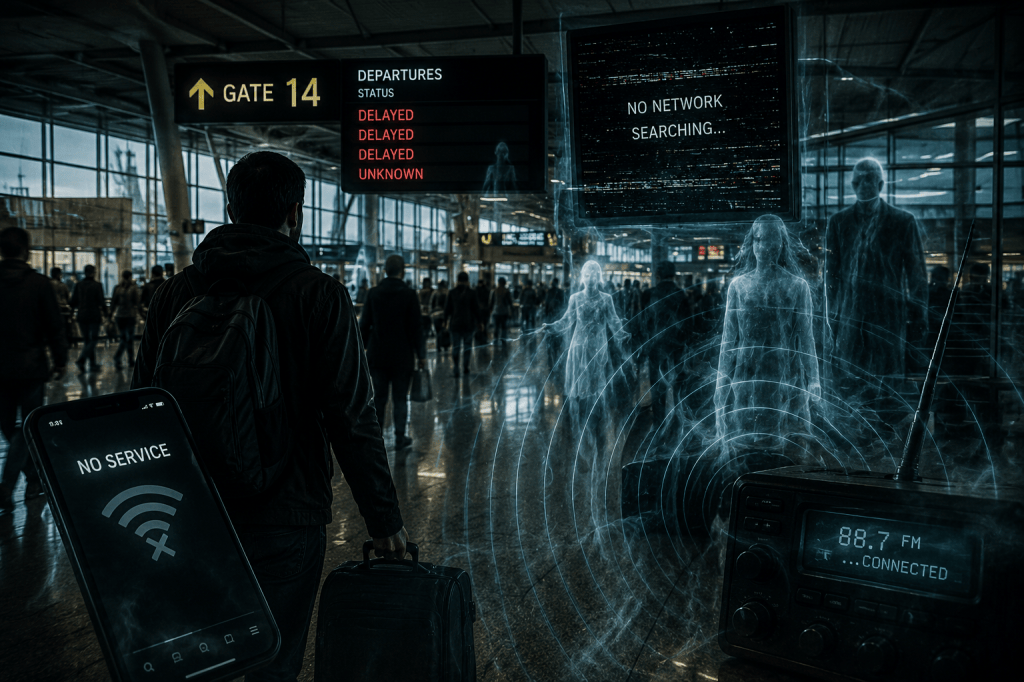
People are moving around you with luggage and boarding passes. Announcements echo overhead. Screens flicker with departures. Phones vibrate. Radios crackle. Wi-Fi signals pass invisibly through thousands of bodies.
And somehow you know:
You’re here for a reason.
Not just a flight.
Not just a destination.
Something else is happening in the terminal.
Something you cannot see.
Call it the spiritual realm.
Call it another dimension.
Call it consciousness.
Call it nonsense, if you prefer.
But entertain the possibility for the length of this article.
Suppose entities exist around us that human eyes normally cannot perceive.
Then the obvious question isn’t merely:
Why can’t we see them?
It’s this:
Could they see—or affect—us?
And if they could, would our increasingly electronic world make that easier?
YOU ALREADY LIVE INSIDE AN INVISIBLE WORLD
Stand in the middle of a modern airport and you’re surrounded by things you cannot see.
Radio transmissions.
Cellular signals.
Wi-Fi.
Bluetooth.
GPS signals reaching receivers from satellites.
Radar.
Electrical fields.
Infrared radiation.
Visible light itself occupies only a portion of the electromagnetic spectrum our instruments can detect.
Your eyes aren’t windows onto everything that exists.
They’re biological sensors.
Useful ones.
Limited ones.
Humans evolved to detect the wavelengths of light that helped our ancestors navigate the environment.
We don’t naturally see radio waves.
We don’t see Wi-Fi.
We don’t see ultraviolet the way some animals perceive wavelengths beyond our range.
That doesn’t make those things supernatural.
It demonstrates something important:
Invisible does not mean nonexistent.
But—and this distinction matters—it also doesn’t mean every invisible thing is a spirit.
WHAT IF THE RECEIVER IS THE PROBLEM?
Imagine an old radio.
Turn the dial.
Static.
Then music.
Turn again.
Another station.
The second station didn’t suddenly begin existing when you tuned into it.
It was already there.
The receiver simply wasn’t configured to detect it.
Paranormal theories have played with versions of this idea for generations.
What if human perception operates similarly?
What if whatever people call spirits, entities or apparitions exists outside the normal range of our sensory equipment?
That would provide an elegant explanation for one of paranormal investigation’s oldest frustrations.
Why can a person enter a supposedly haunted room and see absolutely nothing—
while an electronic device behaves strangely?
THE MACHINE NOTICES FIRST
Anyone who has watched enough paranormal television knows the inventory.
Digital recorders.
EMF meters.
Radios.
Cameras.
Thermal imagers.
Motion sensors.
Phones.
Spirit boxes scanning radio frequencies.
Investigators sometimes report batteries draining unexpectedly, lights flickering, recordings containing unexplained voices, cameras malfunctioning or electromagnetic readings changing without an obvious source.
Do these events prove spirits are manipulating electronics?
No.
Not remotely.
Electronics malfunction.
Batteries fail.
Radio interference occurs.
Wireless networks drop packets.
Recordings produce artifacts.
Cheap sensors behave like cheap sensors.
And when investigators are actively expecting paranormal activity, ordinary technical problems can acquire extraordinary meaning very quickly.
But the recurring association between ghost stories and electrical phenomena creates an interesting hypothetical question:
If a nonphysical intelligence wanted to interact with our physical world, would electronics be easier to influence than matter?
WHY A RADIO?
Moving a chair requires force.
Knocking on a wall requires force.
Opening a door requires force.
But altering an existing signal might require something considerably subtler.
That’s the idea, anyway.
A radio receiver is already processing electromagnetic energy.
A microphone is already converting vibrations into electrical information.
A digital camera is already converting photons into data.
A computer network is already interpreting tiny changes in electrical or electromagnetic states as information.
If some unknown phenomenon could influence those states, even slightly, perhaps it wouldn’t need enough energy to throw a table across the room.
It would only need to change information.
A bit.
A pulse.
A sound.
A packet.
A pixel.
Suddenly the classic paranormal question changes.
Maybe we shouldn’t ask:
Can a ghost move an object?
Maybe we should ask:
Can something alter a signal?
THE AIRPORT IS THE PERFECT PLACE
Which brings us back to the terminal.
Think about what surrounds you.
Thousands of phones.
Dozens of wireless networks.
Airport communications.
Radar systems.
Security equipment.
Digital displays.
Bluetooth devices.
Aircraft communications.
Navigation systems.
Cameras.
Sensors.
Electrical infrastructure stretching through walls and ceilings.
The modern airport isn’t merely a building.
It’s an electromagnetic jungle.
If an intelligence existed that interacted somehow with electromagnetic phenomena, an airport would be one of the noisiest environments imaginable.
Perhaps too noisy.
Or perhaps extraordinarily useful.
Imagine standing there while your phone suddenly loses service.
The departure board glitches.
Your headphones crackle.
A nearby screen briefly goes black.
Your boarding pass refuses to load.
Then a message appears.
Nothing supernatural about any individual event.
All of those things happen.
But what if the pattern mattered?
COINCIDENCE IS CHEAP. INFORMATION IS EXPENSIVE.
This is where paranormal investigation usually gets itself into trouble.
A light flickers.
“Spirit.”
Wi-Fi drops.
“Entity.”
Radio produces static.
“Communication.”
No.
That’s not enough.
Random electrical anomalies are everywhere.
What would matter is information.
Suppose a radio produces a recognizable word.
Interesting.
Suppose it produces your name.
More interesting.
Suppose it gives you a piece of specific information unknown to anyone present, which can later be independently verified.
Now we have something worth investigating.
The more specific the information, the harder coincidence becomes as an explanation.
That’s the standard paranormal researchers should demand.
Not weirdness.
Information.
WHY CAN’T WE SEE THEM?
Assuming for the moment that entities exist, there are several possibilities.
Maybe they don’t interact strongly with visible light.
Maybe they aren’t continuously physical.
Maybe the human brain filters information before it reaches conscious awareness.
Maybe perception itself is doing more editing than we realize.
Or perhaps we’re approaching the entire question backward.
Maybe “spirits” aren’t human-shaped transparent people walking around rooms.
Maybe that’s simply the visual metaphor our brains create when confronted with something we don’t understand.
Think about a computer network.
You can’t see the network.
You see devices connected to it.
You see information moving through it.
You see effects.
If consciousness could somehow exist independently of biological bodies, perhaps asking what a spirit looks like would be as meaningless as asking what the internet looks like.
It doesn’t have to look like anything.
THE NETWORK THEORY OF THE AFTERLIFE
Now we’re entering deep speculative territory.
But let’s go there.
What if consciousness isn’t entirely local?
What if brains don’t manufacture consciousness so much as participate in it?
Under this hypothetical model, individual minds could resemble terminals connected to some larger informational structure.
Birth connects.
Life transmits and receives.
Death disconnects the biological terminal.
But perhaps the information isn’t destroyed.
This sounds suspiciously like a technological version of ideas humans have expressed for thousands of years.
The spirit world.
Collective consciousness.
Akashic records.
Heaven.
Ancestral realms.
Different cultures, different language, similar suspicion:
There is somewhere else.
The modern age simply gives us a new metaphor.
The network.
AND WHAT IF SOMETHING ELSE IS ON IT?
Here’s where the airport dream becomes considerably darker.
If consciousness occupies some unseen informational environment, why assume humans are the only things there?
Every ecosystem we have ever discovered contains multiple forms of life.
Every environment has inhabitants adapted to it.
So if there were some layer of reality beyond ordinary human perception, perhaps calling everything inside it “the dead” would be naïve.
Some entities might never have been human.
That possibility appears repeatedly in religious traditions, folklore and paranormal reports.
Angels.
Demons.
Djinn.
Elementals.
Shadow people.
Guides.
Watchers.
Different names across different cultures for intelligences that supposedly exist alongside humanity.
Are these descriptions of genuine external beings?
We don’t know.
Are they psychological archetypes produced by similar human brains confronting similar fears?
Entirely possible.
But the similarity of the basic concept remains fascinating:
We’re not alone in the room.
YOU’RE BEING RUSHED
Now imagine the airport again.
Someone is rushing you.
You don’t know who.
You just know you have to get somewhere.
There’s urgency.
A flight.
A gate.
A destination.
Except dreams rarely respect literal geography.
Airports are transitional places.
You arrive as one thing.
You leave for somewhere else.
In psychology and mythology, transitional spaces carry enormous symbolic weight.
Doorways.
Bridges.
Staircases.
Crossroads.
Train stations.
Airports.
Places between places.
If the subconscious wanted to represent movement between states—between lives, identities, realities or levels of awareness—an airport would be almost perfect.
Departures.
Arrivals.
Gates.
Even the language sounds suspiciously metaphysical.
MAYBE YOU’RE NOT CATCHING A PLANE
Maybe the dream isn’t about travel.
Maybe it’s about assignment.
Purpose.
The feeling that you’re supposed to be somewhere because something important is happening.
That doesn’t require a supernatural explanation.
The brain frequently turns anxiety, responsibility and uncertainty into narratives involving missed trains, forgotten tickets and urgent journeys.
But paranormal traditions offer another interpretation.
Some dreams are supposedly encounters.
Some are warnings.
Some are instructions.
Some are remembered fragments of experiences occurring while ordinary waking consciousness is offline.
There’s no reliable scientific evidence demonstrating that dreams are literal excursions into a spiritual dimension.
But anybody who has experienced an unusually vivid dream knows why the idea refuses to disappear.
Sometimes you wake up remembering a dream.
Other times you wake up feeling like you came back from somewhere.
There’s a difference.
At least emotionally.
IF THEY CAN TOUCH THE NETWORK
And now we arrive at the question that bothers me most.
Suppose an entity cannot easily materialize.
Cannot speak normally.
Cannot remain visible.
But it can produce tiny disturbances in electromagnetic systems.
What happens as civilization becomes increasingly electronic?
In 1826, perhaps it had a candle flame.
In 1926, a radio.
In 2026?
We’ve covered the planet in receivers.
Phones beside our beds.
Wireless networks in our homes.
Microphones in our pockets.
Cameras on our doors.
Bluetooth in our cars.
Satellites above us.
Data moving everywhere.
If spirits can manipulate electronics—and again, that’s a giant if—then humanity may have accidentally spent the last century constructing the largest paranormal detection system imaginable.
We just haven’t figured out how to distinguish the signal from the noise.
GATE UNKNOWN
So you’re back at the airport.
The announcement system crackles.
People rush past.
Your phone searches for a network.
For one second, the screen freezes.
You look toward the departure board.
Your gate has changed.
Probably software.
Probably coincidence.
Probably nothing.
That’s the answer we should begin with.
But somewhere between the radio waves passing through your body, the satellite signals falling invisibly from space and the billions of packets of information moving through the air is an uncomfortable reminder:
Reality contains things your senses cannot perceive directly.
Science knows that.
The paranormal question is whether someone is hiding there too.
I don’t know.
Neither does the guy selling coffee beside Gate 14.
But if your headphones suddenly crackle and a voice you’ve never heard calmly tells you why you’re at the airport—
don’t panic.
Don’t assume it’s a ghost either.
Check the Bluetooth connection.
Check the radio interference.
Check every ordinary explanation first.
Then write down exactly what it said.
Because if there really is another network running alongside ours, the most important message humanity ever receives may not arrive from a séance, haunted mansion or mountaintop.
It may arrive while you’re staring at your phone beneath fluorescent lights, waiting for a flight.
NO NETWORK.
Then suddenly:
CONNECTED.
 The ChillX Zone
Leave a comment