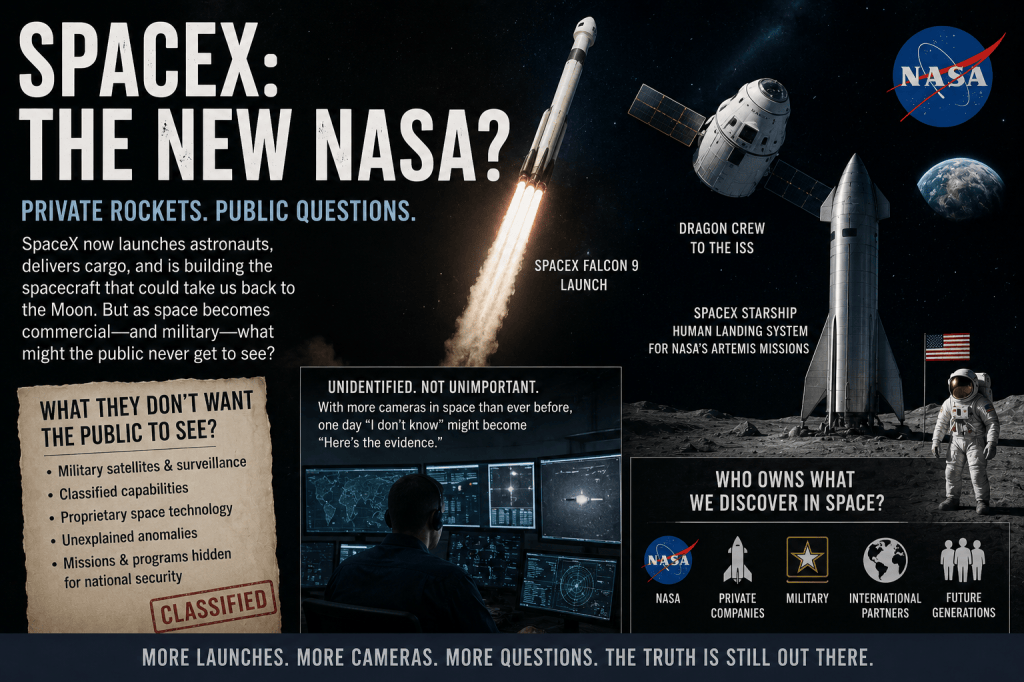
Private Rockets Are Carrying Astronauts and Shaping America’s Return to the Moon. But as Space Becomes Commercial—and Military—What Might the Public Never Get to See?
August 26, 2026
PARANORMAL DESK
For generations, American spaceflight meant one thing:
NASA.
Mercury. Gemini. Apollo. The Shuttle.
Today an astronaut can climb aboard a spacecraft owned and operated by a private company, launch on its privately operated rocket and travel to the International Space Station.
That company is SpaceX.
NASA’s commercial model now purchases astronaut transportation as a service, while the companies own and operate much of their hardware. SpaceX’s Crew Dragon has been certified for NASA missions since 2020 and has become a regular part of American human spaceflight.
So is SpaceX becoming the new NASA?
Not exactly.
But something almost as significant is happening.
NASA BUILDS THE MISSION. SPACEX BUILDS THE RIDE.
NASA isn’t disappearing.
It remains America’s civil space agency, conducting science and exploration and overseeing major programs.
But NASA no longer needs to own every spacecraft carrying its astronauts.
That was one purpose of Commercial Crew: let private companies concentrate on transportation to low-Earth orbit while NASA directs more resources toward deeper-space exploration.
And SpaceX isn’t stopping at Earth orbit.
NASA’s current Artemis plans involve commercial lunar-lander technology from SpaceX and Blue Origin. Under NASA’s 2026 plans, test versions of those systems are intended to rendezvous with Orion during Artemis III as groundwork for later lunar missions.
That’s a remarkable change.
The government still wants to explore the Moon.
But increasingly, private machines may help get us there.
SO WHAT ARE THEY SEEING UP THERE?
That’s where the Paranormal Desk becomes interested.
Spacecraft have cameras.
Satellites have sensors.
Astronauts have windows.
Military spacecraft monitor things civilians never see.
And commercial companies now control enormous amounts of hardware beyond Earth’s atmosphere.
So suppose a SpaceX camera captures something nobody immediately recognizes.
What happens to the footage?
Who owns it?
Who investigates it?
And does the public necessarily get to see it?
YES, THINGS IN SPACE ARE HIDDEN FROM US
But here’s where we have to be careful.
There is no credible public evidence proving NASA or SpaceX is concealing confirmed extraterrestrial spacecraft.
That’s the line between investigation and fiction.
However, there absolutely are things in space the public cannot completely examine.
National-security satellites exist.
Some military capabilities are classified.
Sensor capabilities, intelligence products, communications and operational details may be withheld for obvious security reasons.
And private companies can possess proprietary information that isn’t automatically public either.
So when somebody says:
“They’re hiding things in space.”
In the broadest sense?
Of course.
The unanswered question is what.
WHAT WOULD THEY ACTUALLY HIDE?
Probably something less exciting than aliens.
How accurately a satellite can see.
What frequencies a sensor detects.
Where a classified spacecraft can maneuver.
Military communications.
Surveillance capabilities.
Experimental technology.
The exact performance of new aerospace systems.
If America possesses technology an adversary doesn’t know about, publishing its specifications would be foolish.
But secrecy naturally creates another possibility:
Something gets recorded that nobody understands.
Would we hear about that?
That’s harder to answer.
THE UFO PROBLEM
Imagine a spacecraft camera records a strange object.
It moves.
Changes direction.
Then disappears.
Alien?
Not yet.
First investigate:
Ice.
Debris.
Another satellite.
A rocket component.
Reflections.
Camera artifacts.
Material vented from the spacecraft.
Something nearby that only appears enormous because there’s no useful sense of scale.
Space produces extremely deceptive images.
Unidentified does not mean extraterrestrial.
It means unidentified.
And that’s exactly where the investigation should begin.
WHAT IF IT’S OURS?
There’s another possibility UFO culture often forgets.
Something apparently impossible might be classified human technology.
Secret aircraft have historically been mistaken for UFOs.
The same principle could eventually apply in space.
Military agencies, government contractors and commercial aerospace companies operate in overlapping worlds.
So perhaps somebody really does see something they’re “not supposed to see.”
That doesn’t necessarily mean visitors from another planet.
It might mean they just saw something from this planet too early.
PRIVATE SPACE CHANGES EVERYTHING
Here’s where SpaceX becomes genuinely important to the paranormal question.
More rockets mean more cameras.
More satellites mean more sensors.
More astronauts mean more witnesses.
More lunar missions mean more opportunities to observe the space between Earth and the Moon.
And that should make genuine anomalies harder to hide—but also harder to fake.
Eventually, “I saw a light” shouldn’t satisfy anybody.
We should want multiple cameras.
Radar.
Trajectory.
Velocity.
Telemetry.
Independent observations.
Actual data.
Commercial spaceflight may ultimately destroy a thousand bad UFO stories.
But it could also make one extraordinary case much stronger.
THE NEW NASA?
SpaceX isn’t replacing NASA.
NASA determines exploration goals, conducts science and maintains government programs. SpaceX provides increasingly important transportation and spacecraft capabilities.
It’s more accurate to say the old government-only image of spaceflight is disappearing.
The future belongs to a mixture of:
NASA.
Private companies.
Universities.
International partners.
Military organizations.
Commercial astronauts.
And eventually ordinary customers.
That creates one enormous question we haven’t really confronted yet.
Who owns what humanity discovers in space?
KEEP THE CAMERAS RUNNING
Maybe there’s nothing extraordinary being hidden.
Maybe the classified material consists entirely of military hardware, sensor capabilities and things nobody outside an intelligence agency would find particularly exciting.
But if something genuinely unknown is moving around our planet, we’re entering the best period in history to discover it.
More launches.
Better cameras.
More sensors.
More people looking.
SpaceX may never become “the new NASA.”
It might do something stranger.
It may help create a world where governments are no longer the only organizations capable of seeing what’s happening above us.
And if a privately built spacecraft eventually captures an object that cannot be explained, the biggest question may not be:
What did they see?
It may be:
Who gets to decide whether we see it too?
References: NASA Commercial Crew Program; NASA Office of Inspector General, NASA’s Management of Its Commercial Crew Program (2026); NASA Artemis III mission planning and Human Landing Systems materials.
 The ChillX Zone
Leave a comment