The Mountain, the Stone, and the Search for Noah’s Ship
August 12, 2026
PARANORMAL DESK
There are lost treasures.
And then there is the Lost Ark.
Not Indiana Jones’ gold-covered Ark of the Covenant—the other one.
Noah’s Ark.
The enormous vessel that, according to Genesis, carried Noah, his family and animals through a catastrophic flood before coming to rest upon the “mountains of Ararat.”
For centuries, explorers, clergy, adventurers and true believers have gone looking for it.
Some claimed they saw timber protruding from ice high on Mount Ararat. Others returned with photographs, fragments of wood or stories whispered by local guides.
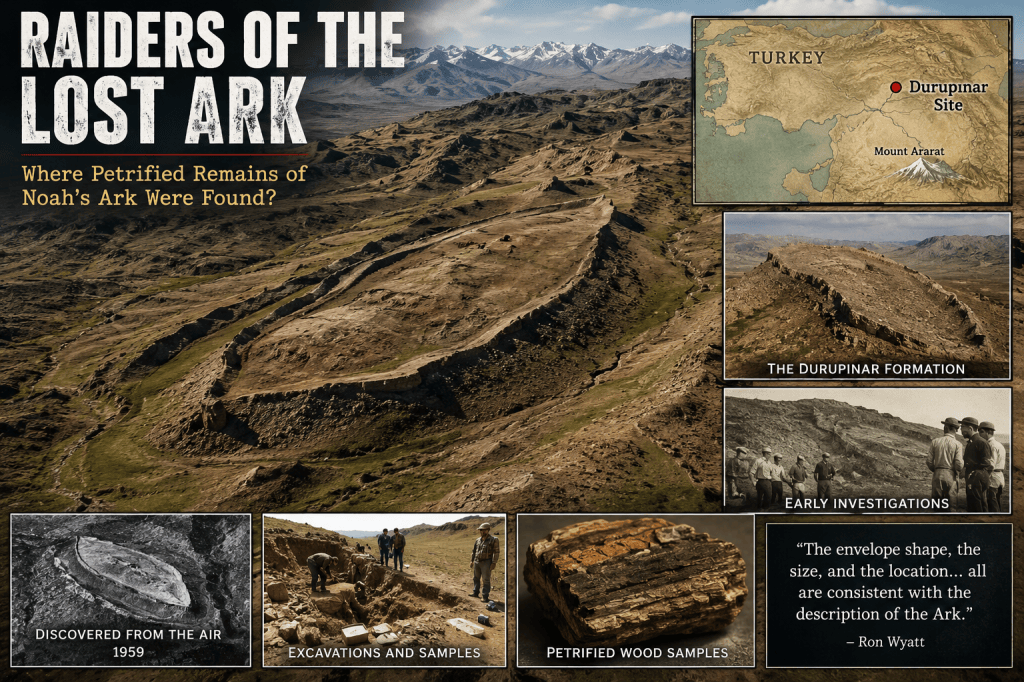
But roughly 18 miles south of Mount Ararat, near the Turkish town of Doğubayazıt, sits something considerably harder to ignore.
A giant boat-shaped formation in the earth.
It is called the Durupınar site.
And depending upon whom you ask, it is either an interesting geological formation—
or the petrified remains of the most famous ship in human history.
Grab your hat, professor.
We’re going in.
THE SHIP IN THE MOUNTAIN
The story begins in 1959.
During an aerial mapping survey of eastern Turkey, Turkish Army Captain İlhan Durupınar noticed an unusual formation in photographs of the region.
It looked remarkably like a ship.
Not vaguely oval.
Not simply a random ridge.
From above, the formation resembles the outline of an enormous vessel resting against the mountainside.
Its discovery quickly attracted attention.
Among the investigators who later became closely associated with the site was American anesthesiologist and amateur archaeologist Ron Wyatt, who became convinced that Durupınar wasn’t merely shaped like a boat.
He believed it was the boat.
Noah’s boat.
And that’s when the story moved from unusual geology into one of the great archaeological controversies of the modern era.
THE PETRIFIED ARK?
The most dramatic version of the Durupınar theory proposes that the original wooden vessel became buried, mineralized and eventually incorporated into the surrounding geological material.
In other words:
petrified.
The wooden ship would no longer look like wood.
Its organic structure, proponents argue, could have been replaced or surrounded by minerals over thousands of years until what remained resembled stone and earth.
That idea is crucial because one of the obvious objections to finding Noah’s Ark is painfully simple.
Wood doesn’t usually survive thousands of years exposed on a mountainside.
A mineralized structure might.
Supporters have pointed to apparent internal patterns, unusual concentrations of certain materials and subsurface features detected during various investigations.
Some have interpreted those features as bulkheads, decks or structural components.
If they’re right, we’re looking at archaeology on a biblical scale.
If they’re wrong, we’re looking at a mountain doing an excellent impression of a boat.
AND THEN THERE’S THE SIZE
This is where believers usually lean forward.
Genesis gives dimensions for Noah’s Ark: 300 cubits long, 50 cubits wide and 30 cubits high.
The exact length of an ancient cubit isn’t universally fixed; different cubit standards existed.
But advocates of the Durupınar site have long argued that the formation’s approximate dimensions correspond intriguingly with biblical descriptions when particular cubit measurements are used.
That’s interesting.
It isn’t proof.
When dealing with an irregular geological formation and an ancient measurement whose exact value is debated, there’s plenty of room to make numbers cooperate.
Still, the resemblance is enough to keep the mystery alive.
Because when you’re standing beside something shaped like a giant ship in the same broad region associated for centuries with the Ark tradition, coincidence begins feeling like a word that deserves investigation.
Not abandonment.
Investigation.
THE GEOLOGISTS ENTER THE ROOM
Here’s where our adventure movie loses the orchestral soundtrack.
Mainstream geologists who have examined the Durupınar formation have generally concluded that it is natural.
Not a fossilized ship.
Not petrified timber.
Geology.
Researchers have pointed to natural rock structures, erosion and earth movement as explanations for the site’s unusual shape.
And that’s important.
If we’re going to call something Noah’s Ark, “it looks like a boat” isn’t remotely enough.
Nature is an extraordinary counterfeiter.
There are rocks shaped like faces.
Mountains shaped like pyramids.
Clouds shaped like dragons.
There is even a psychological term—pareidolia—for our tendency to perceive familiar forms in ambiguous patterns.
Humans are pattern-recognition machines.
Sometimes too good at the job.
So the skeptic asks a perfectly reasonable question:
Are we looking at a ship—or are we looking for a ship?
There’s a difference.
BUT WHAT’S UNDERNEATH IT?
And here the story refuses to die.
Modern investigations of the Durupınar site have included ground-penetrating radar and other geophysical surveys.
Reports surrounding recent work have again generated headlines suggesting unusual structures or geometric patterns beneath the surface.
Naturally, “possible underground structures at Noah’s Ark site” travels around the internet considerably faster than “geophysical anomaly requires additional study.”
But an anomaly isn’t a ship.
Radar doesn’t produce a photograph of Noah’s cargo hold.
Ground-penetrating radar records differences in subsurface materials. Those differences then have to be interpreted.
Rock boundaries can produce patterns.
So can sediment.
So can fractures.
So can human construction.
The instrument gives you data.
The human being looking at the screen supplies the story.
That’s exactly why excavation and physical sampling matter.
If there are genuinely artificial structural elements beneath Durupınar, they should eventually produce testable physical evidence.
Not merely shapes.
Materials.
Construction patterns.
Tool marks.
Datable organic remains.
Something that separates interesting geology from archaeology.
Until then, we’re standing at the door.
We haven’t opened it.
WHAT WOULD PETRIFIED WOOD ACTUALLY PROVE?
Suppose tomorrow somebody digs into the formation and discovers unquestionably petrified wood.
Game over?
Not even close.
Wood near the site would be fascinating, but we’d still need context.
How old is it?
Was it naturally deposited?
Was it part of a structure?
Was that structure a ship?
When was it constructed?
Was it actually large enough to correspond with the biblical vessel?
And even if an enormous ancient ship were discovered in eastern Turkey, there’s still another leap:
Was its captain Noah?
Archaeology doesn’t come with name tags.
Finding Troy didn’t prove every event in Homer’s Iliad happened exactly as described.
Finding an ancient settlement mentioned in a religious text doesn’t automatically prove every supernatural event associated with it.
Evidence has layers.
That’s what makes this mystery so good.
Every answer creates another question.
THE FLOOD BEFORE NOAH
Here’s where things become considerably more interesting.
Noah isn’t humanity’s only ancient flood survivor.
Long before modern biblical archaeology, scholars discovered Mesopotamian texts containing remarkably similar flood traditions.
The Epic of Gilgamesh tells of Utnapishtim, who survives a divinely sent flood aboard a vessel after being warned beforehand.
Other ancient Mesopotamian traditions contain related stories.
Now we’ve got a historical mystery bigger than one boat.
Why did civilizations of the ancient Near East preserve stories about catastrophic flooding?
Maybe the answer is obvious.
They lived around rivers.
The Tigris and Euphrates could flood catastrophically.
Communities destroyed by extraordinary floods would remember them.
Children would hear the story.
Their children would repeat it.
Generations pass.
A flood becomes the Flood.
A survivor becomes a hero.
History becomes legend.
Legend becomes sacred history.
That’s one possibility.
But there’s another question worth asking:
What if multiple traditions preserve distorted memories of one or more genuine prehistoric disasters?
Now we’re no longer searching only for Noah’s Ark.
We’re searching for the event behind the story.
WHEN THE WORLD REALLY FLOODED
At the end of the last Ice Age, the world changed dramatically.
Ice sheets melted.
Sea levels rose.
Coastlines moved.
Land inhabited by prehistoric humans disappeared beneath water.
This wasn’t one Hollywood-style wall of water swallowing the entire planet overnight.
It happened across long periods, with regional catastrophic events potentially occurring within that broader transformation.
But imagine experiencing one.
Your village is gone.
Your hunting grounds are gone.
The shoreline your grandparents knew is underwater.
People flee inland.
Survivors tell their children what happened.
How many generations before the story changes?
How many before geology becomes mythology?
And how many before somebody says:
The whole world was flooded?
Because to an ancient person, “the whole world” didn’t mean a satellite image of Earth.
It meant everything they knew.
THE PARANORMAL POSSIBILITY
So where does the paranormal enter?
Not necessarily with angels pushing animals up a gangplank.
The paranormal question is whether human mythology sometimes preserves information longer—and more accurately—than skeptics traditionally assumed.
Could oral traditions retain memories of real geological catastrophes across thousands of years?
Could stories dismissed as mythology contain distorted eyewitness accounts of events occurring before written history?
And if one part of an ancient story proves unexpectedly grounded in reality, how carefully should we reconsider the rest?
That’s dangerous territory.
Finding evidence of an ancient flood does not prove divine intervention.
Finding a large ancient boat wouldn’t prove that two of every animal boarded it.
And discovering Durupınar was artificial wouldn’t establish every sentence of Genesis as literal history.
But science shouldn’t be afraid of where evidence leads.
Neither should believers.
WHAT WOULD SETTLE IT?
Forget blurry photographs.
Forget YouTube arrows pointing toward rocks.
Forget declarations that the mystery has already been solved.
If Durupınar is Noah’s Ark—or even an ancient human-made vessel unrelated to Noah—we need serious evidence.
Controlled excavation.
Independent geological analysis.
Peer-reviewed results.
Datable material recovered from secure archaeological contexts.
Evidence of intentional construction.
Repeated findings by researchers who don’t begin with the conclusion already written.
If those tests reveal nothing artificial?
Then we accept the mountain made a convincing boat.
If they reveal an enormous ancient vessel?
Then somebody better call every archaeology department on Earth.
Because we’d have a discovery considerably bigger than a movie.
RAIDERS OF THE LOST ARK
There’s something wonderfully appropriate about this mystery surviving into 2026.
Satellites can photograph the planet.
Radar can look beneath soil.
Geneticists can reconstruct ancient migrations.
Archaeologists can identify what somebody ate thousands of years ago from chemical signatures in their bones.
And yet we’re still staring at a boat-shaped patch of Turkish mountainside asking the same question explorers asked generations ago.
Is that it?
Maybe not.
The responsible answer today is that the Durupınar formation has not been established as Noah’s Ark, and geological explanations remain the conventional scientific interpretation.
But that’s not the same thing as saying stop looking.
Quite the opposite.
Dig carefully.
Measure everything.
Publish the data.
Invite the skeptics.
Invite the believers.
Then make both groups stand behind the yellow tape while the evidence comes out of the ground.
Because if history has taught us anything, it’s that legends shouldn’t automatically be mistaken for facts.
But neither should they automatically be thrown away.
Sometimes legends point toward places.
Sometimes they preserve disasters.
Sometimes archaeology finds something nobody expected.
And sometimes—
just sometimes—
you look down from an airplane and there’s a ship where no ship ought to be.
Maybe it’s geology.
Maybe it’s history.
Maybe Noah never came within a hundred miles of the place.
But somewhere beneath the soil of eastern Turkey is an answer.
And until somebody produces enough evidence to settle it, the world’s most famous missing ship remains exactly where every great mystery belongs:
somewhere between the map and the legend.
 The ChillX Zone
Leave a comment