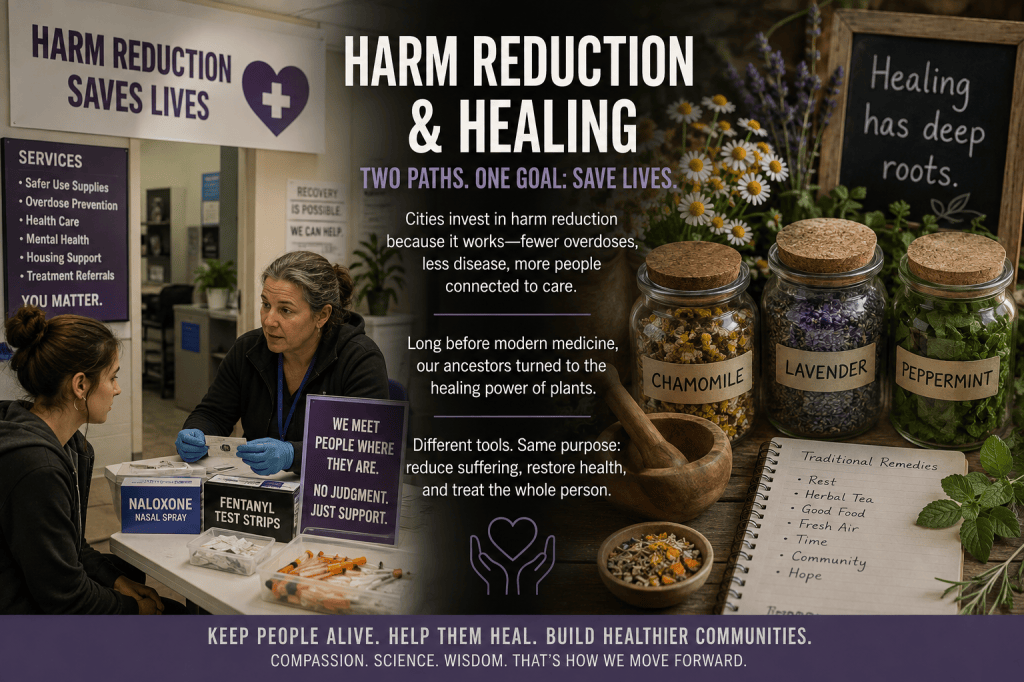
Why Cities Are Helping People Survive Drug Use—and What Our Grandparents’ Medicine Cabinets Can Teach Us About Healing Without Pretending Every “Natural” Remedy Was Safe
August 25, 2026
PARANORMAL DESK
Walk into a modern harm-reduction center and you may find something that would have been politically unimaginable a generation ago.
Naloxone.
Sterile supplies.
Fentanyl testing.
Medical care.
Counseling.
People explaining how to reduce the risks of drugs they know some visitors may continue using.
In New York City, overdose prevention centers even allow people to consume previously obtained drugs under supervision while trained staff watch for overdose and connect visitors with health and social services.
To some people, this looks like compassion.
To others, it looks suspiciously like government helping people use drugs.
So which is it?
And how did we get from our grandparents reaching for herbs, teas, poultices and home remedies to cities operating facilities where illegal drug use may be supervised?
The answer is more complicated than either side usually admits.
HARM REDUCTION ISN’T SUPPOSED TO MEAN “DRUGS ARE FINE”
This distinction matters.
The basic philosophy of harm reduction is not:
Take whatever you want.
It’s:
Some people are going to use drugs whether we approve or not. How many of them have to die before we’re willing to meet them where they are?
That’s why harm-reduction programs distribute naloxone, provide sterile equipment, offer testing and connect people with treatment and health services. CDC guidance also describes harm-reduction approaches including fentanyl test strips, naloxone and connections to substance-use treatment.
The objective is survival.
Keep someone alive today and perhaps recovery becomes possible tomorrow.
A dead person doesn’t get another chance.
BUT THE PUBLIC’S QUESTION IS FAIR
There’s still an uncomfortable question.
At what point does reducing harm begin looking like accommodating drug use?
That’s a legitimate public-policy debate.
A neighborhood may support saving lives while simultaneously worrying about public drug use, discarded equipment, disorder, dealing and whether services are actually moving people toward treatment.
Those concerns shouldn’t simply be dismissed as ignorance.
Likewise, giving somebody naloxone or sterile equipment doesn’t mean a city believes heroin or fentanyl is healthy.
Two ideas can coexist:
Drug dependence can devastate people and communities.
And people experiencing that dependence still deserve medical care.
That’s the balance policymakers are trying to find.
HOW DID OUR GRANDPARENTS HANDLE PAIN?
Now go backward.
Before the enormous modern pharmaceutical industry, families possessed another medicine cabinet.
The garden.
The kitchen.
The forest.
Herbal preparations have extraordinarily long histories across cultures. Plants and botanicals have been used traditionally for health purposes for generations, and plants have also contributed compounds that eventually became important modern medicines.
Grandma made tea.
Someone used ginger for an upset stomach.
Peppermint appeared after meals.
Chamomile appeared before bed.
Families passed remedies down because sometimes they seemed to help—and because for much of history there wasn’t a 24-hour pharmacy five minutes away.
Humans experimented with nature because nature was the pharmacy.
BUT DON’T ROMANTICIZE THE OLD DAYS
Our ancestors also got things wrong.
Frequently.
“Natural” doesn’t automatically mean safe.
Plants contain chemicals.
Some heal.
Some irritate.
Some interact with medications.
Some are poisonous.
Modern research has found that the evidence supporting traditional herbal products varies dramatically, and herbal supplements can interact with prescription drugs or contain contaminants.
That’s the correction we need whenever somebody says:
“People used herbs for thousands of years.”
True.
People also died young for thousands of years.
Tradition is worth investigating.
It isn’t automatically proof.
THE PART MODERN MEDICINE GOT RIGHT
Modern pharmacology didn’t appear because every traditional remedy was useless.
It appeared partly because humans learned to isolate, measure, standardize and test biologically active substances.
That’s revolutionary.
Instead of:
Take some of this plant.
Medicine can increasingly ask:
Which compound?
What dose?
How often?
What interaction?
What side effect?
Does it actually outperform placebo or existing treatment?
That’s progress.
But something may have been lost along the way.
HEALING VERSUS TREATING
Older traditions frequently treated healing as something broader than swallowing a chemical.
Rest.
Food.
Family.
Touch.
Ritual.
Plants.
Community.
Time.
Sometimes spirituality.
Modern medicine can become extraordinarily specialized.
One doctor for this organ.
Another for that symptom.
Another prescription.
Another appointment.
That’s often necessary.
But human beings aren’t collections of independent replacement parts.
Someone struggling with addiction may also be struggling with trauma, housing, loneliness, chronic pain, psychiatric illness, unemployment or despair.
Handing them a pamphlet saying STOP USING DRUGS doesn’t solve those things.
Neither does handing them a clean syringe.
The real work begins after survival.
THAT’S WHERE HARM REDUCTION EITHER SUCCEEDS OR FAILS
A good harm-reduction system shouldn’t end at:
Here’s how to use more safely.
It should open a door:
Medical care.
Mental-health care.
Housing assistance.
Addiction treatment.
Medication for opioid use disorder when appropriate.
Counseling.
Recovery services.
Human connection.
New York City’s own description of overdose prevention centers emphasizes connections to treatment, health care and social services alongside overdose intervention.
That’s an important distinction.
Harm reduction should be a bridge.
The controversy begins when people fear society is building the bridge but forgetting where it’s supposed to lead.
WHAT WOULD GRANDMA SAY?
Probably something more complicated than either political camp expects.
Our grandparents understood something modern culture occasionally forgets:
You often care for someone before they’ve fixed their life.
You feed them first.
Get them through the night.
Treat the wound.
Sit beside them.
Then figure out tomorrow.
That’s harm reduction in its most basic form.
But older generations also understood another concept:
Eventually, something has to change.
You don’t keep putting a bucket beneath a leaking roof forever.
At some point you repair the roof.
HERBS AREN’T THE ANSWER TO FENTANYL
And here’s another line we shouldn’t cross.
A cup of herbal tea isn’t treatment for opioid overdose.
Chamomile isn’t naloxone.
Peppermint isn’t addiction medicine.
Traditional remedies may have places in wellness and complementary care, but they shouldn’t replace proven emergency or medical treatment when serious illness is involved.
Even herbal products deserve caution because some can interact with medications or cause harmful effects of their own.
Respecting traditional medicine doesn’t require rejecting modern medicine.
Maybe the smarter future uses what survives serious examination from both.
THE STRANGE CIRCLE
And perhaps that’s the irony.
We think we’re doing something radically modern.
Meeting people where they are.
Reducing suffering.
Keeping them alive.
Treating the person rather than simply condemning the behavior.
But humanity has been wrestling with those ideas forever.
The tools changed.
Grandmother had herbs drying in the kitchen.
The emergency worker carries naloxone.
The addiction specialist has medications and counseling.
The harm-reduction worker has test strips and sterile supplies.
Different centuries.
Same fundamental question:
What do we do when somebody in front of us is hurting?
Punish them?
Ignore them?
Save them?
Treat them?
Help them change?
Maybe the answer isn’t choosing only one.
KEEP THEM ALIVE—THEN HELP THEM LIVE
Cities aren’t necessarily supporting recreational drug use simply because they support harm reduction.
They’re acknowledging an ugly reality:
Prohibition doesn’t make every drug disappear.
Addiction doesn’t disappear because somebody receives a citation.
And people don’t become ready for recovery according to a government timetable.
So keep them alive.
But don’t stop there.
Offer treatment.
Offer a way out.
Demand safe neighborhoods too.
Measure whether programs actually work.
Listen to residents.
Listen to people in recovery.
Listen to families who have buried someone.
And remember something our grandparents understood long before anyone coined the phrase harm reduction:
Healing isn’t merely preventing death.
It’s helping someone return to life.
 The ChillX Zone
Leave a comment