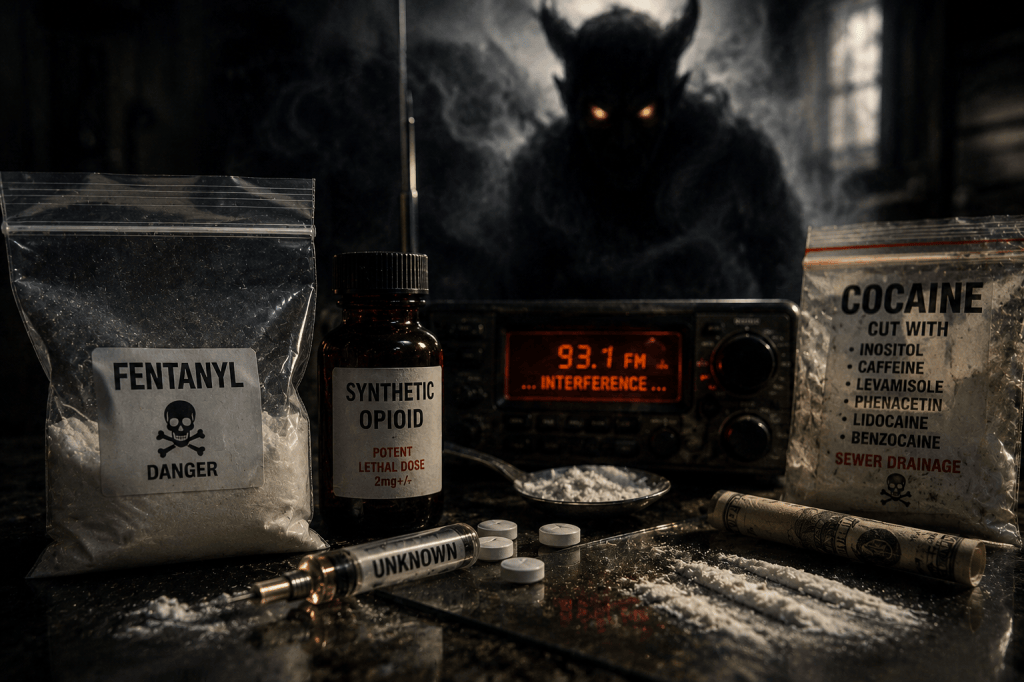
Synthetic Drugs, Contaminated Cocaine, and the Paranormal Question of Whether Chemistry Can Open More Than the Mind
August 15, 2026
PARANORMAL DESK
There was a time when you could at least describe many illegal drugs by where they began.
Cocaine came from the coca plant.
Heroin began with opium poppies.
Marijuana was cannabis.
Mushrooms were mushrooms.
That never made them safe. Illegal drugs have always carried risks involving potency, adulteration, addiction and overdose.
But something has changed.
Today, synthetic drugs can be produced entirely through chemistry. Fentanyl is the most notorious example: a laboratory-created synthetic opioid so potent that tiny quantities can cause fatal overdoses. Illicit fentanyl and related substances have also entered supplies of other street drugs, sometimes without the person taking them realizing they’re there.
And that creates a distinctly modern nightmare.
You may think you know what you’re taking.
You may even have taken something sold under the same name before.
But the powder in front of you tonight may be chemically different from the powder you had last month.
The dealer may not know.
The person who sold it to the dealer may not know.
And you certainly can’t determine what’s inside by looking at it.
But there’s another question—one belonging firmly on the paranormal side of this desk.
What if chemically altering consciousness doesn’t merely change what the brain experiences?
What if, under certain conditions, it changes what can experience you?
That’s speculation.
There is no scientific evidence that fentanyl, cocaine or any other drug attracts demons or spiritual entities.
But humans have associated intoxication, altered consciousness and spiritual encounters for thousands of years.
And our modern chemical age adds a disturbing new ingredient to that ancient story.
THE DRUG WITHOUT A PLANT
Fentanyl feels different in the cultural imagination because there doesn’t have to be a field somewhere.
No coca bush.
No poppy harvest.
No cannabis plant.
It is synthetic chemistry.
Legitimate pharmaceutical fentanyl has important medical uses, particularly in anesthesia and severe pain management. Illicitly manufactured fentanyl is another matter entirely and has played a devastating role in the overdose crisis.
This distinction matters.
The molecule isn’t “evil.”
Chemistry doesn’t possess morality.
But illegal manufacturing creates a frightening problem: potency and composition can become unpredictable.
And when we’re talking about substances active at extremely small doses, unpredictability can kill.
The old street question was:
How strong is it?
The modern question may be:
What is it?
COCAINE ISN’T WHAT IT USED TO BE — AND MAY NEVER HAVE BEEN
You’ll hear an old claim from longtime users:
“Cocaine used to numb your whole face. You only needed a little. Now it’s garbage.”
There’s a kernel of something worth examining there, but nostalgia isn’t laboratory analysis.
Cocaine itself is a local anesthetic and can cause numbness. But street cocaine has long varied dramatically in purity and composition.
Illegal suppliers can dilute or adulterate it with other substances.
By the time a product reaches the street, the buyer cannot reliably determine purity from appearance, taste, smell or the amount of numbness it causes.
And “watered down” doesn’t necessarily mean somebody literally dumped sewer water into it.
Stories about sewer drainage and grotesque processing conditions circulate around illegal drugs, and clandestine production can unquestionably involve filthy or dangerous environments. But without evidence about a particular batch, those stories remain stories.
The real situation is frightening enough without embellishment.
You don’t know where it was made.
You don’t know who handled it.
You don’t know what was added.
You don’t know its concentration.
And increasingly, you may not know whether the substance you’re buying is even pharmacologically what you were told it was.
THE CHEMICAL MASK
Here’s where the paranormal question begins.
For thousands of years, humans deliberately altered consciousness.
Alcohol.
Cannabis.
Psychoactive plants.
Mushrooms.
Ritual preparations.
Fasting.
Sleep deprivation.
Drumming.
Meditation.
Ancient cultures interpreted some altered states spiritually.
Visions became messages.
Voices became spirits.
Nightmares became attacks.
Ecstasy became divine contact.
Modern neuroscience gives us another explanation: alter brain chemistry and perception changes.
That includes perception of time.
Fear.
Identity.
Sound.
Body awareness.
Memory.
And the sensation that another presence is nearby.
That last one matters.
Because the feeling that something is in the room can be extraordinarily convincing.
WHEN THE BRAIN SAYS SOMEONE IS THERE
Paranormal investigators call it a “sense of presence.”
People report it in haunted houses.
Bedrooms.
Hospitals.
Wilderness environments.
During sleep paralysis.
During extreme stress.
And during some altered states of consciousness.
The person doesn’t merely think someone might be nearby.
They can feel it.
Behind them.
Beside the bed.
Standing in the doorway.
Watching.
Neuroscience gives us good reasons to suspect that at least some of these experiences arise from disturbances in the brain’s construction of body, space and self.
But paranormal traditions interpret the same phenomenon differently.
They say the altered person isn’t hallucinating something into existence.
They’re perceiving something normally filtered out.
Those are radically different explanations.
And we don’t get to call the paranormal explanation established simply because the experience feels real.
“DEMON-TUNED”
Here’s the phrase that keeps coming to mind.
Demon-tuned.
Not as chemistry.
Not as established science.
As a paranormal hypothesis.
Imagine consciousness as a radio.
Ordinary waking consciousness occupies one frequency.
Change the chemistry and you change the tuning.
Most of the time, perhaps you simply produce distorted reception: hallucinations, paranoia, confusion, euphoria, sedation.
But occult traditions would ask a different question:
Did you change the station?
Could certain altered states make a person psychologically—or spiritually—more vulnerable?
Religious traditions have warned about intoxication for centuries, although their explanations differ considerably.
The modern skeptic can explain that warning without demons.
A severely intoxicated person has impaired judgment.
They’re vulnerable to suggestion.
Fear becomes amplified.
Paranoia can become overwhelming.
Sleep disappears.
Reality testing deteriorates.
Those conditions alone can create an experience indistinguishable, to the person experiencing it, from supernatural attack.
You don’t need a demon.
The brain can build one.
But that still leaves the paranormal investigator asking:
What if sometimes it doesn’t?
CAN “THEY” KNOW WHEN THE DRUG WAS MADE?
Now we cross completely into speculation.
Could some spiritual intelligence somehow recognize a substance when it is manufactured?
Could it anticipate who will eventually take it?
Could an entity somehow attach itself to an object, substance or chain of human behavior?
There is no scientific evidence demonstrating this happens.
But versions of the idea are ancient.
Cultures throughout history have believed objects could carry blessings, curses, spiritual contamination or attachments.
Religious objects are consecrated.
Buildings are blessed.
Possessions are believed haunted.
Places become sacred.
Places become cursed.
The underlying idea is always similar:
Matter can carry more than matter.
Apply that ancient belief to modern clandestine chemistry and you get a particularly unsettling thought.
Somewhere a substance is manufactured.
Packaged.
Transported.
Divided.
Sold.
Passed from hand to hand.
Every stage surrounded by desperation, greed, addiction, violence or fear.
If human emotion somehow matters spiritually, then perhaps the question isn’t whether a demon recognizes the molecule.
Perhaps it’s whether something recognizes the environment around it.
Again: paranormal conjecture.
But an interesting one.
MAYBE THE DRUG ISN’T THE BEACON
This may be the more sophisticated version of the idea.
Suppose entities existed.
Why would they care about fentanyl?
A molecule is a molecule.
But a person experiencing addiction may be isolated, frightened, sleep-deprived, desperate and psychologically vulnerable.
Perhaps that’s the “signal.”
Not chemistry.
Consciousness.
Under the supernatural interpretation, an entity wouldn’t need to follow a bag of powder from the laboratory.
It would follow suffering.
That concept appears repeatedly in paranormal folklore: negative entities supposedly gather around fear, addiction, violence, grief and despair.
There is no reliable scientific evidence establishing such entities exist.
But psychologically, the metaphor is disturbingly accurate.
Addiction does behave like something that follows you.
It waits.
It bargains.
It lies.
It tells you one more time won’t matter.
It gradually separates you from people trying to help.
Human beings were describing destructive compulsions as demons long before neuroscience had vocabulary for dependence and reward circuitry.
Maybe sometimes “demon” was never intended to describe a horned creature.
Maybe it described the thing that takes control.
THE DEVIL IN THE SUPPLY CHAIN
And there’s another kind of demon here requiring no paranormal explanation whatsoever.
Profit.
Synthetic production can allow illegal suppliers to create highly potent substances without relying on the same agricultural supply chains required by plant-derived drugs.
Adulteration can stretch products farther.
Substitution can make one substance resemble another.
Counterfeit pills can resemble legitimate medications while containing illicit fentanyl.
The buyer sees a pill.
The chemistry sees something else.
That’s perhaps the most frightening transformation in the modern drug market.
Appearance has become unreliable.
The object can lie.
WHEN A DRUG BECOMES A DOORWAY
The phrase “gateway drug” usually refers to progression from one substance to another.
Paranormal traditions imagine another kind of gateway.
A doorway in consciousness.
Most altered perceptions don’t require supernatural explanations. Drugs directly change the organ responsible for constructing our experience of reality.
If the walls move, voices appear or a shadow stands in the corner after someone takes a psychoactive substance, the drug effect is the obvious explanation.
Start there.
Always.
But suppose somebody repeatedly reports the same entity.
Suppose different people independently describe something similar.
Suppose information emerges during an experience that can later be verified.
Then you’ve got a better paranormal question.
Not proof.
A question.
Because the dividing line should always be information.
Hallucination can create monsters.
Evidence requires something the experiencer couldn’t reasonably have produced alone.
THE MODERN ALCHEMISTS
Ancient alchemists dreamed of transforming matter.
Modern chemistry actually does it.
We can design molecules that alter pain, sleep, mood, perception and consciousness.
That’s extraordinary.
It’s also dangerous when those molecules escape controlled medicine and enter an illegal market where dosage and identity can become uncertain.
Maybe there’s nothing supernatural about any of it.
Maybe every shadow seen during intoxication is generated by a distressed nervous system.
Maybe every “entity” is chemistry wearing a face.
That’s presently the explanation with actual scientific footing.
But the paranormal question remains worth asking precisely because humanity has been asking it for so long:
When consciousness changes, are we only changing the world inside the brain?
Or are we changing our relationship with something outside it?
Nobody has demonstrated the second possibility.
Yet.
CHECK THE CHEMISTRY BEFORE THE DEMONS
There’s a rule we ought to establish.
If someone behaves strangely after taking an unknown street drug, don’t call an exorcist.
Call emergency medical help.
If someone is unresponsive, breathing abnormally or appears to be overdosing, treat it as a medical emergency. Naloxone can reverse an opioid overdose when opioids such as fentanyl are involved.
Because whatever your beliefs about the spiritual world, chemistry can kill a person long before anything paranormal gets the opportunity.
That’s the part we know.
The rest remains conjecture.
Maybe modern synthetic drugs aren’t demon-tuned.
Maybe the only entities waiting for someone who takes an unknown powder are molecules interacting with receptors in the brain.
But somewhere tonight, somebody will buy something believing they know what it is.
They’ll hold it beneath a kitchen light.
Same color.
Same bag.
Same name.
Looks ordinary.
They won’t know where it was manufactured.
They won’t know what was mixed into it.
They won’t know its potency.
And they won’t know exactly what will happen when it crosses the barrier between the outside world and the human mind.
Perhaps that’s frightening enough without demons.
Then again, if something really does wait for us in the darker corners of consciousness—
we’ve become extraordinarily good at opening doors.
 The ChillX Zone
Leave a comment