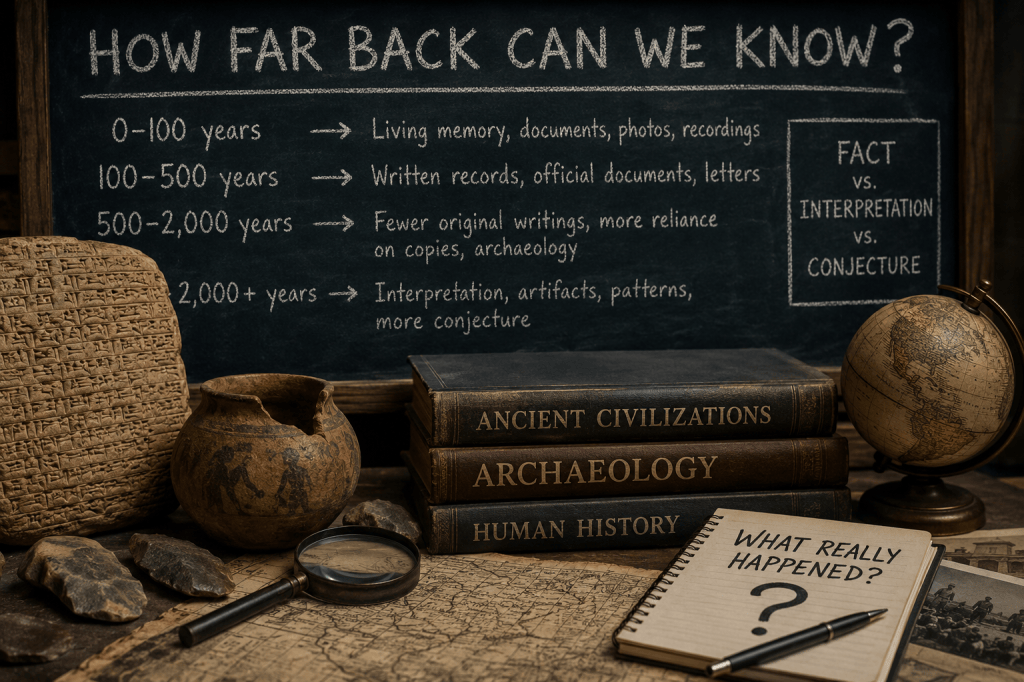
What History Can Know, What It Can’t, and Why It Matters
August 11, 2026
PARANORMAL DESK
There is a strange thing we do in classrooms.
We open a history book and begin speaking in complete sentences.
This king did this.
This army went there.
These people believed that.
This civilization collapsed because of this.
The farther backward we travel, the confidence often sounds exactly the same.
Yesterday. A hundred years ago. A thousand years ago. Five thousand.
But should it?
Ask a teacher what happened in Washington in 1974 and there are mountains of evidence available: newspapers, photographs, recordings, government documents, memoirs, television broadcasts and witnesses who were actually alive.
Ask what happened in Rome two thousand years ago and the evidence changes considerably.
Go back five thousand years and it changes again.
Ten thousand?
Twenty thousand?
Now we’re assembling human history from bones, pollen, charcoal, stone tools, pottery fragments, genetic evidence and settlements buried beneath dirt.
That doesn’t make ancient history fiction.
Far from it.
But perhaps schools—and skeptics, historians, journalists and paranormal investigators alike—should become considerably more comfortable with three words:
We don’t know.
Because there’s an important difference between history, reconstruction and conjecture.
And somewhere along the road into the ancient past, we routinely forget to put up the road signs.
IS THERE A 100-YEAR WALL?
No.
There is no historical rule saying anything older than a century becomes unreliable.
In fact, some events thousands of years old are supported by extraordinary amounts of archaeological and written evidence.
But a century provides an interesting mental boundary.
Consider August 1926.
People alive then left behind photographs.
Newspapers.
Court records.
Letters.
Diaries.
Government documents.
Buildings.
Film.
Audio recordings.
Financial records.
Gravestones.
And millions upon millions of physical objects.
More importantly, until fairly recently there were people alive who remembered that world.
Cross approximately that hundred-year boundary and something important begins disappearing:
living memory.
The witnesses leave us.
Then we’re dependent entirely upon what they left behind.
That’s when history becomes detective work.
HOW FAR BACK CAN WE ACTUALLY GO?
As far as the evidence allows.
That’s the answer.
Not 100 years.
Not 1,000.
Not 10,000.
As far as the evidence allows.
The pyramids at Giza aren’t conjecture because they’re ancient. They’re standing there.
Pompeii isn’t mythology because nobody alive witnessed Mount Vesuvius erupt in A.D. 79.
Ancient coins exist.
Roman roads exist.
Egyptian inscriptions exist.
Human remains exist.
Entire cities exist beneath our feet.
And modern archaeology has tools earlier historians couldn’t have dreamed of: radiocarbon dating, dendrochronology, isotope analysis, ancient DNA, satellite imagery and increasingly sophisticated methods of examining landscapes and artifacts.
Sometimes physical evidence can tell us things more reliably than a witness could.
But here’s where the distinction becomes important.
An artifact can tell us that something existed.
Determining exactly what somebody thought about it can be considerably harder.
THE THREE LEVELS
Maybe history should be taught using three simple categories.
1. WHAT WE KNOW
These are claims supported by strong, converging evidence.
A settlement existed here.
A battle occurred.
A particular ruler existed.
These people traded with those people.
A volcanic eruption happened during this period.
This building was constructed using these materials.
The date may occasionally shift as new evidence appears, but the basic claim is solid.
2. WHAT WE THINK
This is interpretation.
Why was the building constructed?
Why was a particular object buried?
Why did people abandon a settlement?
Why did a civilization collapse?
Here historians and archaeologists combine evidence into the explanation that currently fits best.
That’s legitimate scholarship.
But it should be labeled accordingly.
The evidence suggests.
Researchers believe.
The leading explanation is.
Those aren’t weak phrases.
They’re responsible ones.
3. WHAT WE IMAGINE
Now we’ve entered conjecture.
Maybe this object was ceremonial.
Maybe that chamber belonged to a priest.
Maybe this symbol represented a god.
Maybe those people feared an eclipse.
Maybe a particular legend preserves the memory of an actual catastrophe.
Interesting?
Absolutely.
Worth investigating?
Certainly.
Established fact?
No.
And that’s where things get particularly interesting for those of us who investigate the strange.
THE SKEPTIC HAS THE SAME RESPONSIBILITY
Paranormal believers are frequently accused of filling gaps in evidence with extraordinary explanations.
Sometimes correctly.
Nobody knows why an ancient structure was constructed?
Aliens.
Nobody recognizes an artifact?
Ancient technology.
A civilization disappeared?
Atlantis.
An old text mentions something flying through the heavens?
UFO.
That’s not investigation.
That’s putting a conclusion into an empty space.
But skeptics can make exactly the same mistake from the opposite direction.
“It was obviously ceremonial.”
Was it?
“That’s just mythology.”
How do we know?
“Ancient people invented the story.”
Maybe.
But where’s the evidence?
Saying something paranormal must have happened without evidence isn’t good history.
Saying something paranormal could not possibly have happened without examining the evidence isn’t particularly scientific either.
“I don’t know” belongs to everybody.
WHEN DOES MYTH BECOME HISTORY?
Here’s where the rabbit hole gets deep.
Human beings told stories long before they wrote them down.
Oral traditions can change across generations. Characters merge. Numbers inflate. Metaphors become literal. Real events become supernatural.
But sometimes stories preserve memories.
Flood traditions are an obvious example.
Cultures around the world possess stories involving catastrophic floods. That does not automatically mean every flood story describes one global event.
Human settlements have also tended to develop around rivers and coastlines.
Rivers flood.
Coastlines change.
Disasters become stories.
Stories become traditions.
Traditions become mythology.
But somewhere inside a myth there can be historical information.
The difficult question is determining which part.
And that is exactly where historians and paranormal researchers should have something in common.
Neither should begin with belief.
They should begin with evidence.
WHAT ABOUT ANCIENT TEXTS?
This becomes especially sensitive when religion enters the classroom.
The Bible is an ancient collection of texts.
So are the Quran, the Vedas, Buddhist texts, Egyptian religious writings, Mesopotamian tablets and countless other surviving traditions.
Schools can study religious texts historically.
They can discuss what people believed, when texts appeared, how traditions influenced societies and where archaeological or documentary evidence intersects with them.
But historical study is different from declaring supernatural claims scientifically established.
A teacher can say:
Ancient people recorded this belief.
That’s history.
A teacher can say:
Archaeological evidence supports this particular location, ruler or event.
That’s evidence.
A teacher saying:
Therefore the supernatural explanation is proven
has crossed into another category.
The same standard should apply whether we’re talking about angels, demons, ghosts, extraterrestrials or gods.
Present the claim.
Present the evidence.
Present competing explanations.
Then clearly identify what remains unknown.
AND THEN THERE’S PREHISTORY
Eventually we reach a much bigger wall.
Writing disappears.
Now there are no newspapers.
No diaries.
No royal decrees.
Nobody wrote:
“Terrible winter. Mammoths scarce. Neighbor stole spear again.”
We have what survived.
Bones.
Tools.
Caves.
Footprints.
Hearths.
Burials.
Art.
DNA.
And landscapes.
From those fragments, scientists have reconstructed an astonishing amount about prehistoric humanity.
But imagine trying to reconstruct the United States in 2026 using nothing except what archaeologists might dig up 20,000 years from now.
A smartphone survives.
A football stadium survives.
A church survives.
A casino survives.
A cemetery survives.
What would they conclude?
Would they understand what those objects actually meant to us?
Or would somebody publish a paper describing MetLife Stadium as a gigantic ceremonial complex where tens of thousands gathered to worship helmeted warrior-priests?
And would they really be entirely wrong?
THE PARANORMAL PROBLEM
This uncertainty becomes especially important when we encounter ancient mysteries.
Megaliths.
Unexplained burials.
Legends of strange beings.
Ancient astronomical knowledge.
Unusual artifacts.
Stories of lights in the sky.
Accounts of giants, spirits, gods and monsters.
The temptation is to choose a team.
Believers say:
Proof.
Skeptics say:
Nonsense.
But sometimes the most accurate answer is neither.
Sometimes it’s:
Interesting. We don’t have enough information.
That answer doesn’t sell many television specials.
It doesn’t make a very exciting YouTube thumbnail.
But it’s probably the most important sentence in historical investigation.
TEACH THE CONFIDENCE LEVEL
Perhaps this is what classrooms should emphasize.
Not merely what happened.
But how we know it happened.
Show students the evidence.
Here’s the document.
Here’s the artifact.
Here’s the excavation.
Here’s the dating method.
Here’s the contemporary account.
Here’s the later account.
Here’s where they agree.
Here’s where they contradict one another.
Here’s what historians conclude.
And here’s what remains disputed.
Suddenly history stops being a collection of answers somebody printed in a textbook.
It becomes an investigation.
Students learn something much more valuable than memorizing dates.
They learn how knowledge is built.
THE FARTHER BACK WE GO
So how far can we go?
A hundred years?
Easily.
A thousand?
Absolutely.
Five thousand?
Certainly, although the evidence becomes different.
Ten thousand?
Yes—but now archaeology carries much more of the load.
Fifty thousand?
We can still know remarkable things.
Hundreds of thousands?
Now we’re reconstructing increasingly broad patterns rather than reporting daily events.
Millions?
We’ve left conventional human history and entered paleoanthropology, geology and evolutionary history.
The line isn’t chronological.
The line is evidentiary.
Some things from 3,000 years ago can be established with remarkable confidence.
Some things supposedly occurring thirty years ago remain completely uncertain.
Age doesn’t determine truth.
Evidence does.
WHAT SHOULD WE TEACH?
Teach the pyramids.
Teach Mesopotamia.
Teach Rome.
Teach ancient China.
Teach Indigenous civilizations.
Teach religious history.
Teach human migration.
Teach prehistoric peoples.
Teach myths.
Teach legends.
Teach disputed archaeology.
Hell, teach Atlantis—provided the teacher explains that Plato’s account is the source of the famous story and that an actual lost Atlantean civilization has not been established by archaeological evidence.
Teach ancient astronaut claims too, if there’s a legitimate educational reason to examine them.
Then examine the evidence.
Students aren’t endangered by strange ideas.
They’re endangered when nobody teaches them how to distinguish an idea from a fact.
That’s the skill that matters.
THE EMPTY SPACE ON THE MAP
A hundred years from now, historians will study us.
They’ll have billions of photographs, videos, emails, websites and records.
And they’ll still get things wrong.
Some context will disappear.
Some files will be lost.
Some witnesses will lie.
Some governments will conceal things.
Some journalists will make mistakes.
Some stories that everybody “knows” today will turn out to have been false.
Now imagine 5,000 years.
That’s ancient history.
Not necessarily inaccurate history.
Not fantasy.
Not mythology by default.
But a landscape where certainty must be earned.
And maybe that’s the lesson schools should teach more often.
History isn’t a sacred collection of finished answers.
It’s a reconstruction of the past from surviving evidence.
The responsible historian says what the evidence supports.
The responsible skeptic admits what the evidence cannot settle.
And the responsible paranormal investigator does exactly the same.
Beyond that boundary lies conjecture.
Conjecture isn’t forbidden.
Sometimes conjecture is where discoveries begin.
Just write one word across it before entering:
UNKNOWN.
Because the most dangerous thing we can teach about history isn’t an old myth, a strange theory or an unanswered mystery.
It’s certainty where certainty doesn’t exist.
 The ChillX Zone
Leave a comment