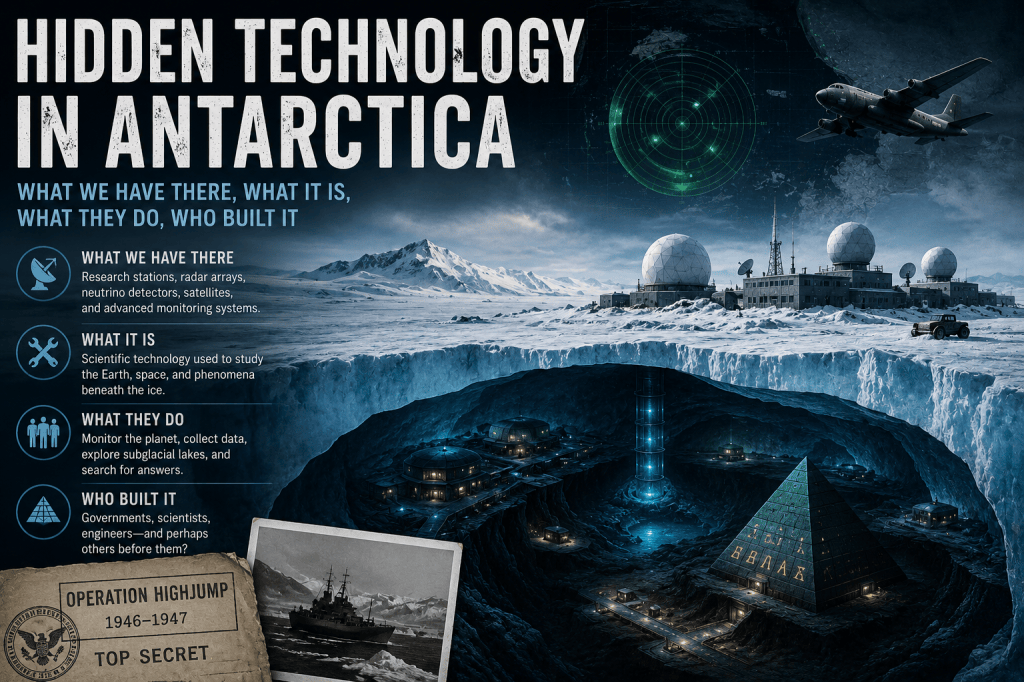
Hidden Technology in Antarctica: What We Actually Built There—and What Might Still Be Waiting Under Two Miles of Ice
August 23, 2026
PARANORMAL DESK
Antarctica looks empty.
That’s the illusion.
From above, it is white almost beyond comprehension: ice, mountains, wind and a horizon capable of making a human being feel very small.
But Antarctica isn’t technologically empty.
There are research stations.
Radar installations.
Satellite communications.
Ice-penetrating instruments.
Neutrino detectors buried deep beneath the surface.
Telescopes staring into space.
Sensors listening to the planet.
And below all of it lies something considerably larger.
An entire continent we can barely see.
Mountains.
Valleys.
Canyons.
Ancient landscapes.
Subglacial lakes.
River systems beneath the ice.
Most of Antarctica’s bedrock is concealed beneath an ice sheet that in places reaches kilometers in thickness.
So here’s the question.
When somebody says there’s hidden technology in Antarctica, what are they actually talking about?
And how much of the mystery is real?
FIRST: THERE REALLY IS TECHNOLOGY UNDER THE ICE
Let’s separate fact from internet mythology.
Humans have deliberately installed scientific equipment beneath Antarctic ice.
One of the most spectacular examples is IceCube.
IceCube isn’t a secret military superweapon.
It’s a neutrino observatory.
Thousands of optical sensors were installed deep within Antarctic ice near the South Pole. Instead of looking upward through a telescope, IceCube uses the ice itself as part of an enormous detector for elusive subatomic particles called neutrinos.
Think about that.
Humans drilled deep into Antarctic ice and lowered thousands of detectors into the darkness to observe particles passing through the Earth.
If you stumbled across the project without knowing what it was, you’d probably assume we’d discovered alien technology.
But we built it.
Scientists and engineers.
And it isn’t the only strange machine down there.
WE USE RADAR TO SEE THROUGH THE CONTINENT
Aircraft fly over Antarctica transmitting radar pulses downward.
Some of that energy penetrates the ice.
The returning signals help scientists determine what’s beneath it.
That’s how we can map landscapes humans have never physically walked across.
Mountain ranges can be completely buried.
Valleys can disappear beneath ice.
Ancient terrain can remain sealed away for extraordinary periods of time.
We’re effectively using technology to X-ray a continent.
And what we’ve discovered is remarkable.
Antarctica beneath the ice isn’t a smooth frozen floor.
It’s a world.
LAKES WHERE THERE SHOULDN’T BE LAKES
Then there are the subglacial lakes.
Hundreds have been identified beneath Antarctica.
The most famous is Lake Vostok, concealed beneath kilometers of ice.
Water.
Under Antarctica.
In darkness.
Cut off from the surface environment for immense stretches of time.
Scientists are fascinated because subglacial environments may help us understand microbial life in extreme conditions—and perhaps provide analogues for environments elsewhere in the solar system.
But paranormal imaginations immediately ask another question.
If a lake can remain hidden beneath kilometers of ice…
what else can?
THE LOST LANDSCAPE
Antarctica wasn’t always the frozen world we recognize today.
Its geological and climatic history stretches through dramatically different environments.
That fact creates one of the most persistent Antarctic fantasies:
What if something from before the ice remains underneath?
Not necessarily aliens.
Not necessarily a civilization.
Just evidence.
Ancient ecosystems.
Sediments.
Fossils.
Plant material.
Geological records from a warmer Earth.
All of that would be extraordinary.
But internet mythology inevitably takes another step.
Ruins.
Structures.
Machines.
Cities.
WHO BUILT THE “STRUCTURES”?
This is where evidence becomes thin very quickly.
Images circulate online showing supposed Antarctic pyramids, entrances, artificial walls and enormous geometric objects.
Many have conventional explanations.
Mountains can look remarkably pyramidal when erosion shapes multiple faces.
Snow and shadows create artificial-looking geometry.
Satellite imagery can produce strange artifacts.
Human beings are also exceptionally good at pareidolia—seeing meaningful structures in ambiguous shapes.
Show us three sides of a mountain and we’ll build Egypt around it.
So far, there is no accepted archaeological evidence establishing that an advanced prehistoric civilization constructed cities beneath Antarctica’s ice.
That distinction matters.
Could something archaeological theoretically be buried beneath ice?
That’s a question.
Have we demonstrated an ancient technological civilization existed there?
No.
THEN WHY IS ANTARCTICA SO RESTRICTED?
This is where conspiracy theories gain oxygen.
You can’t simply buy some equipment, head south and start drilling wherever you want.
Antarctica is governed through an international treaty system and extensive environmental rules.
Activities can require permits.
Protected areas exist.
Scientific work is coordinated.
Environmental impacts matter enormously.
The continent is dangerous enough that uncontrolled tourism and exploration would create problems even without anything secret beneath the ice.
So restrictions aren’t evidence of hidden alien machinery.
But psychologically, they create the perfect conspiracy environment.
A gigantic continent.
Difficult access.
Government facilities.
International agreements.
Military logistical support.
Strange scientific equipment.
Satellite imagery.
And miles of ice covering almost everything.
You couldn’t design a better location for rumors.
THE MILITARY QUESTION
Military aircraft, ships and personnel have historically supported Antarctic logistics for various national programs.
That sounds suspicious until you consider what operating in Antarctica requires.
Moving fuel.
Transporting scientists.
Landing aircraft on ice.
Emergency evacuation.
Delivering enormous quantities of supplies to remote stations.
Few organizations possess better heavy-logistics capability than militaries.
Still, the military association has helped fuel decades of speculation about secret bases and classified operations.
And then there’s the historical event conspiracy researchers never stop talking about.
Operation Highjump.
OPERATION HIGHJUMP
In 1946–47, the United States conducted a massive Antarctic expedition commonly known as Operation Highjump.
Ships.
Aircraft.
Thousands of personnel.
The scale alone has made it irresistible to conspiracy culture.
Over the decades, stories have claimed the expedition encountered hidden Nazi installations, flying saucers, underground civilizations or unknown technology.
Those claims have become woven into Antarctic UFO mythology.
But the historical existence of a large military expedition does not prove the extraordinary stories subsequently attached to it.
Operation Highjump was real.
The secret Nazi-alien war beneath Antarctica?
That’s another matter.
Evidence is the dividing line.
Always.
THE NAZI ANTARCTICA STORY
Nazi Germany did conduct an Antarctic expedition before World War II.
That’s historical fact.
From there, the mythology explodes.
Secret underground bases.
Advanced aircraft.
Escaping Nazi scientists.
Recovered extraterrestrial technology.
Subterranean warm-water caverns.
Flying saucers emerging from beneath the ice.
It’s fantastic material.
It’s also unsupported by credible evidence at the scale usually claimed.
Building a substantial secret base in Antarctica would require an enormous logistical chain.
People need food.
Fuel.
Equipment.
Heat.
Replacement parts.
Transportation.
Construction materials.
Waste disposal.
Hidden civilizations apparently have one advantage over every Antarctic research program ever created:
They never seem to need a supply department.
BUT THERE IS SOMETHING UNDER THERE
This is where Antarctica becomes more interesting than the conspiracy theories.
Because we don’t need imaginary Nazi UFO hangars.
Reality is already strange.
There are buried mountain ranges.
Subglacial lakes.
Ancient sediments.
Hidden valleys.
Water moving beneath ice.
Microbial ecosystems under extreme conditions.
Meteorites preserved on the surface.
Scientific instruments buried thousands of meters deep.
And huge regions where our knowledge comes primarily from remote sensing rather than direct observation.
We genuinely don’t know everything beneath Antarctica.
That’s not conspiracy.
That’s geography.
COULD AN ANCIENT CIVILIZATION HAVE EXISTED THERE?
This requires some discipline.
Antarctica’s transition into its modern glaciated state began tens of millions of years ago.
Modern humans appeared vastly later.
So the popular idea of a technologically advanced human civilization occupying Antarctica immediately before the recent ice age runs into a major geological timeline problem.
For conventional archaeology, there’s currently no evidence supporting it.
To make the theory work, you’d need to propose something considerably more extraordinary:
A civilization far older than known human civilization.
Perhaps nonhuman.
Perhaps unknown entirely.
At that point we’re no longer extending archaeology.
We’re proposing a radical rewrite of Earth’s history.
Possible in the abstract?
Almost anything is.
Supported by current evidence?
No.
WHAT WOULD CHANGE EVERYTHING?
A wall.
Not something that looks like a wall in a blurry satellite photograph.
A wall.
Artificially cut stone.
Regular construction.
Tools.
Manufactured alloys.
Writing.
Machinery.
A chamber.
Something retrieved from beneath ancient Antarctic ice that could be dated and independently examined.
One unmistakably artificial object in the wrong geological layer would create an enormous scientific problem.
And scientists love enormous scientific problems.
Because that’s where discoveries live.
The conspiracy assumption is that scientists would hide such an object.
History suggests another possibility.
They’d fight over who gets to publish it first.
THE TECHNOLOGY WE HAVEN’T BUILT
Here’s the version of the mystery worth keeping alive.
Suppose radar someday detects something beneath the ice.
Straight lines.
Repeated geometry.
A cavity.
Investigators assume geology.
More scans.
Same result.
Eventually somebody drills.
The borehole descends.
One kilometer.
Two.
Three.
Then the instrument reaches something unexpected.
Not rock.
Not sediment.
Not water.
Material.
Manufactured material.
That’s the moment everything changes.
Because the question would no longer be:
Is there hidden technology in Antarctica?
It would become:
Who put it there?
And more importantly:
When?
MAYBE WE’RE THE ANCIENTS
There’s another way to think about this.
Right now we’re installing technology in Antarctica.
Sensors.
Cables.
Stations.
Detectors.
Drilling equipment.
Scientific infrastructure.
Some of it will eventually be abandoned.
Some will become buried.
Ice moves.
Snow accumulates.
Centuries pass.
Thousands of years.
Imagine archaeologists 10,000 years from now discovering the remains of IceCube.
Thousands of optical modules buried deep beneath ancient ice.
Cables.
Electronics.
Geometry.
They might ask exactly the question we’re asking now.
Who built this?
The answer would be us.
The strange civilization that once pointed detectors through an entire planet to catch invisible particles from the universe.
Put that way, we sound suspiciously like the aliens.
THE REAL SECRET OF ANTARCTICA
Maybe there isn’t an alien machine beneath the ice.
Maybe there isn’t a lost city.
Maybe there aren’t doors leading into warm underground caverns where something has been waiting for 50,000 years.
There’s currently no credible evidence establishing any of that.
But don’t make the opposite mistake.
Don’t confuse no evidence of an ancient technological civilization with nothing left to discover.
Antarctica remains one of Earth’s greatest concealed landscapes.
We have mapped it.
Measured it.
Scanned it.
Drilled it.
Flown over it.
But enormous portions remain physically inaccessible beneath immense quantities of ice.
And every improvement in radar, drilling, satellite imaging and remote sensing gives us another look.
That’s the irony.
The supposed secret technology of Antarctica probably isn’t what somebody else left behind.
It’s what we’re using to uncover the continent.
But if one of those machines ever sends back an image showing something beneath the ice with corners a little too perfect…
Save the data.
Run the scan again.
Bring another instrument.
And whatever you do—
don’t call it a pyramid until somebody drills through the roof.
 The ChillX Zone
Leave a comment