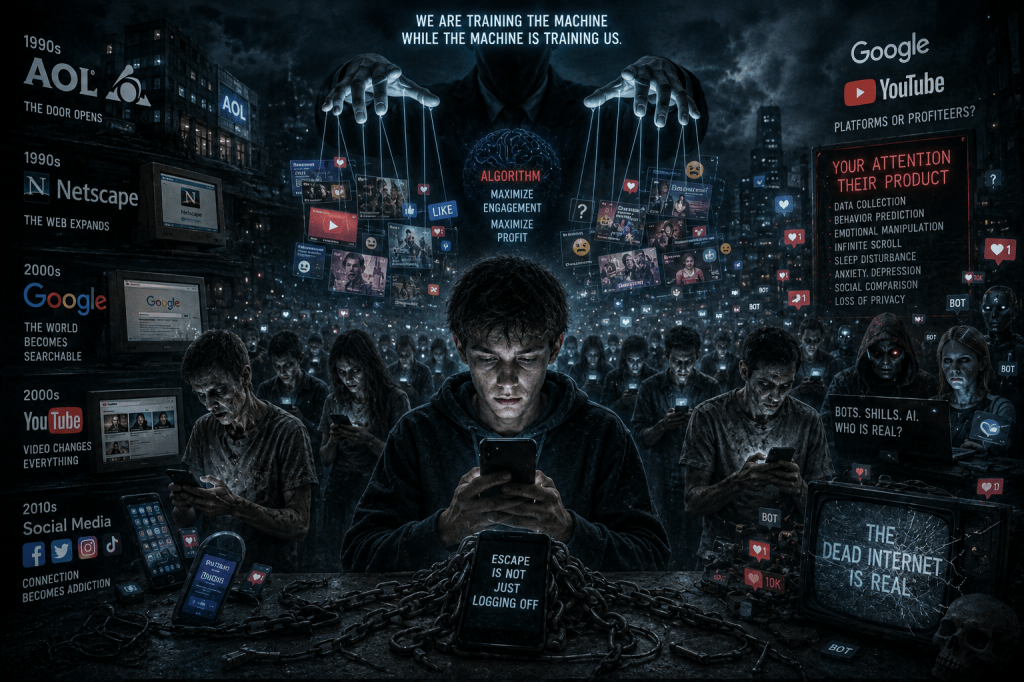
August 7
There was a time when going online was something you did.
You sat at a computer. You connected to the Internet. You heard a modem negotiate with another machine somewhere in the darkness.
Then you entered.
And eventually, you left.
Today, leaving is much harder.
The Internet is in our pockets, bedrooms, cars, televisions, watches and workplaces. Notifications follow us. Recommendations anticipate us. Videos automatically continue. Search engines remember what interests us. Social platforms learn which images make us stop scrolling.
The Internet was once somewhere we visited.
Now many of us live there.
So who is responsible for what it became?
Is it social-media companies?
Advertisers?
Smartphone manufacturers?
Artificial intelligence?
Bots?
Or should we travel farther backward and ask whether predecessors such as AOL and Netscape helped build the road that eventually led here?
Perhaps the answer is more disturbing than identifying one villain.
Maybe nobody built the digital haunted house intentionally.
Maybe each generation simply added another room.
AOL Opened the Door
For millions of people, AOL was not merely a website.
It was the Internet.
Its famous discs arrived in mailboxes. Its software offered email, chat rooms, news, entertainment and communities within an accessible environment.
AOL helped ordinary households understand something revolutionary:
A computer could be a social place.
That was an extraordinary achievement.
It connected families, strangers, hobbyists and communities across distances that previously separated them.
Should AOL therefore be blamed for social media?
Not really.
That would be like blaming the inventor of the road for every traffic accident that occurred after automobiles were invented.
But AOL helped normalize something enormously consequential.
The computer was no longer simply a machine for performing tasks.
It became somewhere people went to meet other people.
The first room of the digital house had been built.
Netscape Gave Us the Hallway
Then came the browser revolution.
Netscape Navigator helped transform the World Wide Web into something ordinary people could explore.
The importance of that change is difficult to exaggerate.
Instead of remaining inside one controlled online service, users could move from website to website.
The Internet became a landscape.
Businesses arrived.
Publishers arrived.
Advertisers arrived.
Communities arrived.
Eventually almost everyone arrived.
Again, blaming Netscape for today’s Internet would make little historical sense.
A browser is fundamentally a tool for accessing information.
But every technological breakthrough changes what becomes possible next.
AOL demonstrated that people wanted to socialize online.
Browsers demonstrated that people would explore an enormous network of information.
Search engines would soon confront the next problem:
How do we decide what people see?
That question changed everything.
Search Organized the Chaos
As the Web exploded in size, finding information became increasingly difficult.
Search engines became our guides.
Google became extraordinarily successful by making the chaotic Web searchable and useful.
That was another remarkable human achievement.
But something important happened along the way.
The Internet learned that attention had economic value.
If millions of people were searching, reading and clicking, businesses wanted to reach them.
Advertising could finance services that users did not directly pay to access.
The bargain seemed wonderful.
Search for free.
Watch for free.
Communicate for free.
Upload for free.
But “free” services still required revenue.
And increasingly, revenue depended upon attention.
That created a powerful incentive:
Keep the person looking.
YouTube Gave the Machine a Remote Control
YouTube changed television.
Anyone could become a broadcaster.
A teenager in a bedroom could potentially reach more viewers than a traditional television station.
Teachers could teach millions.
Musicians could find audiences without record labels.
People could document history as it happened.
It was one of the most democratizing media technologies ever created.
But an impossible problem appeared.
With an ocean of videos available, what should each person watch next?
The answer was recommendation technology.
Today, YouTube says its recommendation system considers enormous numbers of signals, including watch and search histories, subscriptions, likes, dislikes, feedback and satisfaction surveys. Its stated aim is to help viewers find material they want and maximize long-term viewer satisfaction.
That sounds reasonable.
But philosophically, something enormous has happened.
The machine is choosing what comes next.
Not absolutely. Users retain agency.
But the menu is no longer neutral.
The platform can learn what holds our attention and construct an increasingly personalized stream around us.
We stopped merely searching the Internet.
The Internet began searching us.
Then Social Media Learned the Human Nervous System
Social media added another ingredient.
Human beings do not merely want information.
We want recognition.
Approval.
Belonging.
Status.
Novelty.
Outrage.
Curiosity.
We want to know whether someone responded to us.
Whether someone liked us.
Whether somebody disagreed with us.
Whether something happened while we were gone.
These are ancient psychological impulses.
Technology did not invent them.
But technology discovered that they could be measured.
A click can be measured.
A pause can be measured.
A like can be measured.
Viewing time can be measured.
A share can be measured.
The human nervous system began producing data.
And data could improve the machine that decided what the nervous system saw next.
That creates an extraordinary feedback loop:
The platform observes the person.
The platform changes what the person sees.
The person reacts.
The platform observes the reaction.
Repeat billions of times.
Are Algorithms Making People Sick?
We need to be precise here.
It would be too simplistic to say an algorithm directly causes depression, anxiety or other illnesses in every user.
Human mental health is vastly more complicated.
Social media can also provide friendship, education, creativity, entertainment and support.
But serious health concerns exist.
The U.S. Surgeon General’s advisory concluded that social media presents meaningful risks of harm to young people while also recognizing potential benefits. It reported that adolescents spending more than three hours per day on social media faced twice the risk of certain poor mental-health outcomes, while emphasizing that important scientific questions remain unresolved.
That distinction matters.
Correlation is not the same thing as proving that an algorithm caused an individual’s illness.
But uncertainty is not evidence of safety either.
When billions of people interact with systems designed to learn from their behavior, society has every reason to investigate what those systems are doing to human attention, sleep, relationships and psychological well-being.
Welcome to the Zombie Internet
Then something stranger happened.
We began sharing the Internet with entities that were not people.
Bots.
Automated accounts.
Spam networks.
Recommendation systems.
Content generators.
Scrapers.
AI assistants.
Automated advertising systems.
Ranking systems.
Moderation systems.
Increasingly, machines communicate with machines while humans watch the results.
This produces something almost paranormal.
You can encounter an account online without immediately knowing whether there is a human being behind it.
You can read a comment without knowing whether a person wrote it.
You can watch content selected by software according to signals you cannot see.
You can argue with an account that may exist primarily to provoke engagement.
The Internet begins to resemble a haunted city.
There are voices everywhere.
But sometimes we do not know who—or what—is speaking.
The Zombies Are Human Too
There is another kind of zombie.
Us.
Not literally, of course.
But observe a crowded train.
People stare downward.
Walk through an airport.
People stare downward.
Sit in a restaurant.
Phones rest beside plates.
Wake up in the morning.
Check the phone.
Stand in an elevator.
Check the phone.
Wait thirty seconds.
Check the phone.
We have created machines capable of accessing much of humanity’s accumulated knowledge.
And frequently we use them to scroll without remembering what we saw five minutes later.
That may be one of technology’s strangest achievements.
The greatest information system in human history can also become a machine for avoiding thought.
So Who Is at Fault?
AOL?
No.
Netscape?
No.
Google?
Partly.
YouTube?
Partly.
Social-media companies?
Certainly they carry responsibility for the systems they design and operate.
Advertisers?
They participate in the attention economy.
Smartphone manufacturers?
They made permanent connectivity physically possible.
Governments?
They allowed technology to develop much faster than many regulatory systems adapted.
Parents?
Schools?
Users?
We participate too.
Perhaps the search for one guilty party is the wrong question.
This is a chain of responsibility.
AOL helped make cyberspace social.
Browsers opened the Web.
Search engines organized it.
Advertising monetized attention.
Social networks monetized relationships.
Smartphones removed the boundary between online and offline.
Recommendation algorithms personalized reality.
Bots automated participation.
Generative AI is beginning to automate the production of the reality being recommended.
Nobody needed to plan the final destination.
Each step made the next step possible.
The Paranormal Machine
This is where technology begins to resemble the paranormal.
Not because there is necessarily anything supernatural inside our phones.
But because we have created invisible forces that influence our behavior while remaining largely unseen.
You cannot see an algorithm walking down the street.
It has no face.
No body.
No voice of its own.
Yet it can influence what millions of people watch tonight.
It can influence which political argument appears on a screen.
Which beauty standard a teenager encounters.
Which conspiracy theory someone discovers.
Which product somebody desires.
Which song becomes famous.
Which stranger becomes influential.
Which subject disappears from attention.
An invisible intelligence selecting information according to rules most people cannot inspect would have sounded almost supernatural to previous generations.
Today we call it a recommendation system.
But the Algorithm Is Not a Demon
There is danger in making technology too supernatural.
Algorithms are not demons.
They are designed systems.
And research does not support the simple claim that recommendation engines alone explain everything troubling people encounter online. One study using counterfactual bots, for example, found that YouTube’s recommender did not simply push users toward more partisan material and could have a moderating effect under the conditions examined.
That complicates the story.
And it should.
Because if we blame an imaginary all-powerful algorithm for everything, we avoid confronting the human half of the equation.
Algorithms learn partly from what people choose.
People choose partly from what algorithms present.
We are training the machine while the machine is training us.
That is the loop we should fear—not a robot secretly controlling humanity, but humans and machines continuously reshaping one another.
The Greatest Mistake Was Removing the Exit
Perhaps early Internet pioneers actually got something right that we later lost.
The old Internet had an exit.
The computer sat on a desk.
You entered cyberspace.
Then you disconnected.
The modern Internet follows us.
There is no modem to turn off.
No busy signal.
No obvious moment when cyberspace ends and physical life begins.
Maybe the greatest technological mistake was not inventing social media.
It was allowing digital life to consume the boundaries around ordinary life.
Boredom disappeared.
Silence became uncomfortable.
Waiting became scrolling.
Loneliness became scrolling.
Anger became posting.
Curiosity became recommendations.
Every empty moment became commercially valuable territory.
August 7: Who Owns Your Attention?
The Internet is not evil.
Neither were AOL, Netscape, search engines, smartphones, YouTube or social media inevitable steps toward disaster.
Each solved real problems.
Each expanded human possibility.
But inventions accumulate.
And eventually society must evaluate not simply what each technology does individually, but what all of them do together.
Perhaps that is where we are now.
The question is no longer whether technology connects us.
Obviously it does.
The question is whether connection without boundaries has begun disconnecting us from something else:
Our attention.
Our privacy.
Our physical communities.
Our ability to tolerate silence.
Our ability to distinguish people from machines.
Perhaps even our ability to decide what deserves our attention without an algorithm deciding first.
So who built the digital haunted house?
We all did.
Engineers built rooms.
Companies installed doors.
Advertisers paid the electricity bill.
Algorithms rearranged the furniture.
Bots began wandering the hallways.
And billions of us moved inside.
The important question now is not who first opened the door.
It is whether humanity still remembers how to walk outside.
 The ChillX Zone
Leave a comment