August 5
There is something almost paranormal about modern life.
Pick up a shirt.
Open a package of food.
Take a pill from a blister pack.
Turn on a phone.
Look at the object in your hand and it appears complete. Clean. Ordinary. Harmless.
But you are not really looking at the whole object.
You cannot see the mine that produced its metals. You cannot see the oil extracted to make its plastic. You cannot see the water consumed during manufacturing, the chemicals used in processing, the ships and trucks that moved its components, the electricity that powered the factories, or the discarded packaging left behind after it reached you.
Those things have disappeared.
And yet their environmental consequences have not.
Perhaps this is one of the strangest characteristics of industrial civilization:
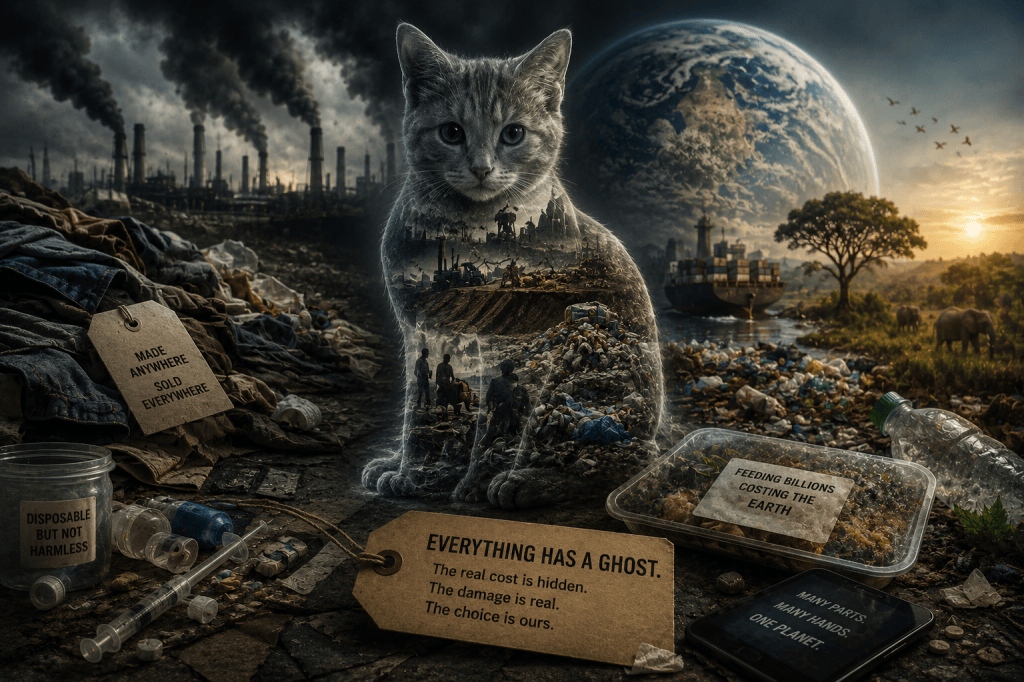
Everything we own has a ghost.
Not necessarily a supernatural ghost, but an invisible history—a trail of extraction, energy, chemicals, transportation and waste that follows an object even when we cannot see it.
And the more complicated the object becomes, the longer that invisible trail can become.
The Paranormal Object
Imagine putting a new smartphone on a table.
We see one object.
But is it really one object?
Inside are metals, glass, plastics, electronic components, adhesives, coatings and a battery. Those materials may originate in different parts of the world before being processed, manufactured, assembled, packaged and transported.
The finished device hides that complexity beautifully.
That is what modern industry does extraordinarily well.
It makes complexity disappear.
A hospital syringe appears to be a syringe.
A sneaker appears to be a sneaker.
A packaged meal appears to be dinner.
A laptop appears to be a laptop.
But environmentally, each is better understood as the final visible point of an enormous invisible network.
The paranormal has traditionally concerned things we believe might exist even though we cannot easily see them.
Perhaps industrial civilization has created its own version of the invisible world.
We are surrounded by objects whose true environmental existence extends far beyond what our eyes can perceive.
When One Product Requires a World of Parts
There is an important principle hiding here:
Complexity can multiply environmental consequences.
This does not mean that every complicated product is environmentally worse than every simple one. A sophisticated medical device, for example, may save thousands of lives and justify environmental costs that society reasonably accepts.
But every additional component potentially introduces another material, supplier, manufacturing process, transportation step, package and waste stream.
One product may depend upon another industry, which depends upon another industry, which depends upon another.
A factory needs machines.
The machines require metals.
The metals require mining.
Mining requires heavy equipment.
The equipment requires fuel.
The fuel requires extraction and refining.
The finished component requires transportation.
Transportation requires roads, ships, trucks or aircraft.
The product requires packaging.
Eventually, much of it becomes waste.
So where does the environmental footprint of the original product actually begin?
That is surprisingly difficult to answer.
Medicine: The Industry That Saves Us and Leaves Waste Behind
Medicine presents perhaps the most uncomfortable example because its purpose is overwhelmingly beneficial: to preserve human life.
Yet saving human beings also requires enormous physical infrastructure.
Hospitals use pharmaceuticals, plastics, syringes, gloves, masks, electronics, chemicals, diagnostic equipment, sterilization systems and disposable materials.
The World Health Organization estimates that approximately 85% of health-care waste is ordinary non-hazardous waste, while about 15% is hazardous, potentially including infectious, toxic, chemical or radioactive material. Improper treatment can contaminate water or release pollutants, while inappropriate incineration can produce substances including dioxins, furans and particulate matter.
This produces a strange contradiction.
An institution devoted to preventing illness can itself generate substances capable of damaging human and environmental health when waste is poorly managed.
That does not make medicine an enemy.
It reveals something more important:
Good intentions do not erase physical consequences.
Clothing: The Beautiful Object With an Invisible Past
Now look inside a closet.
Cotton shirts. Polyester jackets. Shoes. Jeans. Dresses.
Again, we see finished objects.
We don’t normally see agricultural land, petroleum feedstocks, dyes, factories, wastewater, packaging, shipping or discarded clothing.
The United Nations Environment Programme describes fashion as highly resource-intensive, reliant on fossil fuels and polluting throughout its value chain. UNEP has cited estimates placing fashion’s contribution at roughly 2–8% of global carbon emissions, while emphasizing the industry’s problems of overproduction and consumption.
A cheap shirt can therefore perform an extraordinary illusion.
Its price tag tells us its monetary cost.
It does not necessarily tell us its ecological cost.
The missing information is the ghost.
Food: The Industry We Cannot Live Without
Food presents an even greater paradox.
Nothing is more natural than eating.
Yet feeding billions of people has become an enormous industrial system involving agriculture, fertilizers, pesticides, livestock, refrigeration, processing, plastics, transportation, supermarkets and waste.
UNEP identifies today’s global food system as a major driver of climate change, biodiversity loss, pollution and waste.
Agriculture also places immense pressure on land, water and ecosystems. UNEP describes the global food system as a leading driver of biodiversity loss and deforestation and the world’s largest land user.
Again we encounter the same contradiction.
The thing required to keep us alive can damage the biological systems required to keep us alive.
Food itself is not the enemy.
The question is whether the enormous industrial architecture surrounding food has become unnecessarily destructive.
Then There Is Everything We Throw Away
Perhaps the true monument to industrial civilization is not the skyscraper.
Perhaps it is the landfill.
More than 2 billion tonnes of municipal solid waste are generated globally each year, according to WHO guidance. Poor disposal can contaminate water, soil and air.
Consider what waste actually represents.
A discarded object is not merely garbage.
It is extracted material.
Energy.
Water.
Labor.
Transportation.
Manufacturing.
Packaging.
And land.
All of those resources were assembled temporarily into something we wanted.
Then the object became something we wanted to disappear.
But there is no true “away.”
The garbage truck creates the illusion of disappearance.
The material continues existing somewhere else.
The Ghost Does Not Leave When the Product Does
This may be the paranormal dimension of industrial civilization.
Our consequences outlive our attention.
We stop thinking about the plastic bottle after throwing it away.
We stop thinking about the phone after replacing it.
We stop thinking about clothing after donating or discarding it.
We stop thinking about packaging seconds after opening it.
The object disappears from our personal world.
But it does not disappear from the physical world.
Human civilization has therefore created billions of environmental ghosts—consequences detached from the people and decisions that produced them.
Nobody individually intended to poison an ocean.
Nobody woke up intending to fill the planet with discarded plastic.
Nobody designed modern civilization with the explicit objective of destabilizing ecosystems.
Yet billions of individually ordinary actions can combine into something extraordinary.
That may be more frightening than a monster.
A monster has an intention. A system does not need one.
What Is the Worst Industry?
It is tempting to ask which industry is the worst.
Oil?
Fashion?
Food?
Mining?
Transportation?
Medicine?
Electronics?
Perhaps that question is too simple.
Industries are interconnected.
Fashion needs agriculture, petrochemicals, manufacturing and transportation.
Medicine needs chemicals, plastics, metals, electronics and transportation.
Food needs agriculture, machinery, refrigeration, packaging and transportation.
Electronics need mining, chemicals, energy, manufacturing and global logistics.
The environmental problem may therefore not belong to one villainous industry.
It may belong to a design philosophy shared across industrial civilization:
Extract.
Manufacture.
Transport.
Consume.
Discard.
Repeat.
The haunting is not located inside one factory.
It exists in the connections between them.
Complexity Without Responsibility
Human civilization has become exceptionally good at dividing production into pieces.
One company extracts.
Another refines.
Another manufactures.
Another assembles.
Another packages.
Another transports.
Another sells.
Another disposes.
Every participant sees one fragment.
But who sees the entire environmental life of the object?
Perhaps this is where responsibility becomes almost paranormal itself.
It disappears between the parts.
The consumer says the manufacturer made it.
The manufacturer says consumers demanded it.
The retailer says it merely sold it.
The waste company says it merely collected it.
Governments point toward industry.
Industries point toward markets.
Markets point toward consumers.
And somewhere between all of them, forests disappear, rivers accumulate pollutants, carbon enters the atmosphere and mountains of waste grow.
Everyone touched the system.
Yet somehow nobody seems to own the whole consequence.
Maybe the Haunting Is Us
For centuries, humans imagined haunted places as locations where something from the past refused to disappear.
Perhaps we should reconsider that metaphor.
A polluted river is haunted by decisions made upstream.
A landfill is haunted by yesterday’s purchases.
The atmosphere is haunted by fuel already burned.
An abandoned mine is haunted by materials now sitting inside products thousands of miles away.
The ocean is haunted by objects people threw “away.”
These are not supernatural hauntings.
They may be more disturbing because they are real.
We have constructed a civilization in which consequences can become invisible to the people creating them.
And perhaps that is why environmental destruction is so difficult to stop.
We experience the product immediately. We experience its consequences somewhere else, sometime later, or through somebody else’s life.
August 5: Look Behind the Object
Perhaps environmental responsibility begins with learning to see differently.
When we see a shirt, see its materials.
When we see medicine, see both the life it saves and the waste its delivery may create.
When we see food, see the land and water behind it.
When we see electronics, see the mines, factories and discarded devices.
When we see garbage, understand that we are looking at the final chapter of a much longer industrial story.
The goal cannot simply be to stop manufacturing everything complicated.
Human civilization depends upon complex technologies. Medicine saves lives. Electronics connect societies. Food systems feed billions. Clothing is a necessity.
The challenge is more ambitious:
Can complexity become circular rather than destructive?
Can products use fewer unnecessary components?
Can they last longer?
Can they be repaired?
Can materials be recovered?
Can packaging disappear without becoming pollution?
Can factories operate with cleaner energy?
Can supply chains become shorter and more transparent?
Can companies remain responsible for what happens after their products are sold?
Those questions may define the next stage of industrial civilization.
Because the greatest environmental danger may not be one evil industry poisoning Earth.
It may be something much stranger.
It may be a civilization containing so many interconnected parts that no individual can see the whole machine anymore.
And when nobody can see the whole machine, nobody feels completely responsible for what the machine leaves behind.
Perhaps the planet is not haunted by something paranormal.
Perhaps it is haunted by everything humanity has made—and then chosen not to see.
 The ChillX Zone
Leave a comment