August 10
There is a question humanity rarely stops long enough to ask:
What if we have fundamentally misunderstood what threatens us?
We spend extraordinary amounts of money preparing to destroy one another. We build weapons capable of ending millions of lives. We maintain nuclear arsenals because we fear what another nation might do with its nuclear arsenal. We study enemies, missiles, aircraft, submarines and satellites.
Yet there is another mystery that has repeatedly appeared at the edges of the nuclear age: reports of unidentified anomalous phenomena—UAPs—around military and nuclear facilities.
That does not prove extraterrestrials exist. It does not prove paranormal forces control nuclear weapons, cause wars or stand behind human deaths. Those conclusions would go far beyond the evidence presently available.
But the reports raise a fascinating question:
What if humanity is spending trillions fighting the wrong battle?
War May Be Humanity’s Greatest Misallocation
A word that may describe the problem is misallocation—a catastrophic misallocation of human attention, intelligence and resources.
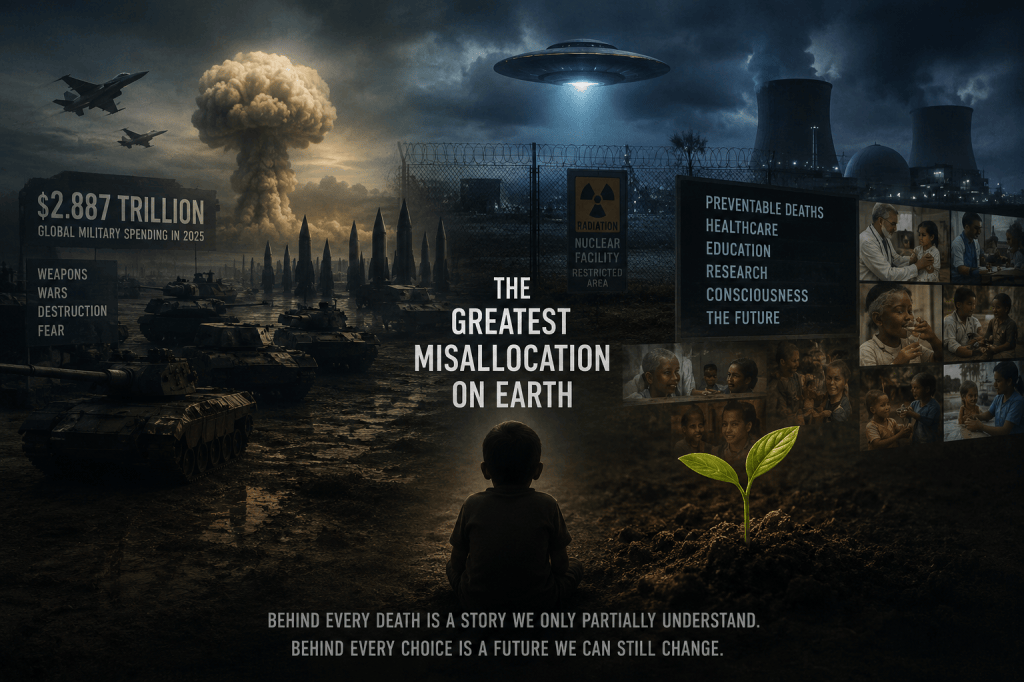
Worldwide military expenditure reached approximately $2.887 trillion in 2025, according to the Stockholm International Peace Research Institute.
Think about what nearly $3 trillion represents.
It represents scientists, engineers, factories, satellites, computers, aircraft, ships, weapons, intelligence systems and millions of working lives devoted in some fashion to preparing for conflict.
Some military spending is intended to deter aggression and protect populations. Nations face genuine security threats, and simply eliminating defense budgets would not eliminate those threats.
But there is still a profound question of proportion.
How did humanity reach a point where trillions can be directed toward military power while millions of people continue dying from causes we already know how to prevent or reduce?
Look at What Actually Kills Us
War is horrifying precisely because human beings intentionally inflict death upon other human beings. But when we widen the lens, another uncomfortable picture appears.
Cardiovascular disease kills millions each year. Cancer, respiratory disease, infections, dementia, diabetes and kidney disease remain major causes of death.
Road crashes kill more than a million people globally each year.
Millions of children still die before reaching their fifth birthday, many from preventable or treatable causes.
These enemies do not arrive in fighter jets.
They are already among us.
Yet civilization has demonstrated an extraordinary ability to mobilize money, technology and political will when the perceived enemy is another nation.
Why?
Then There Is the UAP Question
Here is where the subject becomes stranger.
For decades, military personnel and others have reported unidentified objects or phenomena in sensitive airspace, including accounts associated with nuclear installations and weapons.
We should be careful with this subject.
A UAP is, by definition, unidentified. Unidentified does not automatically mean extraterrestrial. It does not automatically mean paranormal. Some cases receive conventional explanations; others remain unresolved because the available evidence is insufficient.
But unresolved phenomena should produce investigation rather than ridicule.
The nuclear connection is particularly provocative because nuclear weapons represent something unique in human history: our species acquired the ability to destroy cities almost instantaneously and potentially devastate civilization through large-scale nuclear war.
If genuinely unexplained phenomena have repeatedly appeared around nuclear infrastructure, there is a scientific question worth asking:
Why?
Perhaps every case ultimately has a conventional explanation.
Perhaps some do not.
Either result would matter.
What If the Paranormal Question Is Bigger Than UAPs?
This leads to an even deeper possibility.
When we speak about a paranormal fault behind death, this should not mean declaring that a ghost, extraterrestrial intelligence or invisible entity causes every human death. There is no scientific evidence establishing such a claim.
The idea is larger than that.
Human beings understand death remarkably well mechanically, but perhaps not ultimately.
We can describe what happened to a body. The heart stopped. Cancer spread. A bullet entered an organ. A vehicle collided with another vehicle. A bomb exploded.
Those explanations tell us how someone died.
They do not necessarily answer humanity’s oldest questions.
What exactly is consciousness?
Why is conscious life temporary?
Does consciousness completely cease at death?
Why have people across cultures reported extraordinary experiences surrounding death?
Are all apparently paranormal experiences products of the brain, or could some currently unexplained phenomena point toward something science has yet to understand?
If even a fraction of what humanity calls paranormal represents a genuine but undiscovered aspect of nature, the implications would be enormous.
We Investigate the Weapon but Not the Mystery
Imagine a person dies in war.
Governments may be able to determine the weapon used, its manufacturer, trajectory, explosive yield and perhaps even who fired it.
Yet the deepest event—the transition of a conscious human being into death—remains unresolved at a fundamental level.
That may someday look extraordinarily strange.
Humanity has spent staggering resources learning how to cause death while comparatively little attention has been directed toward determining whether consciousness contains properties our present scientific models do not fully explain.
That is the paradox:
We have industrialized death without solving the mystery of life.
The Real Fault May Be Our Priorities
The argument is not that paranormal forces have been proven responsible for war, disease or accidental deaths.
They have not.
The argument is that humanity repeatedly behaves as though the boundaries of reality have already been settled.
We know enough to build nuclear weapons.
We know enough to build increasingly autonomous machines.
We know enough to spend nearly $3 trillion a year on military power.
Yet we still cannot provide a complete explanation of consciousness.
We continue debating extraordinary experiences associated with death.
And governments continue recording observations in our skies that, in some cases, remain unidentified.
Perhaps UAPs will ultimately prove mundane.
Perhaps consciousness will eventually be explained entirely through biology.
Perhaps every supposedly paranormal phenomenon will receive a conventional explanation.
But those are conclusions to be discovered, not assumptions to be made.
A civilization confident enough to construct weapons capable of destroying itself should be courageous enough to investigate questions that challenge its assumptions about reality.
August 10: Questioning Humanity’s Priorities
Imagine redirecting even a fraction of the world’s military expenditure toward preventing childhood deaths, cardiovascular disease, cancer, road fatalities, hunger and other preventable causes of death—while also funding rigorous scientific investigation into consciousness and genuinely unexplained phenomena.
We might discover nothing paranormal.
That itself would be knowledge.
Or we might discover that consciousness, UAPs or some other phenomenon contains something our current understanding of nature has missed.
That discovery could change civilization.
The greatest mistake may therefore not be war alone.
It may be misallocation: pouring extraordinary human intelligence and resources into learning how to defeat one another while leaving some of the largest questions concerning life, consciousness and death at the margins.
Behind every death is a physical story.
But behind that physical story remains perhaps the greatest unanswered question human beings have ever confronted:
What actually happened to the person who was there?
Until humanity is willing to investigate that question with something approaching the seriousness, funding and determination with which it investigates its enemies, perhaps we should hesitate before declaring that we understand what the greatest threats to human existence really are.
 The ChillX Zone
Leave a comment