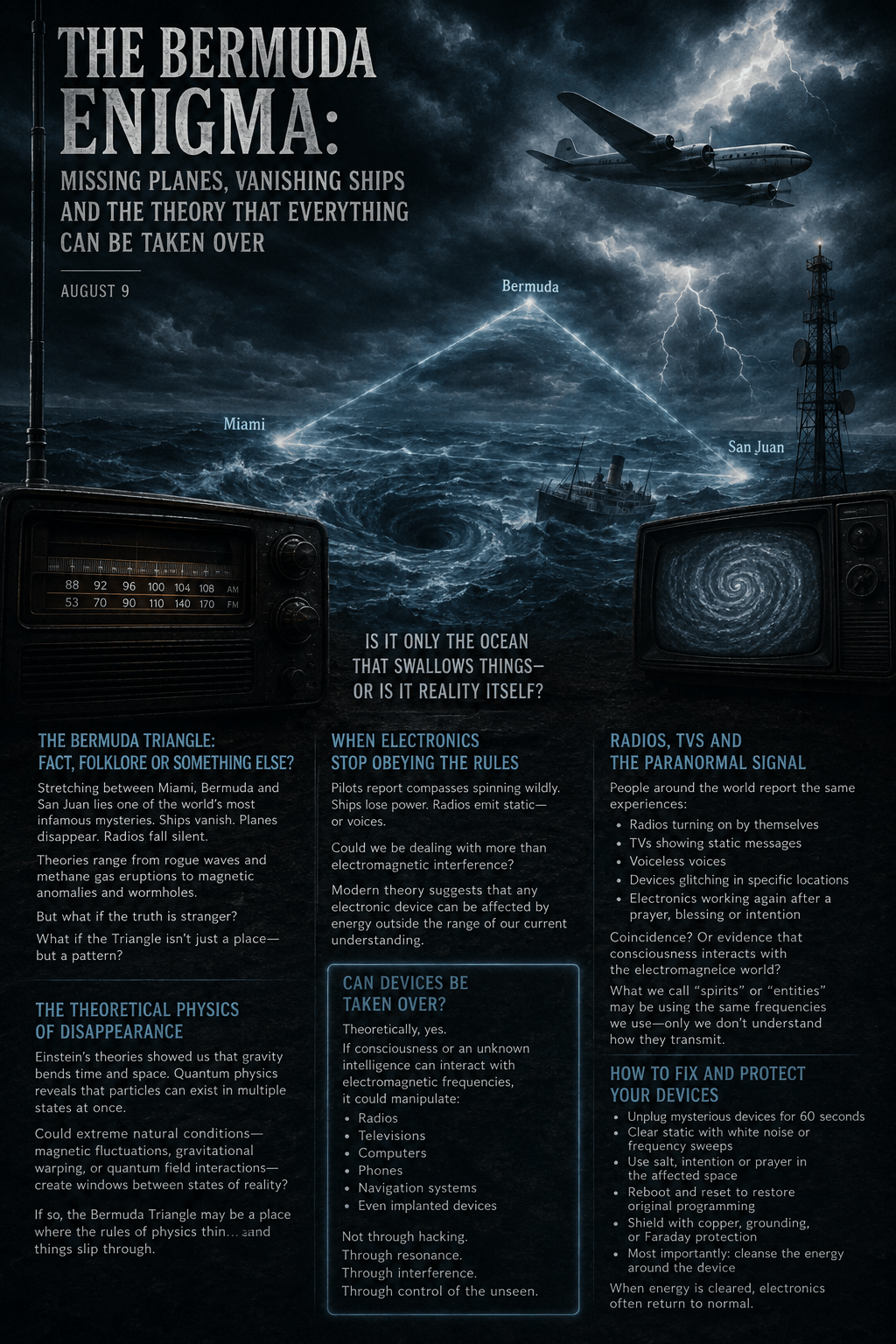
August 9
A ship enters the ocean and never returns.
A plane disappears.
A compass behaves strangely.
A radio transmission ends.
Then there is silence.
Few places have accumulated stories like the Bermuda Triangle—the loosely defined region of the Atlantic commonly associated with Miami, Bermuda and Puerto Rico.
For decades, missing ships and aircraft have transformed those waters into one of the world’s most recognizable paranormal legends.
Many incidents attributed to the Triangle have conventional explanations, disputed details or no compelling evidence of anything supernatural. The U.S. National Oceanic and Atmospheric Administration says there is no evidence that mysterious disappearances occur there more frequently than in other large, heavily traveled areas of ocean.
But perhaps the Bermuda Triangle remains fascinating because it represents a larger mystery.
What happens when the machines we trust to tell us where we are stop telling us the truth?
And that leads to an even stranger question.
If radios, televisions, navigation equipment and computers can unquestionably be influenced by physical forces we already understand, could an unknown physical phenomenon interfere with them in ways we do not yet understand?
Not necessarily ghosts.
Not necessarily aliens.
Something unknown.
The Triangle Between Fact and Legend
The Bermuda Triangle is not an officially defined geographic region.
Its boundaries vary depending upon who tells the story.
Nevertheless, its mythology contains famous disappearances, particularly Flight 19, the group of five U.S. Navy TBM Avenger aircraft lost during a training mission on December 5, 1945.
All 14 men aboard the five aircraft disappeared. A PBM Mariner sent to search for them was also lost with 13 people aboard.
That incident became inseparable from Bermuda Triangle folklore.
Yet folklore can distort history.
Bad weather, navigation problems, mechanical failure, human error and the enormous difficulty of finding wreckage in deep ocean water provide far less exotic explanations for many maritime and aviation mysteries.
The paranormal question should therefore not begin by declaring:
“The Bermuda Triangle makes things disappear.”
It should begin with:
“What evidence remains unexplained after ordinary explanations have been exhausted?”
That is a much more interesting question.
Before GPS, Your Instruments Were Reality
Imagine flying over open ocean decades ago.
No smartphone.
No digital map showing a moving blue dot.
No modern satellite navigation display giving your exact position.
Your instruments mattered enormously.
Your compass mattered.
Your radio mattered.
Your calculations mattered.
If those systems failed—or if a pilot incorrectly interpreted them—the ocean offered very few landmarks with which to correct the mistake.
That creates an important distinction.
An instrument behaving incorrectly does not require paranormal interference.
Electronics and navigation systems can malfunction for countless ordinary reasons.
But there is something philosophically fascinating about our dependence upon them.
Human beings increasingly experience reality through machines.
A compass tells us direction.
Radar tells us something exists beyond our eyesight.
Radio allows a voice to travel invisibly through space.
Television reconstructs distant images.
GPS tells us where we are.
Our senses alone cannot perceive the electromagnetic conversations occurring around us every second.
We trust machines to translate an invisible universe.
Radio Was Already Almost Paranormal
Imagine explaining radio to someone centuries ago.
A person’s voice disappears into a device.
It travels invisibly through walls and darkness.
Another object miles away reconstructs the voice.
No visible connection exists between them.
To someone without knowledge of electromagnetism, that sounds remarkably similar to telepathy.
But radio is not paranormal.
It is physics.
That should teach us humility.
Something appearing supernatural does not mean it is supernatural. It may mean we do not yet understand the mechanism.
Human history repeatedly turns mysteries into technologies.
Lightning became electricity.
Invisible electromagnetic radiation became communication.
Magnetism became navigation.
Quantum behavior became electronics.
The impossible becomes ordinary remarkably quickly once the mechanism is understood.
Can an Electronic Device Be “Taken Over”?
In ordinary physics and engineering, electronic devices absolutely can be disrupted or manipulated.
Electromagnetic interference can affect electronics.
Radio-frequency signals can interfere with receivers.
Electrical disturbances can cause malfunctions.
Software can be compromised.
Navigation systems can encounter interference or deliberate spoofing.
None of that is paranormal.
But suppose we ask a deliberately speculative question.
Could an unknown phenomenon interact with electronics?
In principle, yes—if that phenomenon had a physical mechanism capable of transferring energy or information into the device.
That qualification is everything.
A radio does not care whether humans understand the source of a signal.
It responds according to physics.
If an unknown phenomenon produced the appropriate electromagnetic effects, a receiver might detect them before scientists understood their source.
But there is currently no established scientific evidence demonstrating that ghosts, spirits or disembodied consciousness can remotely commandeer arbitrary electronic devices.
That idea remains paranormal speculation.
The Ghost in the Radio
And yet radios have occupied a special place in paranormal culture.
Static seems alive.
Turn an analog radio between stations and noise pours from the speaker.
Occasionally fragments of distant broadcasts appear.
A word.
Music.
A voice.
Then nothing.
Paranormal investigators have interpreted some electronic recordings or rapidly scanned radio audio as possible communication with spirits—a field generally associated with electronic voice phenomena, or EVP.
Skeptics point toward radio contamination, audio artifacts, expectation and pareidolia: the human tendency to perceive meaningful patterns in ambiguous information.
A vague sound becomes a word because the brain is extraordinarily good at finding words.
This creates a fascinating problem.
If something truly anomalous attempted to communicate through noise, how would we distinguish it from our own pattern-seeking minds?
That is the experiment paranormal research has struggled to solve.
Television Made the Invisible Visible
Early television could be equally eerie.
Static.
Rolling pictures.
Interference.
Ghost images.
Signals bleeding into other channels.
A television might display something unexpected without its owner understanding why.
Today we recognize many such effects as ordinary consequences of broadcasting and electronics.
But television introduced a profound idea into everyday life:
An invisible signal could create a visible person inside a box.
Again, this is completely normal physics.
But conceptually it sits remarkably close to humanity’s ancient paranormal imagination.
Something invisible exists around us.
A specially constructed device detects it.
The invisible information becomes visible.
That is television.
So paranormal investigators naturally began asking whether machines might detect other things our biological senses cannot.
Theoretical Physics Does Not Prove the Paranormal
This is where paranormal arguments often go too far.
Quantum mechanics is strange.
Relativity is strange.
Space and time behave in ways everyday intuition does not predict.
Particles display quantum properties that seem bizarre compared with ordinary objects.
Gravity affects spacetime.
None of that proves ghosts, portals, disappearing ships or paranormal control of electronics.
Saying “quantum physics is mysterious, therefore spirits can control televisions” is not scientific reasoning.
But theoretical physics does provide a more modest lesson:
Reality is under no obligation to conform to human intuition.
There are physical phenomena humanity did not know existed until instruments revealed them.
There may be phenomena still awaiting discovery.
That possibility justifies curiosity.
It does not justify pretending we already know what the discovery will be.
What Would Paranormal Electronic Control Require?
Suppose, purely as a thought experiment, that some unknown intelligence could influence a radio.
Something physical would need to happen.
The receiver would have to encounter a measurable change.
Energy would need to enter or alter the system.
A signal would need characteristics.
The effect should potentially be repeatable.
Other instruments should be capable of detecting something associated with it.
That gives us a boundary between paranormal storytelling and paranormal science.
Do not merely ask whether the radio spoke.
Measure what happened.
Record the electromagnetic environment.
Use multiple independent devices.
Synchronize timestamps.
Shield equipment.
Create control experiments.
Determine whether nearby transmitters could be responsible.
Attempt repetition.
If the phenomenon disappears whenever rigorous controls appear, that tells us something.
If it survives them, that tells us something far more important.
Could the Bermuda Mystery Be an Electronics Mystery?
This creates an intriguing alternative way of thinking about Bermuda Triangle stories.
Forget portals for a moment.
Forget extraterrestrials.
Forget Atlantis.
Ask instead:
Were there unusual instrument readings?
If so, which instruments?
Under what weather conditions?
Were the reports documented before the legend became famous?
Could electrical storms explain them?
Could equipment failure?
Could navigation error?
Could geomagnetic effects?
Could misunderstood radio propagation?
Could human stress have caused pilots or sailors to misinterpret perfectly normal instruments?
And after eliminating those possibilities, does anything remain?
That last category—not the dramatic stories—is where the real mystery belongs.
When Machines Become Our Sixth Sense
Modern civilization has become even more dependent upon electronics than the pilots and sailors of earlier eras.
Aircraft.
Ships.
Cars.
Hospitals.
Power grids.
Phones.
Satellites.
Banking.
Communication.
Navigation.
Even implanted medical devices.
Machines extend human perception and capability so deeply that losing them can feel like losing a biological sense.
Perhaps that is the modern paranormal vulnerability worth discussing.
Not the claim that ghosts can possess your television.
Something broader:
What happens when an intelligent civilization becomes completely dependent upon systems that can be affected by forces its inhabitants cannot directly perceive?
We already know electromagnetic interference exists.
We already know solar activity can affect technological systems.
We already know radio signals can be jammed.
We already know navigation signals can be disrupted.
The unknown question is simply whether nature contains additional interactions we have not discovered.
The Bermuda Triangle May Be the Wrong Triangle
Perhaps the most interesting triangle is not Miami, Bermuda and Puerto Rico.
Perhaps it is:
Human perception.
Technology.
The unknown.
Human perception is limited.
Technology extends it.
The unknown occupies whatever remains beyond both.
Every generation moves that boundary.
Yesterday’s paranormal-sounding phenomenon becomes today’s engineering textbook.
That does not mean every paranormal claim will eventually become established science.
Many will probably disappear under better investigation.
But dismissing every anomaly because it sounds strange is no more scientific than believing every anomaly because it sounds exciting.
The correct response is measurement.
August 9: Listen to the Static
Perhaps that is why the Bermuda Triangle refuses to disappear from our imagination.
The ocean itself is an enormous unknown.
Deep water hides evidence.
Weather changes rapidly.
Navigation mistakes become deadly.
Wreckage can vanish beneath thousands of feet of water.
And when people disappear without leaving an answer, imagination occupies the empty space.
But there is another kind of empty space surrounding us.
The electromagnetic world.
We cannot see radio.
We cannot see Wi-Fi.
We cannot see GPS signals.
We cannot see the information passing through the room around us.
Yet our machines can.
That alone should make us cautious about declaring that human senses reveal everything worth knowing.
Could a paranormal intelligence take control of any electronic device?
There is no scientific evidence establishing that.
Could an unknown physical phenomenon interact with electronics if it possessed the appropriate mechanism?
Of course.
The device would not know the phenomenon was “unknown.”
It would simply respond to physics.
And perhaps that is where the Bermuda mystery becomes larger than the Bermuda Triangle.
The most important question is not whether a supernatural force swallowed Flight 19.
It is whether humanity has become too comfortable assuming that everything capable of affecting our machines—and ourselves—has already been discovered.
Maybe the strangest signal has not arrived yet.
Or perhaps it has.
And somewhere, buried beneath all the static, we simply haven’t learned how to recognize it.
 The ChillX Zone
Leave a comment