July 22, 2026
A Haunting That Follows the Person
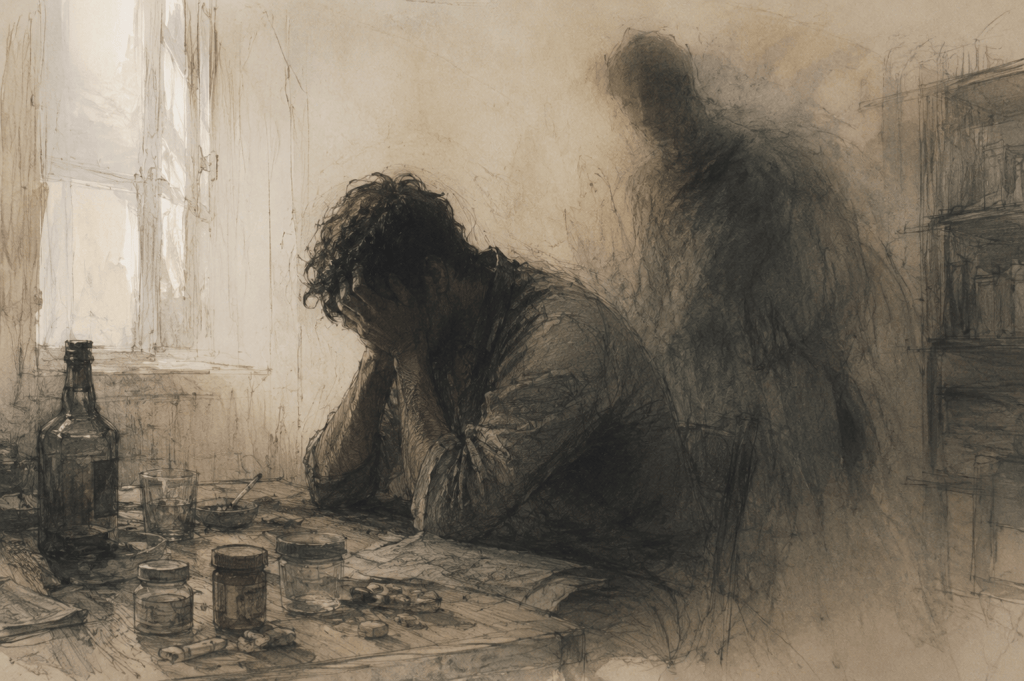
When most people think of a haunting, they imagine an abandoned house or an aging asylum with a dark history. Paranormal investigators, however, have long discussed another possibility—that sometimes the source of unexplained activity isn’t the location, but the individual experiencing it.
Across religious traditions, demonology, and modern paranormal investigations, some believe that prolonged addiction and emotional suffering can leave a person spiritually vulnerable. The idea is not that alcohol or drugs possess supernatural properties, but that the despair, trauma, isolation, and hopelessness often accompanying addiction may create conditions that some interpret as inviting negative spiritual influences.
The “Human Antenna” Theory
Some investigators describe these individuals as becoming a kind of “human antenna.” Instead of haunting a single home, an alleged attachment is believed to remain with the person, manifesting wherever they go.
Reports often describe similar patterns:
- Unexplained disturbances beginning after one individual moves into a home.
- Activity continuing after the family relocates.
- Friends or relatives witnessing unusual events around the same person.
- A noticeable feeling of heaviness, oppression, or dread that seems connected to the individual rather than the building.
While these reports appear throughout paranormal literature, they remain anecdotal and difficult to verify under controlled conditions.
Fact vs. Belief
Modern psychology offers several well-established explanations for experiences commonly interpreted as paranormal. Addiction can affect sleep, memory, emotional regulation, and perception. Hallucinations, anxiety, sleep paralysis, and heightened suggestibility can all contribute to experiences that feel deeply real.
At present, there is no scientific evidence demonstrating that addiction creates spiritual attachments or attracts paranormal entities.
For believers, however, the absence of scientific proof does not invalidate centuries of religious teachings or thousands of personal testimonies describing spiritual oppression during periods of profound personal struggle.
Why It Still Matters
Whether viewed through the lens of psychology or spirituality, one point remains clear: addiction affects far more than physical health. For paranormal researchers, the continuing reports of activity seemingly following individuals rather than remaining tied to locations raise questions that have yet to be fully answered.
Perhaps the mystery is not whether haunted places exist—but whether some people unknowingly carry their own mysteries with them.
Sometimes the house isn’t haunted. Sometimes the haunting has already walked through the front door.
References
- American Psychiatric Association. Diagnostic and Statistical Manual of Mental Disorders (DSM-5-TR).
- National Institute on Alcohol Abuse and Alcoholism (NIAAA). Research on alcohol’s effects on cognition, perception, and behavior.
- World Health Organization. Substance Use and Mental Health.
- Richard Gallagher. Demonic Foes (2016), discussing reported cases of spiritual oppression from a psychiatric perspective.
- Various religious and folkloric traditions describe spiritual attachment as a matter of belief rather than established scientific fact.
This article explores beliefs found within paranormal and religious traditions alongside current scientific understanding. It does not present supernatural claims as established fact.
 The ChillX Zone
Leave a comment